Government Designates Entire China as Contaminated Area from 0:00 on the 28th
Travelers from China Must Submit Health Status Questionnaire and Undergo One-on-One Quarantine
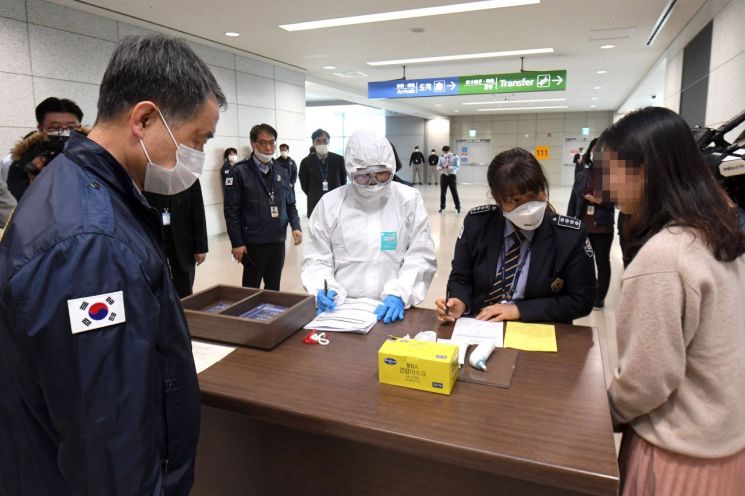 As the number of deaths from the novel coronavirus 'Wuhan pneumonia' rapidly increases in China, on the 23rd, Park Neung-hoo, Minister of Health and Welfare, is inspecting the quarantine system at Incheon International Airport ahead of the Lunar New Year holiday.
 [Asia Economy Reporter Choi Dae-yeol] Strengthened quarantine measures to prevent the spread of the novel coronavirus infection (Wuhan pneumonia) began on the 28th. The measures, which had previously applied only to direct flights from Wuhan, have been expanded to cover all regions within China. The government decided to support quarantine operations with over 200 personnel from other ministries and local governments in addition to the existing National Quarantine Stations. However, it is expected that the explosive increase in quarantine demand will exacerbate difficulties at the frontline.
According to the Central Disease Control Headquarters and other related agencies, as of 0:00 on this day, the entire territory of China has been designated as a quarantine target contaminated area. Passengers arriving in Korea from contaminated areas will be individually checked by quarantine officers on-site for fever or respiratory symptoms upon disembarking from airplanes or ships. They must also submit a health status questionnaire detailing their own health condition and the place they will stay in Korea, including symptoms such as vomiting, diarrhea, chills, and headache. To trace possible in-flight infections, seat numbers must also be recorded. Providing false information can result in up to one year imprisonment or a fine of up to 10 million KRW.
If there are no special symptoms, passengers can proceed through this area, pass the fixed quarantine station, and complete the immigration declaration. If symptoms are reported or if outward signs such as fever are observed even without a response, quarantine officers on-site will conduct additional examinations. Based on symptoms, individuals are classified as active monitoring targets or symptomatic investigation subjects. Active monitoring targets include acquaintances who have had contact with the patient, passengers seated near the patient on the plane, flight attendants, and airport staff, who will be monitored by phone for fever and respiratory symptoms for the following two weeks.
If symptoms appear severe, the individual is immediately classified as a symptomatic investigation subject and may be isolated on-site. This was the case for the first confirmed domestic patient, a woman in her 30s residing in Wuhan. She was identified during the quarantine process immediately after disembarking the plane, isolated, and transferred to Incheon Medical Center, which has nationally designated inpatient treatment beds.
About 250 Quarantine Personnel Supported by Ministry of National Defense and Local Governments, but Manpower Shortage Persists
Quarantine Demand Expected to Surge as Designation Expands from Wuhan City to Entire China
Previously, only four provinces including Guangdong Province were designated (for avian influenza A, AI). On the 8th, Wuhan City, where the infection first occurred, was additionally designated, but now the designation has been expanded to the entire territory of China. This is a response to the rapid increase in confirmed cases of the novel coronavirus in China. To strengthen quarantine, the government has arranged for about 250 personnel from the Ministry of National Defense and local governments to support quarantine operations and has been conducting training for them.
If only Wuhan City were designated as a contaminated area, it would be possible to have airplane passengers enter through specific gates. However, the situation changes with the expansion to the entire China. China is the country with the most human exchange with Korea, with about 170 to 180 flights operating daily. Including passengers who are not Chinese nationals, approximately 26,000 people enter the airport daily (as of December). Considering that before Wuhan’s lockdown, there were eight direct flights per week to Korea with fewer than 200 passengers per flight, the quarantine demand is surging dramatically.
An official from the National Incheon Airport Quarantine Station said, "Although quarantine personnel have been increased since the MERS outbreak in 2015, additional quarantine procedures for arrivals from contaminated areas mean that manpower is insufficient during peak times such as holiday seasons."
© The Asia Business Daily(www.asiae.co.kr). All rights reserved.
![Clutching a Stolen Dior Bag, Saying "I Hate Being Poor but Real"... The Grotesque Con of a "Human Knockoff" [Slate]](https://cwcontent.asiae.co.kr/asiaresize/183/2026021902243444107_1771435474.jpg)











