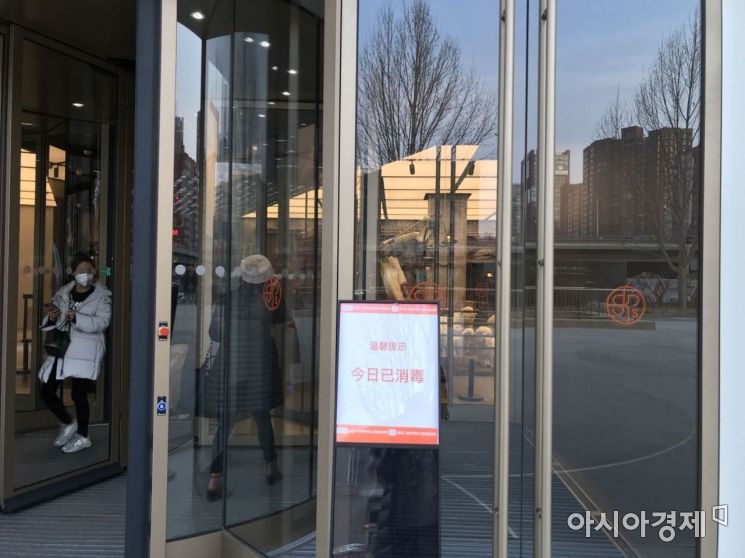
 As Chinese people are refraining from going out due to the Wuhan pneumonia, a large department store in Beijing has placed a sign at the entrance stating that "disinfection was completed today" out of concern for the spread of the virus. Photo by Park Sun-mi, Beijing correspondent
[Asia Economy Beijing=Correspondent Park Sun-mi] The Chinese economy, which can no longer expect a boom during the Spring Festival (Chinese New Year) due to the 'Wuhan pneumonia,' is inevitably facing a blow.
On the 25th, the Hong Kong South China Morning Post (SCMP) diagnosed that the damage to the Chinese economy has already begun due to the spread of the novel coronavirus causing Wuhan pneumonia. The fact that the spread of this Wuhan pneumonia coincided with the Spring Festival period, when Chinese people's consumption is most active throughout the year, is cited as a background that has increased the losses.
The biggest hit is tourism. Due to the spread of the novel coronavirus, closures of major tourist sites are continuously increasing. The Forbidden City in Beijing, China's largest tourist destination, has been closed, and some sections of the Great Wall, including Badaling, have been closed. Popular tourist spots in the Xi'an area such as the Mausoleum of the First Qin Emperor and the Terracotta Army, West Lake in Hangzhou, and Shanghai Disneyland have all closed simultaneously. In each region, cases of cancellation of special Spring Festival performances such as musicals and concerts, which attract many people, are also continuing.
As the virus spreads and major tourist sites and various events are closed, Chinese people are trying to avoid Spring Festival tourism as much as possible by canceling or postponing existing reservations. Initially, the Chinese railway authorities expected that 440 million Chinese people would use the railway during the 40-day special transportation period before and after this year's Spring Festival, which is 8% (32.6 million people) more than last year, and the Chinese aviation authorities also forecasted that passenger transportation would increase by 8.4% to 79 million, setting an all-time record. However, due to Wuhan pneumonia, these projections have become virtually unattainable.
The consumer market has also taken a direct hit. During the week-long Spring Festival holiday, Chinese people usually visit their hometowns to meet family, relatives, and friends, increasing spending in various fields such as food and beverages, entertainment, and tourism. This year, however, many people refrained from going out to avoid the virus and spent the holiday quietly at home with their families. The Chinese film industry postponed the release of more than seven movies during this Spring Festival holiday, and some cinema chains decided to suspend operations nationwide until further notice.
Market research firm TS Lombard predicted that many Chinese people are likely to delay returning to work and take extended leave due to concerns about the spread of Wuhan pneumonia even after the Lunar New Year holiday. It also anticipated the possibility of a 'shutdown' lasting up to 3 to 4 weeks across virtually all industries. It is highly likely that the economic indicators for January and February in China will clearly reflect the damage.
Global credit rating agency Standard & Poor's (S&P) stated in a report, "Chinese people tend to spend more on travel, leisure, and gifts during the Spring Festival, but pneumonia occurred during this period and struck China hard," and pointed out that "the uncertainty caused by the epidemic increases China's economic uncertainty." S&P forecasted, "The economic damage to China caused by Wuhan pneumonia will depend on the extent of the virus's spread, but sectors linked to household consumption will suffer the greatest economic impact."
Meanwhile, as of the morning of the same day, there were 1,287 confirmed cases of the novel coronavirus in China and 41 deaths. The number of confirmed cases and deaths is rapidly increasing during the Lunar New Year holiday period.
© The Asia Business Daily(www.asiae.co.kr). All rights reserved.
![Clutching a Stolen Dior Bag, Saying "I Hate Being Poor but Real"... The Grotesque Con of a "Human Knockoff" [Slate]](https://cwcontent.asiae.co.kr/asiaresize/183/2026021902243444107_1771435474.jpg)
















