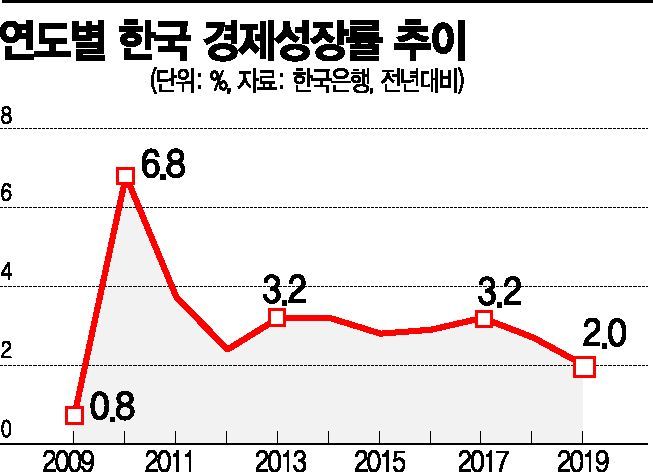
[Asia Economy Reporter Kim Eunbyeol] As the government injected funds toward the end of last year, leading South Korea to barely achieve growth in the 2% range, economic experts are already focusing on the preliminary domestic gross domestic product (GDP) figures to be announced this March. This will allow confirmation of whether the flash estimate and preliminary figures both show growth in the 2% range, as well as provide detailed indicators such as gross national income (GNI) and nominal GDP growth rates.
The preliminary GDP figure for the fourth quarter of last year will be announced on March 3.
◆ Can the 2% range be maintained? First, attention is focused on whether the preliminary GDP figure will not differ significantly from the flash estimate, thereby maintaining the 'annual growth in the 2% range.'
The flash estimate of last year's GDP growth rate announced by the Bank of Korea is 2.01% when confirmed to two decimal places. Of this, the government's contribution is 1.5 percentage points, and the private sector's contribution is 0.5 percentage points. This is the lowest performance in the past 30 years, excluding the global financial crisis in 2009 and the foreign exchange crisis in 1998.
If the number is adjusted in the preliminary figure to be announced this March, last year's GDP growth rate preliminary figure could fall to the 1% range.
The preliminary GDP figure can be adjusted as statistics collected after the flash estimate are compiled. The Bank of Korea announces the flash estimate within 28 days after the quarter ends based on the data collected by then. The preliminary figure, which is based on fully gathered data, is released about 40 days later. However, since the government injected funds until the end of last year, the possibility of a downward revision this time is not high.
◆ Will nominal growth rate be in the 1% range? The nominal GDP growth rate, which reflects market prices, is estimated to be in the 1% range, leading to assessments that the economy has effectively entered deflation. While economic growth rate uses real GDP growth applying base year prices, nominal GDP reflects market prices of the respective year, thus being closer to the perceived economic condition.
A Bank of Korea official said, "The GDP deflator has continuously shown negative values, so the nominal growth rate is expected to be lower than the real growth rate," adding, "Since the nominal growth rate was about 1% up to the third quarter of last year, this trend is expected to continue." South Korea's nominal GDP growth rate has never fallen below 3% since recording -1.1% in 1998, the year following the International Monetary Fund (IMF) crisis.
The rate of change in the GDP deflator, which is the ratio of nominal GDP to real GDP (compared to the same period last year), is also showing an increasing decline. It fell from -0.1% in the fourth quarter of 2018 to -0.5% in the first quarter of 2019, -0.7% in the second quarter, and -1.6% in the third quarter, with the decline deepening. Unlike the consumer price index, which measures prices closely related to consumers, the GDP deflator shows the overall price level of the national economy.
Professor Sung Tae-yoon of Yonsei University said, "Nominal GDP is inevitably much lower than current real GDP," adding, "There is no choice but to see deflation concerns." He also said, "Although the real growth rate achieved 2%, the downward trend is strongly evident, and economic downturn is intensifying," and "The preliminary GDP figure is likely to fail to achieve 2% growth."
◆ Attention on lowered gross national income Meanwhile, last year's per capita gross national income (GNI) is expected to be lower than the 33,346 dollars level of 2018. This is a result of the slowdown in economic growth combined with the depreciation of the Korean won (exchange rate increase).
According to the Bank of Korea, last year's per capita GNI is estimated to be around 32,000 dollars, a 4-5% decrease compared to 33,434 dollars in 2018. If this estimate holds, it would be the first decline in four years since 2015. In 2018, GNI surpassed 31,000 dollars, marking the beginning of the '30,000-dollar per capita national income era,' but now GNI is turning downward again.
Per capita GNI is an indicator showing the living standard of the people. It is calculated by reflecting the nominal gross national income, estimated population by Statistics Korea, and the won-dollar exchange rate. The decrease in GNI appears to be due to the exchange rate effect.
However, even if per capita national income decreases compared to last year, it is expected to comfortably remain above 30,000 dollars. Previously, the Bank of Korea predicted that if the Korean economy continues to grow at the potential growth rate level, it could achieve a per capita national income of 40,000 dollars within 10 years. The exact GNI figure will also be confirmed in March.
© The Asia Business Daily(www.asiae.co.kr). All rights reserved.
![Clutching a Stolen Dior Bag, Saying "I Hate Being Poor but Real"... The Grotesque Con of a "Human Knockoff" [Slate]](https://cwcontent.asiae.co.kr/asiaresize/183/2026021902243444107_1771435474.jpg)















