China Accelerates Toward AI Superpower Status
Still Lagging Due to Investment and Talent Gaps
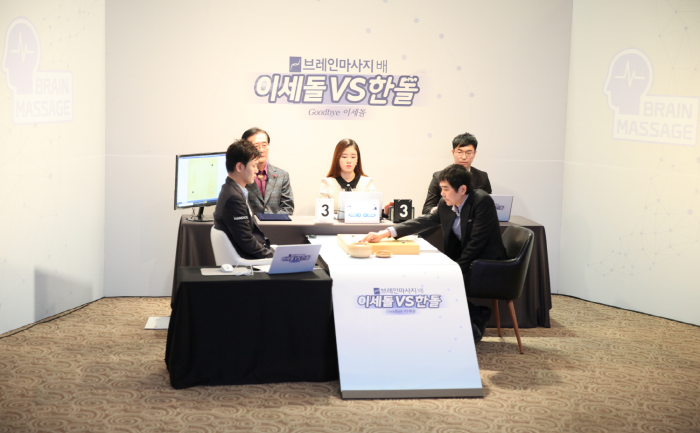
[Asia Economy Reporter Jin-gyu Lee] NHN's Go artificial intelligence (AI) program 'Handol' sparked curiosity about domestic Go AI even among people who usually had no interest in AI or Go when it played its final match against 9-dan Lee Sedol last December. Handol recorded 2 wins and 1 loss against Lee, leading to evaluations that domestic Go AI technology has reached a high level. So, can Handol also win against 'Jueyi,' the Go AI developed by China's Tencent?
Lee Sedol concluded his Go career with a record of 1 win and 2 losses in his retirement match against Handol on December 21 last year. After the final match, he said at a press conference, "Overall, if it had been a good junior player rather than me, Handol would not have won easily," and added, "Compared to China's Jueyi, I still think it is lacking."
Handol is an AI Go program independently developed by NHN based on the vast Go data accumulated through 'Hangame Baduk' since 1999. Among domestic game companies, it is not only the first but also the only Go AI with which the general public can play matches anytime. After a 10-month development period starting in early 2017, Handol version 1.0 was released in December 2017. Since then, after two upgrades, Handol 2.0 has shown a winning rate over 90% compared to 1.0, and Handol 3.0 has shown a winning rate over 90% compared to 2.0. In December 2018, Handol played relay matches against five top-ranked professional Go players, consecutively defeating Shin Min-jun, Lee Dong-hoon, Kim Ji-seok, Park Jung-hwan 9-dans, and finally Shin Jin-seo 9-dan, who is ranked number one in domestic Go rankings.
However, as Lee Sedol mentioned, despite Handol's continuous evolution, it still somewhat falls short in matches against Jueyi. In the '2019 Zhongxin Securities Cup World AI Go Tournament' held in Shandong Province, China, last August, Handol could not overcome Jueyi's barrier. The tournament's championship and runner-up were claimed by China's Jueyi and 'Golaxy,' respectively, with Handol placing third. Park Geun-han, head of NHN's Technology Research Center, said, "We confirmed that China shows intense interest in AI and Go AI at the national level."
In fact, China's steps toward becoming the 'AI superpower' are swift. Consequently, the AI competitiveness gap between Korea and China is widening. China's AI technology has developed to the point of chasing the world's strongest, the United States. In July 2017, China announced the 'Next Generation AI Development Plan,' setting the goal to surpass the U.S. and become the AI superpower by 2030. It laid out a blueprint to grow the core AI industry scale to 1 trillion yuan (approximately 167 trillion won) by 2030. In terms of talent, a core pillar of AI, Korea is also lacking compared to China. According to a survey by the Korea Economic Research Institute under the Federation of Korean Industries, when the U.S.'s AI talent competitiveness is rated as 10, Korea's talent competitiveness was only 5.2, while China was rated 8.1. Accordingly, some argue that considering the scale of AI investment and workforce differences between Korea and China, Handol inevitably falls behind Jueyi.
© The Asia Business Daily(www.asiae.co.kr). All rights reserved.
![Clutching a Stolen Dior Bag, Saying "I Hate Being Poor but Real"... The Grotesque Con of a "Human Knockoff" [Slate]](https://cwcontent.asiae.co.kr/asiaresize/183/2026021902243444107_1771435474.jpg)















