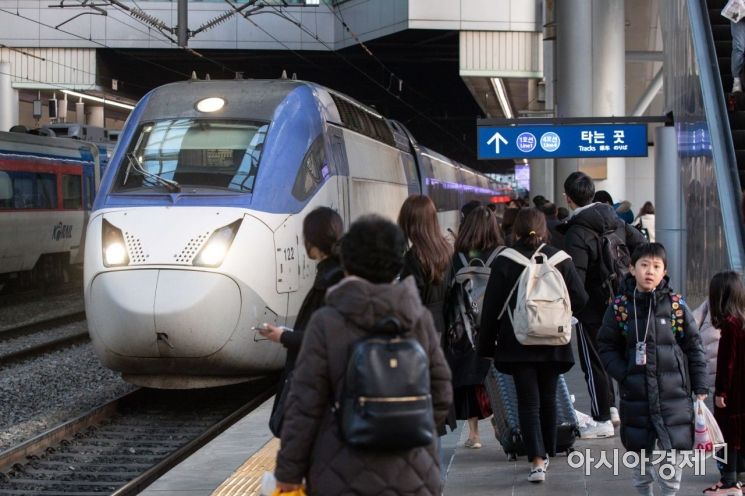
 On the 23rd, when the large-scale Lunar New Year holiday travel began, passengers at Seoul Station were moving to trains heading to their hometowns. Photo by Jinhyung Kang aymsdream@
The 'Reverse Detour Group' is on the rise. While previously many people in the 'Detour Group' would return to their hometown, briefly perform ancestral rites, enjoy a trip, and then come back, this year there is an increase in the 'Reverse Detour Group' who travel first and then visit their hometown afterward.
According to an analysis of domestic travel trends during the Lunar New Year holiday by Interpark Tour, the date with the highest number of accommodation check-ins was January 24th (33.2%), the first day of the holiday. This was followed by January 25th (23.7%), 26th (20.1%), 23rd (14.3%), and 27th (8.7%). These figures are based on domestic accommodation reservations from January 23rd, the day before the holiday begins, through January 27th, the last day of the holiday, indicating a significant number of 'Reverse Detour Group' travelers who enjoy trips before returning home. The most common travel duration was one night and two days (67.8%), followed by two nights and three days (26.8%), and three nights and four days (4.8%).
The analysis based on reservation data during this Lunar New Year holiday period by Yanolja shows similar results. During the entire holiday period, accommodation reservations were highest in the early days, with January 24th (33.4%) and 25th (28.1%) leading. This is more than 1.5 times higher than the latter half of the holiday (38.3%). Unlike last year’s holiday when the Seoul metropolitan area dominated accommodation bookings, Gangwon-do (16.6%) took first place this year. This is likely influenced by family-friendly activities such as ski resorts and local festivals, as well as convenient transportation infrastructure like KTX and highways.
According to accommodation reservation data from Yeo-gi-o-ddae, the day with the highest travel demand was also the first day of the holiday, January 24th (33.4%). January 24th is a Friday, which typically has a high reservation rate and makes domestic travel less burdensome. The stay rate on Lunar New Year’s Day, January 25th, was 24.7%, ranking second, followed by January 26th at 16.8%, ranking third. The most common travel duration was one night and two days (71.1%), but the proportion of travelers staying two nights or more increased by 10.7 percentage points compared to the previous year. As of this year, travelers staying 'two nights and three days' account for 24.5%.
© The Asia Business Daily(www.asiae.co.kr). All rights reserved.
![Clutching a Stolen Dior Bag, Saying "I Hate Being Poor but Real"... The Grotesque Con of a "Human Knockoff" [Slate]](https://cwcontent.asiae.co.kr/asiaresize/183/2026021902243444107_1771435474.jpg)















