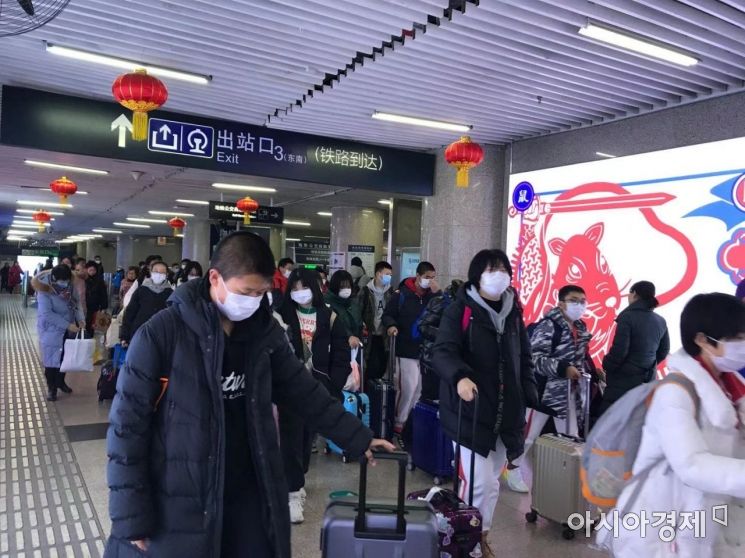
[Asia Economy Beijing=Special Correspondent Sunmi Park] At 10 a.m. on the 23rd (local time), as Chinese authorities took the strong measure of locking down Wuhan City in Hubei Province to prevent the spread of the novel coronavirus, Chinese media emphasized that this decision is an unprecedentedly strong action.
China's Global Times stated, "Closing the external access routes of a mega provincial capital like Wuhan is the first time in the 70-year history since the founding of the People's Republic of China," adding, "Given that Wuhan is a transportation hub in the Central China region connected to nine surrounding provinces, this decision was very difficult." It further added, "One can imagine how much courage and rationality this decision required. We support it."
The newspaper reported, "Some Wuhan citizens will face difficulties going out and severe inconvenience due to public transportation controls in the city, but since most of the confirmed cases so far have occurred within Wuhan, how to contain the novel coronavirus within Wuhan is the key issue to winning the war against Wuhan pneumonia."
It also emphasized, "We must pay respect to the citizens of Wuhan," and "Wuhan City's resolute response is expected to play a significant role in eradicating the novel coronavirus. We hope this decision becomes a decisive turning point in preventing the spread of Wuhan pneumonia."
The lockdown of Wuhan City in Hubei Province, which began at 10 a.m. that day, is seen as the strongest response card taken by Chinese authorities to prevent the spread of the novel coronavirus. It is interpreted as a strong expression of determination to prevent a recurrence of the 2003 Severe Acute Respiratory Syndrome (SARS) crisis, which paralyzed the entire country due to initial response failures.
According to sources, until now, control within Wuhan, the outbreak site of "Wuhan pneumonia," had been focused only around the Wuhan Huanan Seafood Market, where confirmed cases surged. Although police lines were set up to block citizens' access to the market area, which had already been disinfected and closed, criticism arose that it was not a perfect blockade since the market is located next to a main road and many shops are densely clustered in the area.
This city lockdown measure came just three days after Wuhan pneumonia was classified as a legally notifiable infectious disease under full national control, indicating that China is taking the matter very seriously.
Wuhan City's area is larger than New York and London, with a population exceeding 11 million. It is a central inland transportation hub through which all railway networks in China pass, and also a major commercial and industrial city. Moreover, the massive Spring Festival travel period (January 24-30), during which 3 billion trips are made annually, has already begun. The lockdown announcement was posted around 3 a.m. on the 23rd, reflecting concerns that if the initial lockdown failed, confirmed cases would inevitably spread rapidly.
During the 2003 SARS outbreak, some major cities such as Beijing and Shanghai issued school closures and closed major buildings, shops, and main roads connecting cities, but public transportation throughout an entire city was never shut down. Learning from the experience of the failed initial response to SARS, the calculation is to prevent virus spread from the outset with the strongest city lockdown measure.
© The Asia Business Daily(www.asiae.co.kr). All rights reserved.
![Clutching a Stolen Dior Bag, Saying "I Hate Being Poor but Real"... The Grotesque Con of a "Human Knockoff" [Slate]](https://cwcontent.asiae.co.kr/asiaresize/183/2026021902243444107_1771435474.jpg)















