Professor Jaewon Lee of Ulsan University College of Medicine Receives the 13th Asan Medical Award
Successfully Introduced Minimally Invasive Surgery and Continues Research on Valve Reconstruction
Also the First to Use Robotic Surgery
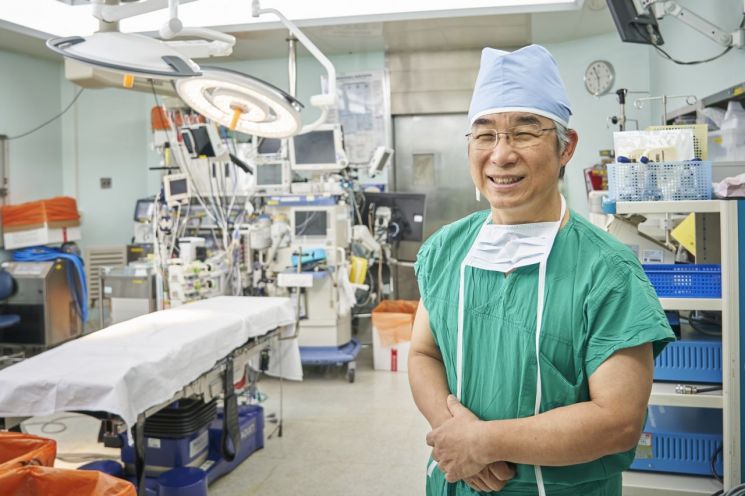
[Asia Economy Reporter Choi Daeyeol] "Why do surgeons hesitate to make the patient's problem their own?"
Professor Jaewon Lee of Ulsan University College of Medicine (photo) was curious. In heart surgery, there has long been an unwritten rule that a large incision is necessary to secure the surgical field, which was a heavy burden not only for doctors but also for patients. Large incisions meant it took more than three months for the sternum to fully heal, and the scar was about 25 cm long.
Professor Lee pondered ways to reduce the incision size and successfully introduced minimally invasive cardiac surgery. This method involved minimizing sternum incisions or avoiding them altogether by slightly opening between the ribs. The recovery period was shortened to just one week, and the scar was reduced to about 5 cm. A paper he wrote on minimally invasive aortic valve surgery was published in 2000 in a journal issued by Elsevier, one of the world's largest publishers in medical and scientific fields. It was the first domestic paper to be cited in a thoracic surgery textbook. This surgical method became the most favored approach for aortic valve surgery.
Since becoming a thoracic surgeon over 30 years ago, Professor Lee has considered better surgical methods from the patient's perspective. In the past, valve problems were mainly treated by replacing the valve with an artificial one, but he refined techniques for valve reconstruction. For arrhythmia diseases, which had been primarily treated with medication and internal medicine, he proposed new surgical methods, helping to spread the perception that surgery could also be effective.
Professor Lee believes that devising new surgical methods benefits not only patients but also doctors. In January last year, his research related to heart transplantation was published in the American Heart Association journal 'Circulation.' The study detailed a suturing technique resembling a bow tie to reduce vessel distortion or twisting during surgery, which was advantageous for both surgeons and patient outcomes. He said, "It was the result of thinking about how to suture more comfortably and effectively."
In 2007, when the concept of robotic surgery was still unfamiliar, he was the first in Korea to use medical robots for surgery, driven by the same motivation. As the application range of robotic heart surgery expanded and various procedures were validated, more hospitals from neighboring countries such as Japan, India, Thailand, and Kuwait have sought to learn robotic surgical techniques from Professor Lee. He often tells those around him that if the goal of surgery is the patient's life and health, there is no need to cling to previously learned methods.
Professor Lee was selected on the 21st as the recipient of the 13th Asan Medical Award in the clinical medicine category, recognizing his contributions to elevating the level of surgical treatment for heart disease to a world-class standard. The prize money is 300 million KRW. The award ceremony will be held on March 19. Alongside him, Professor Wonjae Lee of Seoul National University’s Department of Biological Sciences, who researches gut microbial ecosystems and host interactions, was selected for the basic medicine category. Professors Youngseok Joo of KAIST and Yongho Lee of Yonsei University, who study cancer genome mutation principles and the associations of sarcopenia and fatty liver disease respectively, were chosen as recipients in the young medical scientist category.
© The Asia Business Daily(www.asiae.co.kr). All rights reserved.
![Clutching a Stolen Dior Bag, Saying "I Hate Being Poor but Real"... The Grotesque Con of a "Human Knockoff" [Slate]](https://cwcontent.asiae.co.kr/asiaresize/183/2026021902243444107_1771435474.jpg)















