'Integrated Police Act' Automatically Discarded if Not Processed Before the Launch of the 21st National Assembly in May
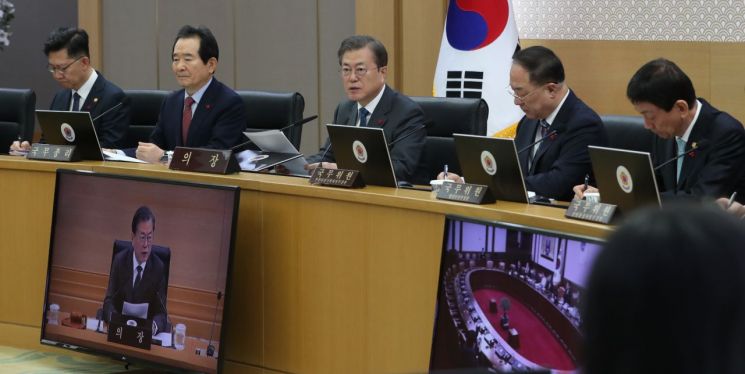 President Moon Jae-in is presiding over a Cabinet meeting at the Government Complex Sejong on the 21st. On this day, President Moon emphasized the prompt reform of the police. [Image source=Yonhap News]
[Asia Economy Reporter Lee Gwan-ju] After the bill adjusting investigative authority between the prosecution and police passed the National Assembly, the government and ruling party are pushing hard for 'police reform.' However, what seemed like an unstoppable momentum for police reform is now raising concerns that it may be entering a 'mountainous and difficult' phase. This is because as the National Assembly enters the full-scale general election phase, setbacks in completing police reform through legislation have become inevitable.
Police reform is currently progressing along three main lines: ▲introduction of the autonomous police system ▲establishment of the National Investigation Headquarters ▲reform of intelligence police. The plan is to decentralize authority by transferring public safety duties from the national police to the autonomous police, ensure fairness in investigations through open appointment organizations, and reduce the powers of the intelligence police, which have been embroiled in controversies such as illegal surveillance and political interference, to prevent the 'dinosaur police.'
President Moon Jae-in emphasized at the Cabinet meeting he presided over on the 21st, "The core of reforming power institutions is controlling abuse of power through checks and balances," adding, "As the prosecution's direct investigation powers are reduced, the expanding authority of the police must also be democratically decentralized." A day earlier, Minister of the Interior and Safety Jin Young also mentioned the necessity of police reform, stating, "Concerns about police overexpansion due to the adjustment of investigative authority are very high."
However, all police reform plans can only be completed through legislation by the National Assembly. The most important bill is the 'Police Act Comprehensive Amendment Bill,' which was introduced as the main bill by Hong Ik-pyo, a member of the Democratic Party of Korea, in March last year. Known as the 'Integrated Police Act,' this bill includes the introduction of the autonomous police system, establishment of the National Investigation Headquarters, and provisions clarifying the 'public safety information' that intelligence police can collect, effectively encompassing all key issues of police reform. Yet, even after 10 months, the bill has not been properly discussed. A month after its introduction, the National Assembly entered a deadlock due to clashes between ruling and opposition parties over the 'fast track' (rapid processing agenda), and in September, the Judiciary Reform Special Committee sent the bill back to the Administrative and Security Committee, but no significant progress has been made since.
In this situation, after the Lunar New Year holiday, the National Assembly is expected to shift into full general election mode. If the bill is not processed before the 21st National Assembly convenes in May, the police reform bill will be automatically discarded. This would mean having to start the bill introduction process all over again. Of course, it is not impossible to process the bill within the remaining term of the 20th National Assembly, which lasts about a month after the April 15 general election, but the election results are likely to be a significant variable.
Another obstacle is the significant differences in stance among the police, prosecution, government and ruling party, and opposition parties regarding the police reform bill. Resistance to the introduction of autonomous police within the police remains, and the prosecution points out the inadequacy of the intelligence police reform plan. There is little time to gather diverse opinions and reach a reasonable conclusion. Even within the police, which is the subject of reform, voices of concern are emerging. A National Police Agency official said, "We are preparing practically on the assumption that the bill will pass," but also expressed frustration, saying, "Ultimately, police reform must be completed through legislation, but there has been no progress."
© The Asia Business Daily(www.asiae.co.kr). All rights reserved.
![Clutching a Stolen Dior Bag, Saying "I Hate Being Poor but Real"... The Grotesque Con of a "Human Knockoff" [Slate]](https://cwcontent.asiae.co.kr/asiaresize/183/2026021902243444107_1771435474.jpg)















