DRAM Spot Prices Rebound Over 20% from Last Month's Low This Month
Semiconductor Exports Rise for the First Time in 14 Months
[Asia Economy Reporter Changhwan Lee] The semiconductor industry, which suffered a significant downturn last year, is showing signs of a V-shaped recovery. Spot prices have surged sharply, and semiconductor exports have rebounded for the first time in 14 months. Expectations for improved earnings from semiconductor companies such as Samsung Electronics and SK Hynix have also increased.
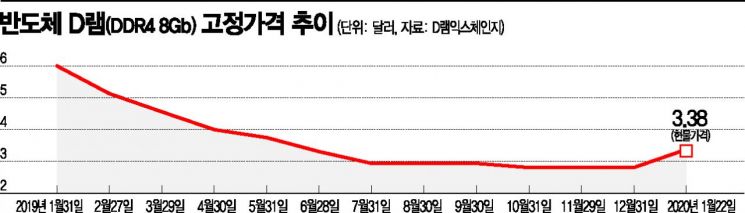
According to DRAMeXchange on the 23rd, the spot price of DRAM (based on DDR4 8Gb), mainly used in PCs, rose sharply by 23% to $3.38 on the 22nd compared to the low of $2.74 recorded in early last month. DRAM prices, which had been declining steeply since the second half of 2018, hit a bottom at the end of last year and have clearly rebounded in January.
As spot prices rise, there are forecasts that the fixed prices, which serve as the standard for semiconductor transactions, will soon increase. The fixed price of DRAM fell by more than 50%, from $6 at the beginning of last year to $2.81 at the end of the year.
The industry expects that, given the recent sharp rise in spot prices, fixed prices will rebound sometime between January and February. This is a faster recovery than previously anticipated. Many experts had predicted that DRAM price increases would begin in the second quarter of this year.
Along with DRAM, the price of NAND flash (based on 128Gb MLC), one of our main semiconductor products, also rebounded in the second half of last year. The fixed price of NAND flash in December last year was $4.42 per unit, up 2.55% from the previous month. NAND flash prices began rising in July last year and increased by more than 10% by the end of December.
The rise in semiconductor prices is due to a significant increase in semiconductor demand driven by the development of the electronics industry, including artificial intelligence (AI), 5th generation mobile communications (5G), and the Internet of Things (IoT). As advanced industries develop, semiconductor demand from customers such as Amazon, Google, and Apple continues to grow steadily, while supply from memory semiconductor companies like Samsung Electronics and SK Hynix remains limited, leading to rising product prices.
Major global market research firms such as IHS Markit and IC Insights predict that the global semiconductor market size, which shrank by 10-15% last year, will turn to grow by 5-10% this year.
With semiconductor prices rising, exports have also rebounded. According to government agencies including the Korea Customs Service and the Ministry of Trade, Industry and Energy, semiconductor exports from the beginning of this month to the 20th increased by 8.7% compared to the same period last year.
During the same period, overall exports decreased by 0.2% year-on-year, while semiconductor exports actually increased. On a monthly basis, semiconductor exports have been declining year-on-year since December 2018, continuing for 13 consecutive months until last month. If the rebound this month succeeds, it will be the first in 14 months.
Jaeduk Kim, a senior researcher at the Korea Institute for Industrial Economics and Trade, explained, "Since the end of last year, the downward trend in semiconductor prices has stabilized or some items have turned to price increases, rapidly spreading expectations for semiconductor price recovery in 2020. Given that semiconductors account for about 20% of Korea's exports, the rise in semiconductor prices due to increased demand will have a significant impact on Korea's exports."
The improvement in the semiconductor industry outlook is expected to proceed rapidly. This is because the demand strength for major products like DRAM is higher than expected and inventory levels have stabilized. Accordingly, the average selling price of DRAM in the first quarter is expected to rise for the first time in six quarters since the third quarter of 2018, with the price increase widening toward the second half of the year. NAND is expected to follow a similar trend. It is also predicted that the earnings improvement of our major semiconductor companies such as Samsung Electronics and SK Hynix will accelerate.
Dongwon Kim, a researcher at KB Securities, stated, "Currently, both semiconductor buyers and manufacturers are adopting conservative purchasing and supply strategies, shortening the semiconductor downcycle period. We expect the operating profits of Samsung Electronics' semiconductor division and SK Hynix to increase by more than 90% compared to last year."
© The Asia Business Daily(www.asiae.co.kr). All rights reserved.
![Clutching a Stolen Dior Bag, Saying "I Hate Being Poor but Real"... The Grotesque Con of a "Human Knockoff" [Slate]](https://cwcontent.asiae.co.kr/asiaresize/183/2026021902243444107_1771435474.jpg)















