[Asia Economy Reporter Moon Chaeseok] It has been confirmed that a radioactive material release accident occurred last year at a facility within the Korea Atomic Energy Research Institute (KAERI). The Nuclear Safety and Security Commission (NSSC) is currently investigating the exact cause and environmental impact of this incident.
On the 22nd, the NSSC announced that after receiving a report the previous day about the release of artificial radioactive nuclides into nearby stormwater drains from some facilities within KAERI in Deokjin-dong, Yuseong-gu, Daejeon, they dispatched an investigation team from the Korea Institute of Nuclear Safety (KINS) to conduct an investigation.
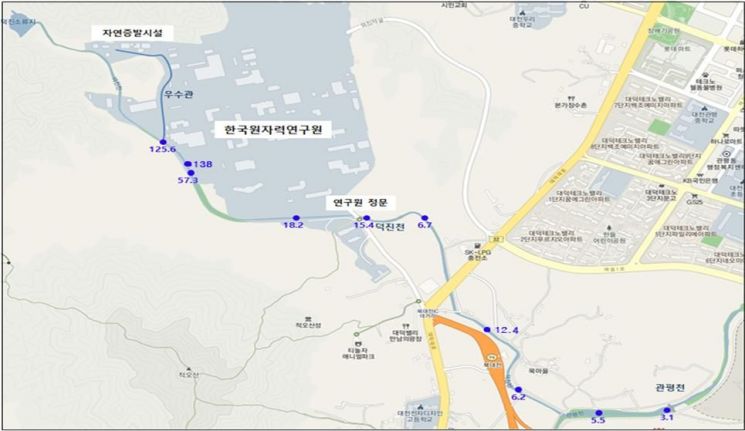
The NSSC stated that they received a report from KAERI indicating that cesium-137, cesium-134, cobalt-60, and other radionuclides flowed into the stormwater drainage area around the facility from a natural evaporation facility within KAERI.
This facility is an auxiliary facility of a test facility and radioactive waste treatment facility. It naturally evaporates moisture from extremely low-level liquid radioactive waste using solar heat.
According to the report, soil samples were collected from riverbeds near the KAERI main gate on the 30th of last year, and on the 6th of this year, radioactivity concentrations were analyzed, revealing a temporary increase.
At the drainage point in front of the KAERI main gate within the KAERI site, the radioactivity concentration of cesium-137 was temporarily elevated to 25.5 Bq/kg, compared to the average value of 0.432 Bq/kg over the past three years.
So far, KAERI’s own investigation results show that the highest radioactivity concentration of cesium-137 measured in the internal riverbed soil was 138 Bq/kg.
Downstream external riverbed soil showed concentrations ranging from 3.1 to 12.4 Bq/kg, which falls within the range of 0.555 to 17.9 Bq/kg measured directly by KAERI around the facility during 2018. No radioactivity was detected in the river water.
Accordingly, on the 21st, KAERI traced the point where cesium-137 temporarily increased and investigated the connected stormwater drains within the institute. It was found that inside a manhole in front of the natural evaporation facility, radiation dose rates reached up to 3.4 μSv/h.
This suggests that the natural evaporation facility is presumed to be the cause. The KINS investigation team dispatched to the institute is also considering the manhole next to the natural evaporation facility as the origin and is investigating the exact cause.
The KINS investigation team instructed KAERI to collect samples and remove contaminated soil to analyze radiation levels in the manhole area. They also sealed the area to prevent rainwater inflow.
Currently, the KINS investigation team is measuring radioactive material concentrations in riverbed soils at various locations, conducting environmental impact assessments, and inspecting all facilities.
The NSSC stated that it plans to transparently disclose the results after reviewing the investigation team’s findings.
Meanwhile, KAERI has experienced accidents for several years. Fires occurred in January and November 2018, respectively. In 2011, radioactive material leaked from Hanaro, causing employees to evacuate urgently.
The institute has also been fined multiple times between 2017 and 2019 for violating the Nuclear Safety Act, such as using nuclear fuel without permission or secretly burying radioactive waste.
© The Asia Business Daily(www.asiae.co.kr). All rights reserved.
![Clutching a Stolen Dior Bag, Saying "I Hate Being Poor but Real"... The Grotesque Con of a "Human Knockoff" [Slate]](https://cwcontent.asiae.co.kr/asiaresize/183/2026021902243444107_1771435474.jpg)















