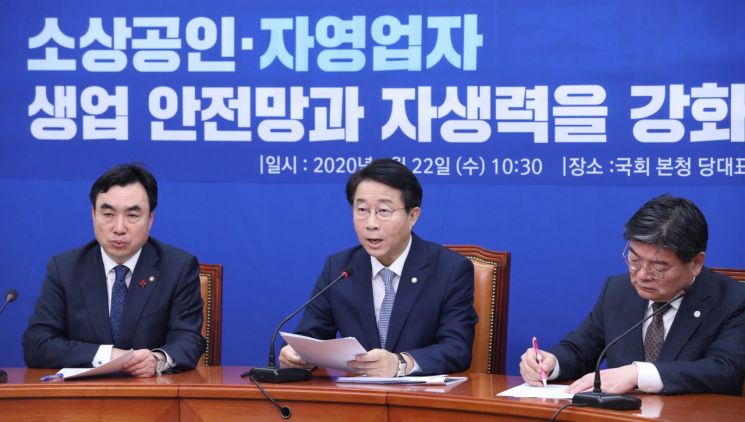
[Asia Economy Reporters Kang Nahum and Jeon Jinyoung] The Democratic Party of Korea announced tailored 'spot' pledges to revitalize the livelihood economy ahead of the Lunar New Year holiday on the 22nd. The key points include expanding the issuance of neighborhood market-exclusive currency and raising special guarantees for small business owners. Amid controversies over the populism and effectiveness of the first and second pledges announced earlier for the general election, attention is focused on whether this pledge can capture public sentiment during the holiday season.
On the morning of the same day, Cho Jung-sik, chairman of the Democratic Party's Policy Committee, and Yoon Kwan-seok, senior deputy chairman, announced these livelihood pledges at the National Assembly.
The main points are ▲ doubling the issuance scale of Onnuri gift certificates and local love gift certificates ▲ additionally expanding the guarantee scale for small business owners by 1.5 trillion won annually (75,000 business sites) ▲ writing off non-performing loans held by policy financial institutions (5.6 trillion won) and expanding the Restart Support Centers (62 locations) ▲ expanding the Commercial District Renaissance Project and creating one new specialized street per city/county/district ▲ expanding consulting and strengthening self-sustainability through fostering smart stores and century-old shops.
First, the Democratic Party plans to double the issuance of neighborhood market-exclusive currencies such as Onnuri gift certificates and local love gift certificates by 2024 (from 5.5 trillion won to 10.5 trillion won) to support small business owners and self-employed people struggling due to domestic demand stagnation. They will also expand the entry of excellent products into online platforms to support small business owners' online advancement. Furthermore, by enhancing the convenience of Zero Pay, they plan to significantly expand affiliated stores (to 2 million by 2024) to reduce card fee burdens.
They also proposed measures to strengthen the livelihood safety net for small business owners. Since 2021, they have been expanding the guarantee scale for small business owners by 1.5 trillion won annually to enable 75,000 small business enterprises that have difficulty securing funds from private financial institutions to utilize it. Special funds for re-challenge support for low-credit small business owners rated 7 or below will also be expanded from 50 billion won to 150 billion won by 2024. Policy financial institutions will continuously write off non-performing loans up to 5.6 trillion won by 2024 and expand regional Restart Support Centers to 62 by next year. They plan to expedite business closure procedures and support employment transitions for wage workers.
The pledge also includes expanding the Commercial District Renaissance Project, which provides a comprehensive view of traditional markets and surrounding commercial districts, to 50 locations by 2024. Additionally, through the 'One Basic Local Government-One Specialized Street' project (240 locations by 2024), they aim to foster specialized individual specialized shopping districts.
The Democratic Party also plans to strengthen 1:1 on-site consulting about tenfold for small business owners and traditional market merchants facing management difficulties to reinforce their self-sustainability foundation. They will expand the New Business Startup Academy to nine locations by 2024, establishing a complex education base that supports lectures, practical training, and commercialization. Moreover, they will expand the 'Small Business Complex Support Centers' to 40 locations in small business clusters to provide integrated support from residency to planning, design, product development, exhibition, and sales.
In addition, they will discover successful models of small business owners such as smart stores, century-old shops, and century-old small business owners. By strengthening the policy research function of the Small Business Research Center, they plan to solidify the status of small business owners as independent economic agents.
The Democratic Party stated, "If the promised pledges are implemented without setbacks, policy effects such as increased sales for small business owners, management innovation, and expansion of livelihood safety nets will appear," adding, "Through this, not only will the self-sustainability foundation of small business owners and self-employed be strengthened, but new growth engines for the overall domestic economy will also be created."
These pledges align with the 'Livelihood General Election' announced by floor leader Lee In-young the day before. Earlier, Lee said, "From the preparation for the general election, we will break away from the temptation of easy political strife and prepare a livelihood-focused general election," and "With the results of this general election, the 21st National Assembly will become a livelihood National Assembly that carefully manages each policy so that the economic recovery effect is quickly delivered to ordinary people."
However, it is questionable whether public sentiment will be stirred by the pledges announced this time. The Democratic Party's first and second pledges for the general election were criticized for not properly reflecting public sentiment. In fact, the first pledge, 'Public Free Wi-Fi,' sparked controversy over populism and effectiveness, and the second pledge, which included allowing multiple (differential) voting rights for founders, raised concerns about infringing on minority shareholders' rights.
Chairman Cho said, "The important things in this livelihood economy pledge are those that change the actual lives of the people and can be felt," adding, "We have prepared policy pledges in many fields for each class and target. We are announcing them sequentially."
© The Asia Business Daily(www.asiae.co.kr). All rights reserved.

















