Russian Constitutional Amendment Proposal Fails to Strengthen Parliament and Prime Minister Powers
Debates Over 'Sangwang' and Influential Prime Minister Theories Shake
Putin Expected to Seek Presidential Re-election Through Constitutional Interpretation After Amendment
[Asia Economy Reporter Naju-seok] Curiosity about Russian President Vladimir Putin's 'plan' has rather increased after the constitutional amendment proposal and the new cabinet were revealed. Although there were speculations that he would become the 'Sangwang (上王)'?a retired king?by becoming the chairman of the State Council or a powerful prime minister after his presidential term, the disclosed constitutional amendment proposal shows parts that differ from public predictions.
On the 21st (local time), President Putin announced the new cabinet. On that day, through a presidential decree, he announced a new cabinet organization that reduced one deputy prime minister and one minister each (9 deputy prime ministers and 21 ministers). After former Prime Minister Dmitry Medvedev announced the cabinet's total resignation on the 15th, President Putin proceeded with follow-up work, including nominating Mikhail Mishustin, who was serving as the head of the Federal Tax Service, as the successor prime minister.
Except for the appointment of Andrey Belousov, Putin's economic advisor, as the first deputy prime minister, most ministers in the economic and security sectors were retained. Key positions such as Defense Minister Sergey Shoigu, Interior Minister Vladimir Kolokoltsev, Foreign Minister Sergey Lavrov, Finance Minister Anton Siluanov, and Industry and Trade Minister Denis Manturov remained in place after the reshuffle. The reshuffle mainly involved changes in social-related ministers such as the Minister of Health, Minister of Culture, and Minister of Development, Communications, and Media.
Earlier, President Putin announced the constitutional amendment abruptly through a state address. Following this, the cabinet's total resignation was announced, leading to speculation that a power restructuring had begun. Experts inside and outside Russia interpreted these series of moves as groundwork for Putin's lifelong rule.
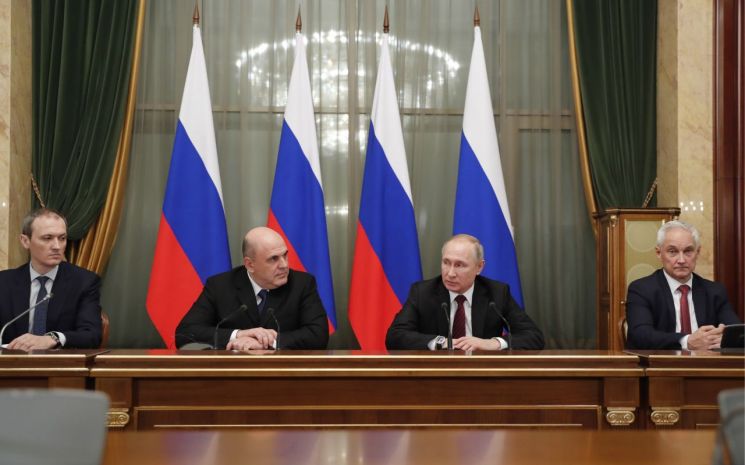
During the state address, President Putin stated the need for constitutional amendments to strengthen the powers of the parliament and prime minister while reducing the president's powers. Based on this, there were speculations ranging from Putin taking on the role of a powerful prime minister to effectively run the government after his term ends, to him leading the ruling United Russia Party and controlling the government. There was also a persuasive theory that he would become the chairman of the State Council, a position surpassing presidential power, thus becoming the 'Sangwang.'
However, after the constitutional amendment proposal was made public, evaluations have emerged that some circumstances do not align with previous predictions.
The New York Times (NYT) added expert opinions on the day, assessing that contrary to what was known, the constitutional amendment proposal did not significantly strengthen the powers of the parliament or prime minister. There is also criticism that the chairman position of the State Council, considered the 'Sangwang,' is rather an empty shell without real substance. According to the amendment proposal, the chairman of the State Council is appointed by the sitting president and can be replaced at any time at the president's discretion.
There are also signs of possible rapid changes related to the constitutional amendment. Russian political scientist Ekaterina Schulmann pointed out, "About half of the commas are missing in the amendment proposal," suggesting that "the amendment proposal may have been hastily drafted." This does not align with President Putin's style of meticulous planning. Because of this, some view the series of changes as events arising from power struggles around President Putin.
There is even speculation that President Putin has begun preparations to hand over power to a successor.
It is said that the suddenly appointed Prime Minister Mikhail Mishustin has been decided as Putin's potential successor. This is similar to the process when former Russian President Boris Yeltsin suddenly appointed Putin, who was from the KGB. On the other hand, there is also speculation that former Prime Minister Medvedev, who stepped down, has been chosen as the successor. The newly established position of deputy chairman of the National Security Council, created by President Putin for Medvedev, is interpreted as effectively serving as a vice president role.
There is also analysis that groundwork has been laid for Putin to become the fifth-term president. This is because the term limit rule prohibiting three consecutive terms can be newly reset starting from the constitutional amendment. If the new presidential term limit rule is applied from the 2020 amendment, President Putin could serve as president two more times. Notably, the amendment proposal includes provisions granting the current president the authority to dismiss Supreme Court justices and Constitutional Court judges. This means that if President Putin is dissatisfied with constitutional interpretations after the amendment, he could replace constitutional judges.
© The Asia Business Daily(www.asiae.co.kr). All rights reserved.
![Clutching a Stolen Dior Bag, Saying "I Hate Being Poor but Real"... The Grotesque Con of a "Human Knockoff" [Slate]](https://cwcontent.asiae.co.kr/asiaresize/183/2026021902243444107_1771435474.jpg)















