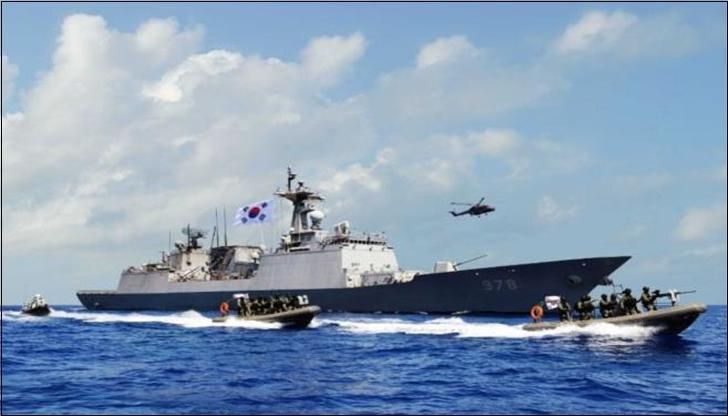
[Asia Economy Reporters Yang Nak-gyu and Lim Cheol-young] The United States has expressed a welcoming stance on the South Korean government's decision to dispatch troops to the Strait of Hormuz. However, Iran has shown discomfort, drawing attention to future developments.
On the 21st (local time), the U.S. State Department stated, "The United States welcomes and appreciates South Korea's decision to expand the Cheonghae Unit's mission to the Strait of Hormuz." David Eastburn, spokesperson for the U.S. Department of Defense, also commented, "We welcome our ally South Korea, which helps ensure freedom of navigation in the Middle East by supporting the International Maritime Security Construct (IMSC)," expressing gratitude. Although South Korea appears to be independently expanding its operational area, the emphasis on supporting the U.S.-led IMSC, the Hormuz escort coalition, is notable.
On the other hand, Iran's opposition is strong. Seyyed Abbas Mousavi, spokesperson for the Iranian Ministry of Foreign Affairs, tweeted on the same day, "How can the South Korean Ministry of Defense send troops to this area with any knowledge or legitimacy when it does not even properly know the historical name of the 'Persian Gulf'? Mutual respect and acceptance of facts are the basics of relations between civilized countries." He pointed out South Korea's Ministry of Defense's reference to the Gulf area as the 'Arabian Gulf' when announcing the expansion of the Cheonghae Unit's operational area to the Strait of Hormuz, revealing discomfort.
The name of the Gulf area is internationally recognized as the Persian Gulf. However, Saudi Arabia, the United Arab Emirates (UAE), which are hostile to Iran, as well as the U.S. government and some Western media, refer to it as the 'Arabian Gulf,' provoking Iran's opposition.
In response, the South Korean government intends to manage relations with Iran from multiple angles.
A senior official from the Ministry of Foreign Affairs told reporters on the afternoon of the 21st, "We informed Iran of this decision in advance through diplomatic channels last weekend," adding, "Iran basically opposes the presence of foreign military forces or vessels in the Strait of Hormuz and has expressed concerns accordingly." The official also noted that since this dispatch decision could affect South Korea-Iran relations, continuous management is planned. He explained, "We must continue efforts to manage South Korea-Iran relations," and "Iran also primarily holds the same position."
The Ministry of National Defense also took a low-profile stance. When announcing the dispatch of the Cheonghae Unit, it emphasized a 'temporary expansion of the deployment area.' It neither set a time limit nor used the term 'dispatch.' This is interpreted as an attempt not to provoke Iran. Additionally, conscious of the U.S.-led Hormuz escort coalition, which Iran opposes, it stressed that this is an 'independent dispatch.'
The future remains uncertain. The Ministry of National Defense has stated that while the Cheonghae Unit will operate independently, it will cooperate with the IMSC if necessary. If the IMSC requests escort of foreign vessels in the future, military confrontation may be unavoidable. This is why some express concerns that the effect of the troop dispatch may be diminished.
© The Asia Business Daily(www.asiae.co.kr). All rights reserved.
![Clutching a Stolen Dior Bag, Saying "I Hate Being Poor but Real"... The Grotesque Con of a "Human Knockoff" [Slate]](https://cwcontent.asiae.co.kr/asiaresize/183/2026021902243444107_1771435474.jpg)















