Impact of China's Subsidy Removal and Intensified Internal Competition
Battery Factory Investments Continue in Europe and the United States
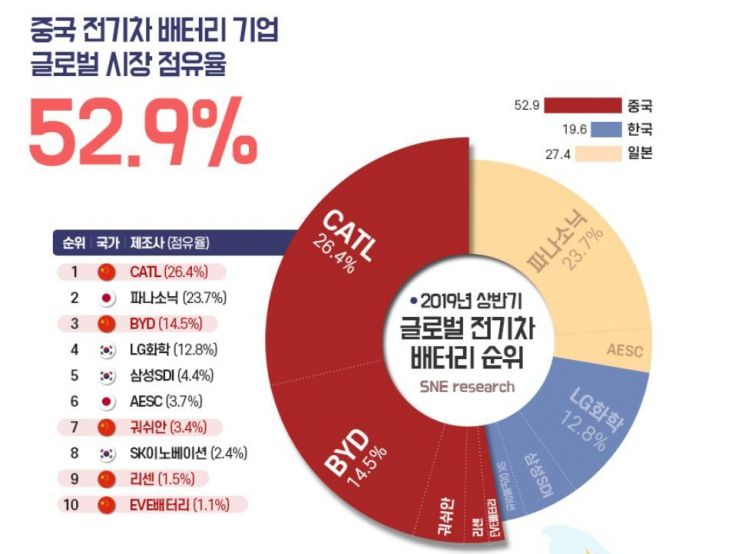
[Asia Economy Reporter Hwang Yoon-joo] As Chinese electric vehicle battery companies make full-scale advances into overseas markets such as Europe and the United States, competition with Korean battery companies is intensifying. CATL, the global electric vehicle battery market share leader, is considering expanding its business in the North American region following Germany, and SVOLT is reviewing investment in Europe. It is interpreted as a strategy for Chinese companies, which grew through subsidy policies, to enter major electric vehicle markets in Europe and the United States and maintain market dominance.
According to POSCO Research Institute on the 22nd, CATL began construction of an electric vehicle battery factory in Germany last October and is recently considering expanding its business in the North American region. The company is currently investing 240 million euros to build a production plant in Erfurt, eastern Germany. Through this, it plans to expand its annual production capacity to 100GWh by 2025. CATL aims to enhance customer responsiveness and supply efficiency in the European market through its investment in Germany.
Battery startup SVOLT plans to invest a total of 2 billion euros in the European region to build battery production facilities and a research center with an annual capacity of 24GWh by 2025. Although the investment country has not yet been decided, construction is scheduled to begin in the second half of next year, and battery production at the European factory is planned to start in 2022. SVOLT's goal is to have a total production capacity of 100GWh by 2025.
Farasis Energy, which signed a battery supply contract with Daimler AG in 2018 for 140GWh from 2021 to 2027, is also establishing a production plant in Germany with an investment of 600 million euros. It plans to produce batteries in Germany starting in 2022, targeting a production scale of 10GWh.
The biggest reason Chinese battery companies are entering the European and U.S. markets is that the Chinese government's electric vehicle subsidy policy was abolished starting in 2021. According to the China Electric Battery Union, the Chinese electric vehicle battery market size reached 100 billion yuan last year, and battery sales increased by 56% compared to 2018. This is due to the Chinese government's subsidy policy aimed at strengthening the competitiveness of domestic electric vehicle companies.
As a result, five of the top 10 global electric vehicle battery market share companies are Chinese. About 53% of the world's electric vehicle battery shipments are produced by Chinese companies. This is more than the combined shipments of Japan (about 27%) and Korea (about 18%).
As the electric vehicle battery market in China has recently grown and competition among domestic companies has intensified, it is interpreted that Chinese companies are entering overseas markets as part of a new market preemption strategy such as sales diversification.
As Chinese battery companies accelerate their overseas market penetration, domestic companies have also become busy. LG Chem has produced electric vehicle batteries in Poland targeting the European electric vehicle market, and Samsung SDI and SK Innovation have established production bases in Hungary.
An industry insider said, "Chinese battery companies are rapidly narrowing the technological gap with Korea and targeting overseas markets, supported by subsidy policies," adding, "Active government support is needed so that Korean battery material and component companies do not fall behind in competition."
© The Asia Business Daily(www.asiae.co.kr). All rights reserved.
![Clutching a Stolen Dior Bag, Saying "I Hate Being Poor but Real"... The Grotesque Con of a "Human Knockoff" [Slate]](https://cwcontent.asiae.co.kr/asiaresize/183/2026021902243444107_1771435474.jpg)















