[Asia Economy Reporter Buaeri] Criticism has been raised in academia regarding numerous legal issues related to the 'Real-time Search Manipulation Prevention Act' currently being discussed in the National Assembly. The bill is considered overly broad, potentially undermining even the positive functions of portals.
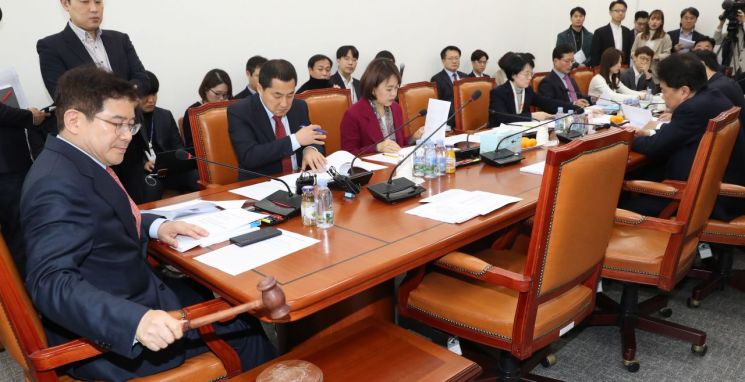
On the 21st, the Regulatory Experience Forum, Digital Economy Forum, and Yonsei University IT Policy Strategy Institute held a seminar titled 'Diagnosis and Discussion on the Macro Prohibition Act' at the Jeongdong 1928 Art Center in Seoul. At this event, criticism continued regarding the amendment to the Information and Communications Network Act being discussed by the National Assembly's Science, Technology, Information and Broadcasting Committee.
The amendment prohibits the use of macro (automatic repetition) programs for improper purposes and bans manipulation of information and communication services using others' personal information. Additionally, service providers must take technical and managerial measures to prevent their services from being manipulated by users. For these reasons, it is called the 'Real-time Search Manipulation Prevention Act' or 'Macro Prohibition Act.'
◆ "Weakening of Domestic Service Competitiveness" = Professor Lee Sang-woo of Yonsei University's Graduate School of Information stated, "Yahoo Japan and Baidu China both provide real-time search services. If such bills are enacted, the number of online services in Korea is likely to decrease," adding, "The bill is so broad that it may shut down service lines," raising concerns about reverse discrimination.
Attorney Jang Jun-young of Sejong Law Firm also pointed out, "During the 2017 National Assembly audit, Lee Hae-jin, Naver's Global Investment Officer (GIO), raised the issue of reverse discrimination," and added, "It is easier to hold domestic operators accountable for violating domestic laws, but there is a practical lack of effective measures to sanction overseas operators."
Professor Lee further explained, "Law enforcement against overseas operators is ineffective," giving the example, "If Google refuses, that's the end of the story. The same applies to YouTube."

Professor Kwak Kyu-tae of Soonchunhyang University's Department of Global Cultural Industry also commented, "Regarding fairness between domestic and foreign operators, the nature of the content itself is relevant," adding, "The law targets neither content nor news. In the case of services like YouTube, even if there is a lot of public opinion manipulation or distorted content, there is hardly any need to intervene."
Technical limitations were also raised. Professor Mo Jung-hoon of Yonsei University's Department of Information Industrial Engineering said, "If 10 million people launch macro attacks simultaneously, it is impossible to block them. Since the attacks do not come from a single server but from so-called zombie PCs, it is practically impossible for the service provider," and added, "As a result, they may have no choice but to eliminate comment services."
◆ "Violation of Freedom of Expression... Lack of Public Discussion" = Professor Jung Yong-guk of Dongguk University's Department of Media Communication said, "For example, under current law, manually requesting to raise real-time search rankings on radio is not an issue. Manual work is acceptable. However, macros are problematic," explaining, "While macros themselves are not justified, excessive legislation could suppress society."
Professor Lee stated, "The policy authorities' perspective on business is related," and explained, "Online business platforms are places where various ideas and creative technologies emerge, and in the U.S., operators are largely entrusted with this."
He continued, "There are voices that the discussions have proceeded secretly within the political sphere," and expressed hope that "those making the laws would sufficiently publicize the potential impact of the laws that could shape the future."
© The Asia Business Daily(www.asiae.co.kr). All rights reserved.
![Clutching a Stolen Dior Bag, Saying "I Hate Being Poor but Real"... The Grotesque Con of a "Human Knockoff" [Slate]](https://cwcontent.asiae.co.kr/asiaresize/183/2026021902243444107_1771435474.jpg)
















