Surging Despite Adverse Factors Like Customer Numbers and Loan Scale
Regulatory Relief Bill to Ease Funding Crunch Stalled in National Assembly
[Asia Economy Reporter Kim Hyo-jin] K-Bank, South Korea's first internet-only bank, is drifting due to financial difficulties. Despite key figures symbolizing growth potential soaring, regulatory bills blocking capital expansion have effectively left the bank in a state of suspended operation, unable to move forward.
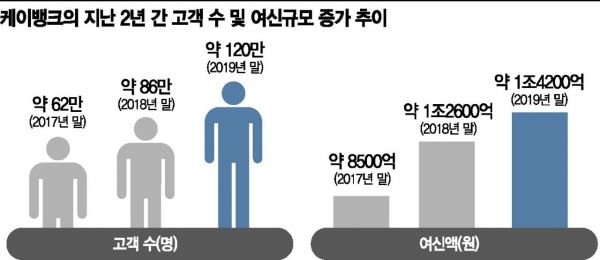
According to the financial sector on the 21st, K-Bank's cumulative number of customers, which was about 620,000 at the end of 2017, increased to 860,000 by the end of 2018 and to 1.2 million by the end of last year. This means it nearly doubled in two years. The loan amount also rose from about 850 billion KRW at the end of 2017 to 1.26 trillion KRW at the end of 2018, and to 1.42 trillion KRW by the end of last year.
Due to capital issues, the bank sequentially and temporarily suspended the sale of new loan products starting from April last year, which reduced the growth rate, but the overall upward trend did not break. A financial sector official said, "It seems K-Bank is experiencing the difficulties that financial companies face in their early stages," adding, "It is not appropriate to define this as a structural limitation of management systems or sales capabilities, as the foundation built so far is not shallow."
Since opening in April 2017, K-Bank has been struggling with financial difficulties. As of the end of September last year, K-Bank's Basel III Capital Adequacy Ratio (BIS ratio) was 11.85%, the lowest level in the industry. According to banking supervision regulations, if the BIS ratio falls below 10.5%, dividend restrictions are imposed, and if it falls below 8%, financial authorities take management improvement measures.
K-Bank planned to overcome its financial difficulties by changing its major shareholder to KT and receiving a capital injection of 590 billion KRW earlier this year, expanding its capital to the 1 trillion KRW level. Under these conditions, other major shareholders such as Woori Bank and NH Investment & Securities are also expected to participate in a large-scale capital increase. Woori Bank holds a 13.79% stake in K-Bank, while KT and NH Investment & Securities each hold 10%.
The problem lies with the amendment to the 'Special Act on Internet-Only Banks' that would allow KT to secure major shareholder status. Current regulations prevent KT from obtaining major shareholder status due to allegations of violating the Fair Trade Act, but the amendment relaxes the eligibility criteria for major shareholders, enabling KT to acquire this status. The amendment passed the Political Affairs Committee, the relevant standing committee of the National Assembly, but has not passed the final hurdle, the Legislation and Judiciary Committee.
On the 9th, Representative Chae I-bae of the Bareunmirae Party blocked the amendment's submission to the plenary session at the Legislation and Judiciary Committee, stating, "Excluding the Fair Trade Act from the major shareholder review completely undermines the financial business law system." Lawmakers opposing the amendment, including Representative Chae, worry that the amendment ultimately grants direct privileges to the giant corporation KT.
A representative of a shareholder company said, "There is certainly merit and important values in the opposing arguments," but also pointed out, "Internet banks are not large-scale vested interest projects that lay golden eggs; they are the result of digital financial innovation, so viewing them only as privileges is problematic."
© The Asia Business Daily(www.asiae.co.kr). All rights reserved.
![Clutching a Stolen Dior Bag, Saying "I Hate Being Poor but Real"... The Grotesque Con of a "Human Knockoff" [Slate]](https://cwcontent.asiae.co.kr/asiaresize/183/2026021902243444107_1771435474.jpg)















