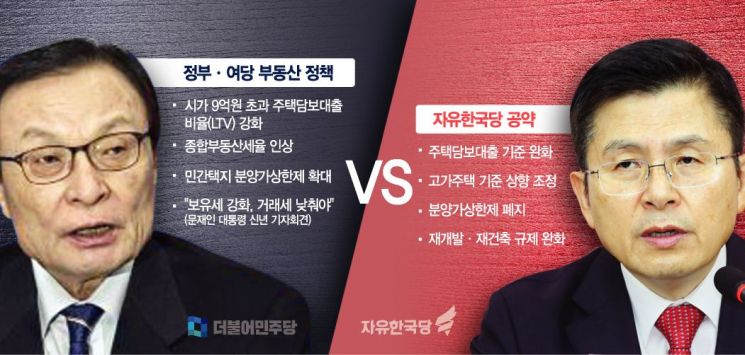
[Asia Economy Reporters Park Cheol-eung, Kim Hye-min] Lee In-young, the floor leader of the Democratic Party of Korea, proposed on the 21st that the direction of real estate policy legislation be determined according to the general election results, which is interpreted as evidence of a significant difference in perspective with the Liberty Korea Party. Considering that the general election phase has practically begun and that it is realistically difficult for the two parties to negotiate on real estate policy, this can be seen as a 'gamble' to compete directly for the people's votes.
It does not seem likely that the Liberty Korea Party will accept this proposal. On the 21st, after announcing the recruitment of foreign affairs and security expert Shin Beom-cheol, Liberty Korea Party leader Hwang Kyo-ahn told reporters, "Today is a place to talk about security, so there will be an opportunity to talk about (real estate pledges) next time."
Kim Jae-won, chairman of the Liberty Korea Party's Policy Committee, said, "This is not an 'all or nothing' matter," adding, "We need to gather the national consensus and decide. Their pledges are absolutely wrong and unacceptable." He continued, "Are they really trying to implement a permit system or a land distribution system? The country is heading for ruin," strongly criticizing, "This is the mindset of the activist group. It is an absurd idea that the 386 activist generation, once in power, will do anything."
From the Liberty Korea Party's standpoint, it is hard to imagine linking the general election results with legislation because they see the government and ruling party's real estate policy as extremely wrong. There may be concerns about potentially taking responsibility for the sensitive real estate policy that the public reacts strongly to. Strategically, it may also be advantageous to criticize the ruling party's real estate regulation policy in the general election.
However, the government and the Democratic Party are showing stronger determination than ever to 'control housing prices.' President Moon Jae-in stated at the New Year's press conference on the 14th, "We are determined to firmly control real estate during our government's term," and added, "If the current measures are judged to have somewhat lost effectiveness, we will continuously introduce stronger measures." The Democratic Party has required general election candidates who own two or more houses in speculative areas to pledge to sell any houses other than their primary residence.
Public opinion is also not unfavorable. Regarding President Moon's remark during the New Year's press conference that "areas with rapid price increases should be restored to their original state," a public opinion poll commissioned by tbs to Realmeter showed that 49.1% responded 'appropriate,' surpassing the 41.9% who said 'inappropriate.' The survey was conducted on the 15th with 502 adults aged 19 and over nationwide, using a mixed method of 10% wireless telephone interviews, 70% wireless, and 20% wired automated responses. The response rate was 5.4%, and the sampling error was ±4.4 percentage points at a 95% confidence level. Even if Lee In-young's proposal does not come to fruition, it is expected to have the effect of further highlighting real estate issues as a general election topic.
The Democratic Party appears eager to achieve visible results before the end of the 20th National Assembly. On the same day, Lee In-young appeared on MBC Radio's 'Kim Jong-bae's Focus' and said, "One option is to open the last National Assembly once more around late April or May to decide on the passage of bills." Regarding the increase in comprehensive real estate tax rates, he mentioned, "Our party member Kim Jung-woo proposed such a bill (to raise rates for owners of three or more houses) around the end of December last year, and it is a proposal worth sufficient consideration."
On the other hand, the Liberty Korea Party strongly criticized the Moon Jae-in administration's real estate policy when announcing its housing pledges on the 16th, saying, "The Moon administration's real estate policy crosses constitutional boundaries and threatens the free market economic system." Along with easing mortgage loan regulations, abolishing the price ceiling system for pre-sale, and relaxing redevelopment and reconstruction regulations, they proposed raising the standard for high-priced housing. They plan to adjust the threshold for property tax relief from a market price of 900 million won to a publicly announced price of 1.2 billion won. This is in the exact opposite direction of the government and ruling party's policy to increase the property tax burden.
© The Asia Business Daily(www.asiae.co.kr). All rights reserved.
![Clutching a Stolen Dior Bag, Saying "I Hate Being Poor but Real"... The Grotesque Con of a "Human Knockoff" [Slate]](https://cwcontent.asiae.co.kr/asiaresize/183/2026021902243444107_1771435474.jpg)
















