Implementation of 'Public Housing Project' in Yeongdeungpo Squalid Area of 10,000㎡ with 360 Residents, Supplying 1,200 Housing Units... Collaboration Among Ministry of Land, Seoul City, Yeongdeungpo District, LH, and SH to Provide Homes for Squalid Area Residents
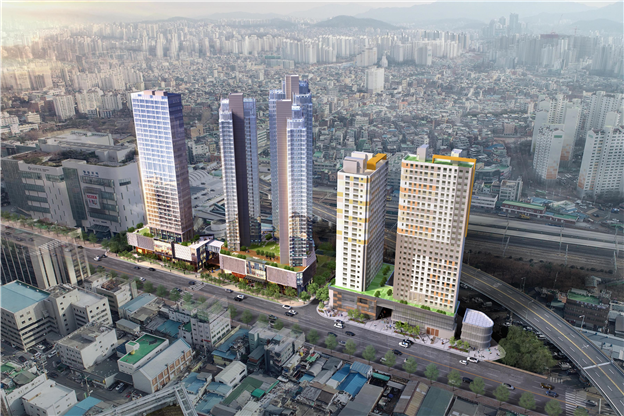
[Asia Economy Reporter Park Jong-il] Yeongdeungpo-gu (District Mayor Chae Hyun-il) is leading the creation of a stable residential environment by supplying 1,200 housing units through a ‘public housing project’ that redevelops the 10,000㎡ area of the densely packed jjokbangchon (tiny room village) around Yeongdeungpo Station into a residential, commercial, and welfare town.
The jjokbangchon around Yeongdeungpo Station is an aging residential area formed in the 1970s alongside regional development, a product of South Korea’s industrialization and a space imbued with the hardships of the working class.
Currently, about 360 residents of the Yeongdeungpo Station jjokbangchon suffer from extreme heat and cold every year in spaces barely large enough for one adult to lie down (1.65~6.6㎡), while being fully exposed to risks of fire and crime.
In 2015, an urban environment improvement project was initiated for the Yeongdeungpo jjokbangchon area but was halted due to insufficient relocation measures for the jjokbang residents.
Since then, the district has made multifaceted efforts such as on-site patrols and health checks for jjokbang residents, but without fundamental housing environment improvement measures, it was insufficient to enhance their quality of life.
Accordingly, since the 7th local government administration, the district has continuously requested the Ministry of Land, Infrastructure and Transport and Seoul City to devise fundamental solutions for the long-awaited jjokbangchon environment improvement, a wish of 380,000 residents.
District Mayor Chae Hyun-il actively advocated the necessity of jjokbangchon redevelopment during meetings with Minister Kim Hyun-mi of the Ministry of Land, Infrastructure and Transport in August last year and with Seoul Mayor Park Won-soon, forming mutual consensus that enabled the project to get on track.
In early December last year, a task force team composed of Yeongdeungpo-gu, the Ministry of Land, Infrastructure and Transport, Seoul City, Korea Land & Housing Corporation (LH), and Seoul Housing & Communities Corporation (SH) concretized the ‘jjokbangchon redevelopment plan.’
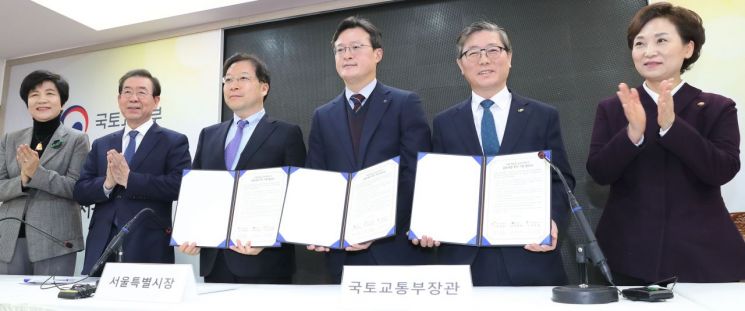
Then, on the 20th, Yeongdeungpo District Mayor Chae Hyun-il, Minister Kim Hyun-mi, Seoul Mayor Park Won-soon, National Assemblyman Kim Young-joo, LH President Byun Chang-heum, and SH President Kim Se-yong held a press briefing at Yeongdeungpo Station to announce the ‘Yeongdeungpo Jjokbangchon Public Housing Project Promotion Plan.’
On the same day, Yeongdeungpo-gu, LH, and SH, as project implementers, signed an MOU to jointly promote the public housing district project in the jjokbangchon area. The district will focus on managing conflicts between jjokbang residents and land/building owners, supporting the resettlement of jjokbang residents and support facilities, and establishing and operating care programs.
The ‘Yeongdeungpo Jjokbangchon Public Housing Project’ will be fully implemented this year, with the public housing district designated in the second half, aiming for district planning and compensation in 2021, and completion of public rental housing, happy housing, and sale housing by 2023, allowing about 1,200 households to move in.
First, 370 units of public rental housing will be created, providing jjokbang residents with spaces up to three times larger (16㎡) at about 20% of the current rent (32,000 KRW).
Additionally, care facilities offering comprehensive welfare services such as self-sufficiency, employment, counseling, and medical care for jjokbang residents will be supported to resettle in this area.
Above all, the most important aspect in this process is to establish policies that embrace socially vulnerable groups through ‘communication’ and ‘coexistence.’
The district consulted with jjokbang support organizations such as Gwangya Church, Joseph Clinic, Thomas House, and Yeongdeungpo Hope Support Center to prevent problems in advance and discuss countermeasures.
Temporary shelters for jjokbang residents will also be provided in the area, ensuring that all residents can settle in their new homes once the public rental housing is completed.
This project is the first development that respects jjokbang residents and is expected to serve as a model case in the social regeneration process that accepts them as dignified neighbors, setting a great example for redeveloping the remaining 10 jjokbangchon sites nationwide.
Moreover, the district plans to supply 220 units of happy housing for university students, youth, and newlyweds, and 600 units of private sale housing including mixed-use residential-commercial buildings and officetels on the site, advancing as a central hub of the southwestern region filled with inclusion and vitality through stable residential environment creation.
The district is also addressing residents’ long-standing demands one by one, such as reorganizing street vendors on Yeongjung-ro in front of Yeongdeungpo Station and designating and enforcing no-smoking zones on private property, starting with crackdowns on smoking in the raccoon dens of Yeouido’s securities district.
In the future, the district plans to solidify its status as one of Seoul’s three major downtowns through projects such as constructing the 2nd Sejong Cultural Center, creating a cultural complex space at Daeseon Flour Mill, and demolishing the Yeongdeungpo Rotary overpass.
District Mayor Chae Hyun-il stated, “By creating a residential, commercial, and welfare town, we will restore the prestige of the southwestern gate of Seoul and create an open Yeongdeungpo. We will spare no support to embrace socially vulnerable groups and transform the area into a safer and more pleasant residential environment.”
Yeongdeungpo-gu Urban Planning Division (☎2670-3542)
© The Asia Business Daily(www.asiae.co.kr). All rights reserved.
![Clutching a Stolen Dior Bag, Saying "I Hate Being Poor but Real"... The Grotesque Con of a "Human Knockoff" [Slate]](https://cwcontent.asiae.co.kr/asiaresize/183/2026021902243444107_1771435474.jpg)

















