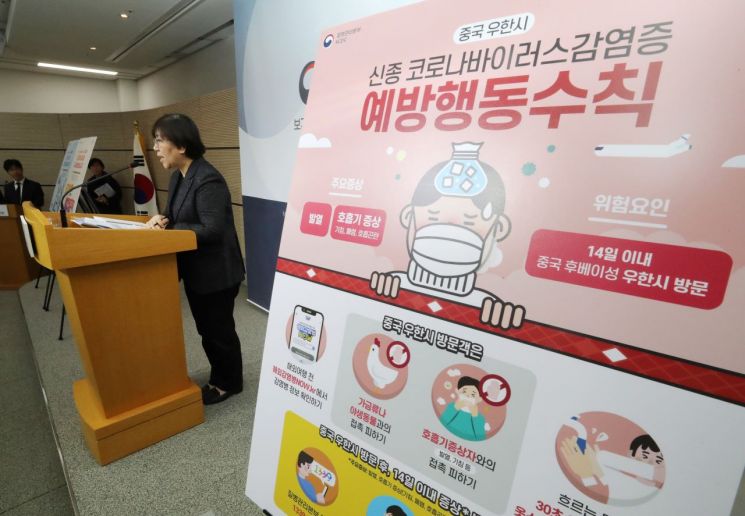
[Asia Economy Beijing=Special Correspondent Park Sun-mi] Chinese health authorities are viewing the recent sharp increase in so-called 'Wuhan pneumonia' cases infected with the novel coronavirus over the weekend not as a result of rapid transmission but due to the application of new investigation methods.
On the 20th, a senior Beijing diplomatic official said, "Regarding the addition of 136 new novel coronavirus infection cases over two days, Chinese health authorities informed us that this was the result of applying 'new investigation (testing) methods,'" adding, "We do not believe China has been hiding the number of infected patients. China is promptly providing information related to this Wuhan pneumonia outbreak to countries including South Korea."
He added, "Unlike during the SARS (Severe Acute Respiratory Syndrome) outbreak in the past, Chinese authorities seem to be providing information quickly about the status and progression of novel coronavirus infections," and "The speed of information delivery is definitely different from before."
Chinese authorities announced on the 16th that they had introduced new testing equipment for diagnosing Wuhan pneumonia infections. Indeed, on the 16th, confirmed cases appeared in Wuhan, followed by 17 cases on the 17th, and a sharp increase to 136 cases on the 18th and 19th. This is why China attributes the surge in novel coronavirus infection cases to changes in testing methods.
The South Korean government is monitoring the spread of Wuhan pneumonia under a state of alert and is committed to managing Korean residents in China with full effort. Ambassador Jang Ha-sung, the South Korean ambassador to China, said at a meeting with Beijing correspondents, "According to the information announced by Chinese authorities, more than 200 patients have been confirmed so far, including cases outside Wuhan in Beijing and Shenzhen," adding, "Confirmed cases have also appeared overseas in places frequently visited by Chinese people, such as Thailand with 2 cases and Japan with 1 case, so caution is necessary in South Korea, which is also a popular destination for Chinese visitors."
Ambassador Jang emphasized, "The Korea Centers for Disease Control and Prevention is working hard on prevention by deploying thermal detection devices from the airport," and added, "The embassy is also striving to promptly deliver information related to the current outbreak situation to Korean residents through its website and regional consulates. During the Chunjie (Spring Festival, the Chinese New Year) period, authorities plan to remain on emergency standby to respond."
China is in a state of extreme alert due to the spread of 'Wuhan pneumonia' ahead of the massive national migration during the Lunar New Year holiday starting this week.
On this day, the Wuhan Municipal Health Commission announced on its website that as of 10 p.m. the previous night, the cumulative number of so-called 'Wuhan pneumonia' patients infected with the novel coronavirus was 198. Among them, 25 have recovered, and 3 have died. The remaining 170 are currently isolated and receiving treatment in hospitals. There are 126 mild cases, 35 severe cases, and 9 critical severe cases, leaving the possibility open for additional deaths soon.
Wuhan health authorities stated that as the number of newly confirmed patients has increased, they are conducting in-depth epidemiological investigations and are focusing on tracing people who have had contact with these patients.
Announcements have also been made about confirmed cases outside Wuhan in other regions of China, indicating that the number of Wuhan pneumonia confirmed cases is set to rapidly increase nationwide.
In the early hours of this day, the Beijing Daxing District Health Commission announced that two people who traveled to Wuhan and returned were infected with Wuhan pneumonia. In Shenzhen, Guangdong Province, a 66-year-old man who had visited Wuhan was confirmed to have the novel coronavirus. These patients are currently in isolation and receiving treatment. Although the Chinese government has not yet officially confirmed it, local media reports have emerged of suspected cases in Shanghai.
Outside China, the number of confirmed Wuhan pneumonia cases is also increasing. Two Chinese visitors to Wuhan in Thailand and one in Japan have been confirmed as infected with the novel coronavirus. Additionally, South Korea confirmed that a Chinese woman who entered the country the previous day was infected with 'Wuhan pneumonia' and raised the infectious disease crisis alert level to 'caution.'
There is widespread criticism that Wuhan health authorities' initial response, which viewed the possibility of human-to-human transmission as low, was mistaken.
Wuhan health authorities based their low assessment of human-to-human transmission on the fact that no infections among close contacts had been found. However, many confirmed patients had no exposure to the Huanan Seafood Wholesale Market in Wuhan, known as the virus's origin, making human-to-human transmission effectively clear. Wuhan health authorities have yet to fully identify the cause and transmission routes of the virus.
With human-to-human transmission of the novel coronavirus now confirmed, China faces growing fears of spread ahead of the Chunjie (Lunar New Year) holiday from the 24th to the 30th, during which billions of people will move. Chinese authorities expect a total of 3 billion person-trips during this year's Chunjie holiday.
Chinese authorities are once again emphasizing that this virus is controllable and preventable, unlike the SARS outbreak in the past, attempting to ease the atmosphere. Li Gang, director of the Wuhan Center for Disease Control and Prevention, said in a weekend interview with China Central Television (CCTV) news that the disease situation is controllable due to the implementation of various prevention and control measures, and that most patients have mild symptoms.
On Chinese social media platform Weibo, there is a surge in demands for Chinese authorities to transparently disclose information, including cases that have spread outside Wuhan. On this day, related topics ranked highly on Weibo, reflecting the anxiety of Chinese people about the novel coronavirus.
Researchers at Imperial College London recently estimated in a report that the number of novel coronavirus infections could expand globally and reach up to 1,700 cases.
© The Asia Business Daily(www.asiae.co.kr). All rights reserved.
![Clutching a Stolen Dior Bag, Saying "I Hate Being Poor but Real"... The Grotesque Con of a "Human Knockoff" [Slate]](https://cwcontent.asiae.co.kr/asiaresize/183/2026021902243444107_1771435474.jpg)















