President Trump Marks 3rd Anniversary in Office
Self-Praises Job Creation and Tax Cut Policies
Con: "Higher Tariffs Make Businesses Uneasy"
Concerns Over Alliance-Neglecting Foreign Policy
[Asia Economy New York=Correspondent Baek Jong-min] On the 20th (local time), marking the 3rd anniversary of Donald Trump's inauguration, opinions in the U.S. are sharply divided between support and criticism regarding the effects of his economic policies. While the sharp rise in stock prices due to strong performance by technology companies is considered an achievement, there is fierce criticism that the use of power in foreign trade policies could actually harm the U.S.
Regarding economic achievements, President Trump has been the foremost in self-praise. On the 19th (local time), he praised various trade agreements made with trading partners since his inauguration through Twitter. The countries he mentioned included China, Mexico, Canada, Korea, and Japan. President Trump emphasized that these were "incredible new trade agreements."
This statement came before attending a farmers' event held in Austin, Texas. On that day, conscious of the farmer audience, President Trump mentioned that "great farmers have hit paydirt with incredible new trade agreements."
In his speech at the American Farm Bureau Federation (AFBF) annual meeting and trade show that evening, President Trump continued similar claims. He stated, "Since I took office, 7 million jobs have been created in the U.S., and the unemployment rate is only 3.5%, the lowest in 50 years. More Americans are working than ever before." He went on to emphasize that the tax cuts he promoted helped farmers. He also insisted, "I made trade agreements, but the left-wing Democrats impeached me. Nevertheless, farmers are on my side."
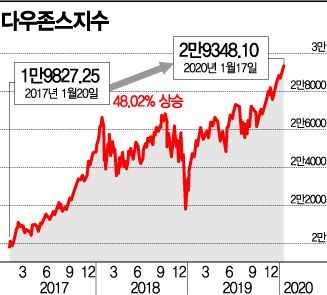
As he expressed, the U.S. is enjoying a major boom. The stock market has surged relentlessly since President Trump's inauguration. The Dow Jones Industrial Average, a representative U.S. stock index, has hit record highs daily, rising 48% compared to January 2017, the early days of his presidency. The Nasdaq, centered on technology companies, surged by a remarkable 69.01%. The unemployment rate has repeatedly hit record lows, leading to evaluations that the country has effectively reached full employment.
President Trump asserted, "Trade agreements have led the stock market to record highs," but added, "The best is yet to come." He emphasized, "The ongoing positive economic news is not a coincidence. It is the result of policies pursued by the Trump administration, such as tax cuts and trade agreements." He also introduced via Twitter that new housing starts in the U.S. increased by 16.9%.
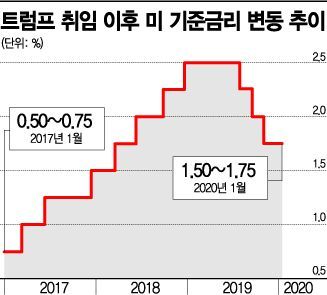
On the other hand, there are also criticisms that the economic achievements he has made are not all rosy. Due to successive tax cuts, the U.S. fiscal deficit has surpassed $1 trillion for the first time in seven years. This means that fiscal capacity has become more difficult to utilize.
Additionally, Gary Cohn, former White House National Economic Council Chairman under the Trump administration, appeared on CBS's 'Face the Nation' that day and said, "I do not differ with President Trump on the strength of the U.S. economy," but sharply criticized the tariff policies that use power. Cohn is a market economist from investment bank Goldman Sachs.
He referred to the steel and aluminum tariff increases that caused friction with President Trump, stating, "They do not help our economy." He added, "The tariffs of the Trump administration hurt America. They completely harm America."
Cohn pointed out, "When tariffs rise, American companies think about capital expenditures." He explained that companies leading the U.S. economy become uneasy due to trade conflicts, reducing investment or moving overseas, which could negatively impact the U.S. economy. Regarding the benchmark interest rate that President Trump pressures to lower, Cohn dismissed concerns, saying, "There is no need to worry at this time."
This is interpreted as an attempt to use various trade agreements achieved after inauguration for his re-election campaign. The core of the Phase One trade agreement with China, signed by President Trump on the 15th, is in the agricultural sector. It is evaluated as the best weapon to target the conservative-leaning agricultural Midwest.
Concerns about the Trump administration's foreign policy, which disregards allies, cannot be overlooked. The Washington Post (WP) expressed concern about President Trump's trip to Davos, Switzerland, where the World Economic Forum (WEF) is held this week. In an article on the topic that the Trump administration's coercive policies have caused tensions with allies, WP criticized President Trump's foreign policy. There are concerns that President Trump could clash with German Chancellor Angela Merkel and British Prince Charles at this forum. WP also sarcastically commented on the actions of U.S. Secretary of State Mike Pompeo and Secretary of Defense Mark Esper, who demanded a significant increase in defense costs from Korea, saying, "This is a conversation that should be held privately, not something to be published in newspapers." President Trump plans to depart for the Davos Forum on the 20th, the 3rd anniversary of his inauguration.
© The Asia Business Daily(www.asiae.co.kr). All rights reserved.
![Clutching a Stolen Dior Bag, Saying "I Hate Being Poor but Real"... The Grotesque Con of a "Human Knockoff" [Slate]](https://cwcontent.asiae.co.kr/asiaresize/183/2026021902243444107_1771435474.jpg)

















