[Asia Economy Reporter Naju-seok] Twelve countries including Germany, France, Russia, and Turkey have agreed to comply with the UN arms export ban to mediate the Libyan civil war. While this is seen as the first step toward ending the Libyan civil war, there are concerns that substantial peace is still a long way off.
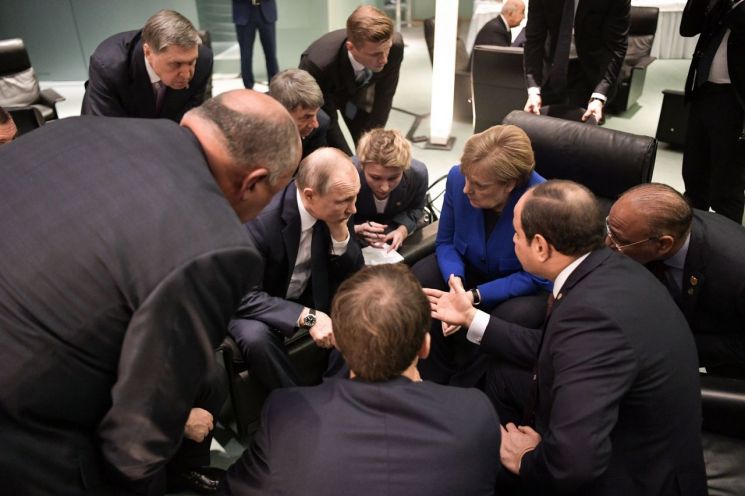
On the 19th (local time), German Chancellor Angela Merkel and UN Secretary-General Ant?nio Guterres held a press conference after their talks in Berlin, Germany, announcing that major countries and neighboring states of Libya agreed to ban arms exports to Libya and to facilitate a ceasefire between both sides. The agreement involved not only the surrounding major powers and parties but also the United Nations, the European Union (EU), and the African Union.
Chancellor Merkel stated, "We all agreed that a political solution is necessary to resolve the Libyan issue," adding, "Recent developments have confirmed that the problem cannot be solved through military means." Secretary-General Guterres said, "All participants must continue to exert pressure to achieve a complete ceasefire agreement."
In addition to the arms embargo, the involved countries agreed to establish a separate military committee in Geneva soon to negotiate a ceasefire.
Libya has been divided since 2014 into the Government of National Accord (GNA), which controls the west, and the Libyan National Army (LNA), which controls the east, following the death of dictator Muammar Gaddafi during the Arab Spring in 2011. The GNA, recognized by the UN as the legitimate government, has been led by Prime Minister Fayez al-Sarraj, while the LNA, classified as a rebel force, has been led by Commander Khalifa Haftar.
© The Asia Business Daily(www.asiae.co.kr). All rights reserved.
![Clutching a Stolen Dior Bag, Saying "I Hate Being Poor but Real"... The Grotesque Con of a "Human Knockoff" [Slate]](https://cwcontent.asiae.co.kr/asiaresize/183/2026021902243444107_1771435474.jpg)















