Decline in Nuclear Power Discourages Top Students from Enrolling: "Industry May End Before Nuclear Phase-Out"
Industry Capacity Weakens, Parts Sector Faces Collapse... Experts Warn "Nuclear Safety at Risk"
Students Say "Enrolled to Help the Country... Nuclear Decommissioning Cannot Be a Core Industry"
[Asia Economy Reporters Kim Bo-kyung and Moon Chae-seok] As the vision for the nuclear power industry becomes unclear, the Department of Nuclear Engineering has quietly fallen into the category of 'unpopular majors.' The number of students majoring in nuclear engineering is gradually decreasing. The sharp decline in employment rates for nuclear engineering graduates is not just a problem for the related departments but directly affects the competitiveness and survival of the domestic nuclear power industry. Experts warn that if this situation continues, the depletion of talent could soon make it difficult to operate and maintain Korea's nuclear power industry. Although the government has announced a phased nuclear power reduction policy over 60 years, concerns are rising that the nuclear era could end even before 60 years due to the disruption of technology development and workforce continuity.
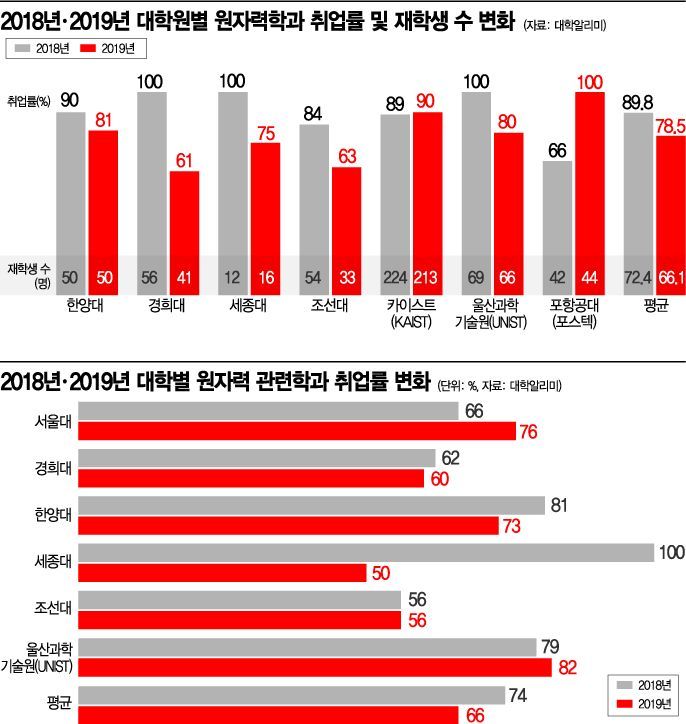
◆Drying up of nuclear talent= The phenomenon of talent depletion has already begun. An analysis of publicly available data on the University Alimi website on the 20th shows that the number of students enrolled in nuclear-related departments across seven major graduate schools decreased by an average of 6.3 last year. At Kyung Hee University Graduate School, the number of students dropped from 56 in 2018 to 41 last year, and at Chosun University, it fell from 54 to 33 during the same period. KAIST and Ulsan National Institute of Science and Technology (UNIST) also saw decreases from 224 to 213 and 69 to 66, respectively.
Professor Jung Dong-wook of Chung-Ang University said, "Nuclear power plants operate for 50 to 60 years, so future generations must safely manage and operate them," adding, "The shrinking nuclear power industry sends a signal that discourages excellent students from entering nuclear engineering departments." Professor Heo Gyun-young of Kyung Hee University said, "I believe the nuclear power industry itself could end in less than 60 years due to manpower shortages," and added, "The reduction in personnel is a problem, but the bigger issue is that it is becoming difficult to maintain the same level of expertise as before."
Professor Jung Beom-jin of Kyung Hee University said, "Not only undergraduate graduates but also graduate students are knocking on doors in industries outside of nuclear power," and added, "This can only be seen as influenced by the government's nuclear phase-out policy." Professor Lee Deok-hwan of Sogang University stated, "The nuclear power component industry ecosystem is rapidly collapsing," and warned, "As specialized personnel leave and future talent does not enter, even the safety of nuclear power is being threatened."
◆Students also say, "Energy is a national foundational industry"= University students majoring in nuclear engineering are also concerned about the government's nuclear phase-out policy. Their worry is "not because of employment but because it harms the country." Kwak Mo (22), a third-year student in the Department of Nuclear and Quantum Engineering at Seoul National University, said, "When talking with friends around me, many entered the nuclear engineering department because they wanted to contribute to the country," adding, "The energy industry is not just one of many industrial sectors but a foundational industry for the nation." Currently, nuclear power accounts for 30% of total power generation.
He also raised concerns about the government's shift in focus from nuclear technology development to nuclear power plant dismantling and nuclear fusion research and development (R&D) after declaring a 'nuclear phase-out within 60 years.' He said, "Many students are interested in and study nuclear fusion because it is considered an energy source that can replace nuclear power," but added, "Since it is still in the research stage, it is questionable whether it can be called an industry." He emphasized, "What we study is 'how to make nuclear power plants safer and more efficient,'" and stressed, "Nuclear power plant dismantling can never be a core industry, nor is it a field we focus on."
© The Asia Business Daily(www.asiae.co.kr). All rights reserved.


















