Not a Daechi-dong Academy
Weekend Real Estate Study for 30s Office Workers
Beginner Lecture Costs 10,000 Won
"Regretting Most Buying Jeonse Trusting the Government"

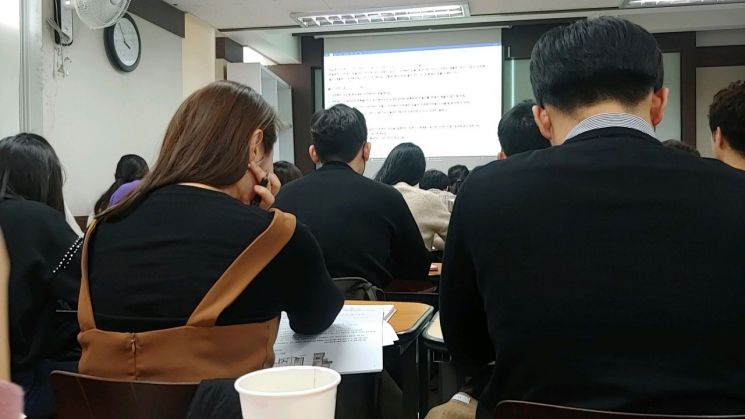
[Asia Economy Reporter Lim On-yu] At 5 p.m. on the 19th, 50 students gathered in a classroom at a language institute near Gangnam Station in Seoul. Most of them appeared to be in their 30s and office workers. The reason they gave up their holiday evening time to gather here was not for language study. It was to attend a lecture for 'real estate beginners.' The lecture registration was done in advance through social media services (SNS), and reportedly, there were more than 20 people on the waiting list.
A(31), who plans to prepare a newlywed home ahead of marriage, said, "With the government constantly issuing various tax and loan regulations, it's become even harder for beginners like me to keep up," adding, "I was only able to attend the lecture because a registered student canceled." The students, who paid a 30,000 won tuition fee, took notes on every word of the instructor and asked numerous questions without showing signs of fatigue despite the nearly four-hour-long lecture.
The students raised their voices when the government's December 16 real estate measures and President Moon Jae-in's New Year's press conference were mentioned. B(35), who works at a large corporation, said, "I don't mind not receiving benefits like the Didimdol loan or special supply for newlyweds due to my income," but added, "I'm angry because even the ladder to move into a better place has been kicked away." This was a complaint about the government's December 16 real estate measures last year, which completely banned mortgage loans for houses exceeding 1.5 billion won and blocked jeonse deposit loans for owners of houses over 900 million won.
Despite President Moon's remark that "strong real estate measures will be implemented to the end," the atmosphere showed little trust. One student sighed, saying, "My biggest regret in life is trusting the government that promised to lower house prices and continuing to live in jeonse," adding, "I honestly saved my salary diligently, but it's hard to cover the increased jeonse prices." This came from self-reproach over the reality that a friend who bought a house years ago by 'borrowing loans to the soul' became an asset owner worth over 1 billion won, while they themselves remain a tenant.
Distrust in government policies was also evident. When the instructor said, "House prices rise the more you regulate. The stricter the redevelopment and reconstruction regulations, the higher Seoul house prices go. It could even be an opportunity," the attendees nodded. Some even responded, "There's no need to blame the government," and "House prices will continue to rise during this administration, so we just need to invest accordingly."
Criticism was also raised that the government's impatience to control house prices caused market confusion. C(33), who is planning redevelopment investment in the metropolitan area, said, "The December 16 measures changed the criteria for one-homeowners and made jeonse loans difficult, but I came to get an explanation because I can't understand what's what." G(32) also said, "The December 16 measures are so confusing that I recently attended a tax-related lecture, but even the instructor apologized, saying 'the content keeps changing, so it's confusing,'" and questioned, "If experts are like this, what about ordinary office workers?" While house price stabilization is good, it has gone beyond the level that actual buyers can understand and accept.
During the lecture, the students unanimously agreed with the instructor's remark, "Rather than living as tenants who get cursed, let's become homeowners who get criticized." They preferred to become homeowners or multiple homeowners, even if they become targets of envy and jealousy, rather than complaining about rising house prices and wandering as jeonse refugees.
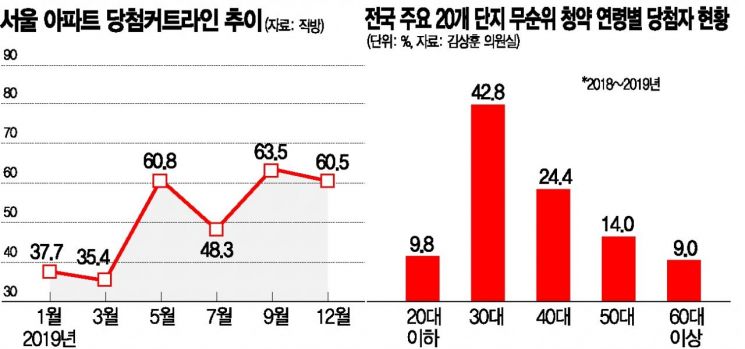 People in their 30s in South Korea are caught in a triple burden related to real estate. Housing prices are soaring, policies are rapidly changing, and under the point-based system, applying for new housing is difficult. This is why many people in their 30s are flocking to non-priority housing applications.
In fact, the lecture introduced various real estate investment methods and financing plans, from reconstruction and redevelopment to so-called 'jupjup,' meaning non-priority subscription. There was also time to organize abbreviations such as 'Mayongseong (Mapo, Yongsan, Seongdong districts),' 'Gyeongja (Gyeonghuigung Xi),' and 'Maraepu (Mapo Raemian Prugio).'
Especially, the students seemed anxious about the sharp rise in jeonse prices caused by the balloon effect of government measures. D(30), who came on a friend's recommendation, said, "For 30-somethings living in Seoul, subscription is an 'insurmountable 4-dimensional wall,' and it's not like I have money to buy a house," adding, "After today's lecture, I'm thinking about buying a small apartment in a new town in Incheon." F(36), a single-income earner with one son, also said, "I have given up on owning a home in Seoul due to tightened loan regulations," and plans to buy an apartment in the metropolitan area.
© The Asia Business Daily(www.asiae.co.kr). All rights reserved.
![Clutching a Stolen Dior Bag, Saying "I Hate Being Poor but Real"... The Grotesque Con of a "Human Knockoff" [Slate]](https://cwcontent.asiae.co.kr/asiaresize/183/2026021902243444107_1771435474.jpg)


















