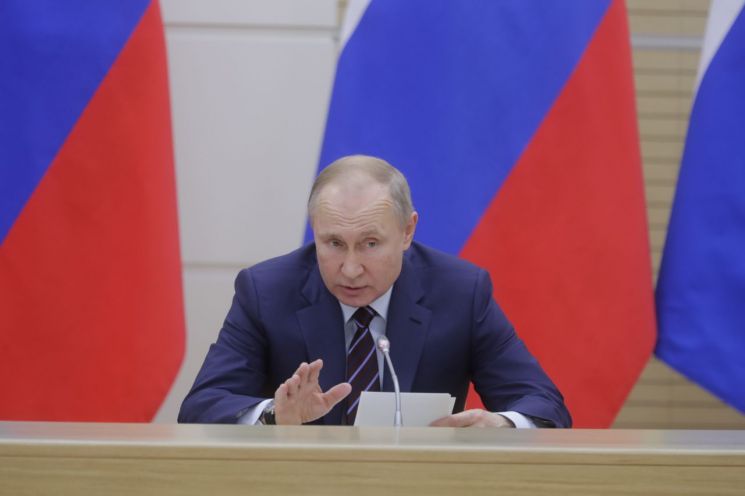
[Asia Economy Reporter Buaeri] Russian President Vladimir Putin has expressed opposition to a constitutional amendment that would completely remove term limits for national leaders.
According to RIA Novosti and other sources on the 18th, President Putin attended a World War II-related event held in Saint Petersburg, Russia's second-largest city, where he spoke with veterans. When one attendee suggested amending the constitution to abolish the current presidential term limits, Putin expressed his stance.
Putin said, "(The proposal to remove term limits) is related to social and national stability concerns expressed by many people," and added that he understands the questioner's intention to allow a capable leader to serve without term limits for political stability.
However, he expressed concern, saying, "At the same time, it would be very worrisome to return to the 1980s (former Soviet Union) situation where national leaders held power consecutively until the end of their lives without creating conditions necessary for power transition."
President Putin added, "It would be better not to return to the situation that existed in the mid-1980s."
Leonid Brezhnev, who ruled the former Soviet Union as General Secretary of the Communist Party during the 1980s, remained in power for 18 years until his death at age 75 from a heart attack in 1982. His successors, Andropov and Chernenko, died at ages 69 and 73 respectively, enjoying short tenures of two years and one year.
Earlier, on the 15th, President Putin proposed a partial constitutional amendment during his annual state address to limit the same individual to serving as president only twice.
The current Russian constitution stipulates that "the same individual cannot serve more than two consecutive presidential terms," but the proposal suggests removing the word "consecutive" so that regardless of whether terms are served consecutively or with a break in between, no one can serve more than two terms as president.
President Putin, who served two consecutive four-year presidential terms from 2000 to 2008, stepped down as prime minister due to the constitutional ban on a third consecutive term, then returned to the presidency in 2012 after the term length was extended to six years, and was re-elected in 2018, continuing his fourth term in office.
If the amendment proposed by Putin is enacted, it would make it impossible for the same individual to serve more than two presidential terms, increasing the possibility of power transition.
However, some speculate that Putin might be attempting to extend his power in other ways, noting that in the same state address, he also proposed reducing presidential powers while strengthening the authority of the State Council?a presidential advisory body composed of regional governors?and the chairs of the upper and lower houses of parliament. There are suspicions that after his fourth term ends in 2024, Putin might step down from the presidency but continue to exert political influence by moving to a position such as the chair of the Federation Council or the State Council, where powers would be enhanced.
© The Asia Business Daily(www.asiae.co.kr). All rights reserved.