Discussion on San-eun and Rehabilitation... Request for Loan Maturity Extension and Additional Loan Support
Government Intervention Creates Justification for Pressure to Support Ssangyong Motor Dismissed Workers' Reinstatement
Today’s Tripartite Commission Negotiation... Likely Focus on Job Preservation Over Job Creation
[Asia Economy reporters Su-yeon Woo and Bo-kyung Kim] Pawan Goenka, chairman of Mahindra, the major shareholder of Ssangyong Motor, is known to have requested additional loan support from the Korea Development Bank (KDB), and on the 17th, he will hold discussions with the Korean government regarding jobs. This is interpreted as a kind of 'job invoice,' where Ssangyong Motor, struggling with management difficulties, is leveraging jobs to force government support.
According to industry and government sources on the 17th, in the afternoon, Goenka, chairman of the Ssangyong Motor board and Mahindra, will meet with government officials including Im Ok-hee, vice chairman of the Presidential Committee on Jobs, and Moon Sung-hyun, chairman of the Economic, Social and Labor Council, to discuss job-related matters. Mahindra is expected to secure additional government support through job negotiations, including follow-up measures for the reinstatement of Ssangyong Motor’s dismissed workers.
Vice Chairman Im Ok-hee said, "Ssangyong Motor, which is still insufficiently prepared for future vehicles, needs to clearly explain its mid- to long-term vision to the government, creditors, and stakeholders," adding, "This issue is seen more as a discussion about 'protecting jobs' rather than job creation."
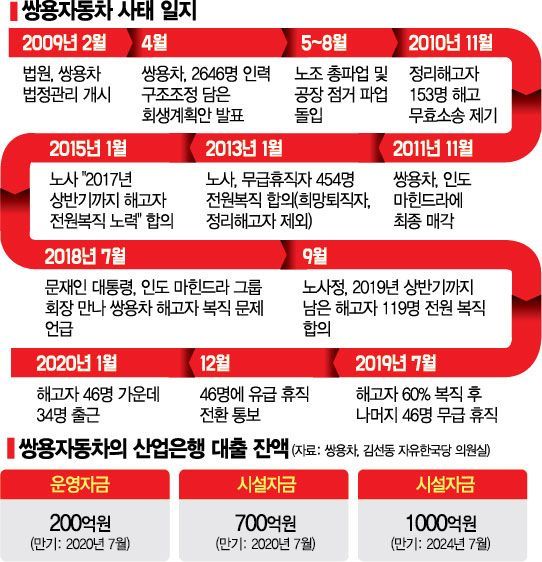
The issue of dismissed workers at Ssangyong Motor, which had dragged on for over ten years due to government intervention since 2018, seemed to have been resolved with the full reinstatement of workers. However, due to recent worsening management conditions at Ssangyong Motor, it has become difficult to assign the last 46 reinstated dismissed workers to the field. At that time, Ssangyong Motor was still struggling financially, but after President Moon Jae-in’s visit to India, the reinstatement issue gained momentum under the leadership of the Economic, Social and Labor Council.
Despite worsening management, since Mahindra accepted the government’s demands on job issues, it is expected that in this negotiation, they will strongly demand proactive government support. There is also a possibility of mentioning loan support through KDB or converting loans into equity, similar to the past case of GM.
Because of this, there are criticisms that the government’s involvement in the Ssangyong Motor dismissed workers issue has become a hindrance. From Mahindra and Ssangyong Motor’s perspective, having accepted the reinstatement of dismissed workers despite management difficulties, they now have grounds to request government-level support. At that time, Choi Jung-sik, president of Ssangyong Motor, emphasized, "Capital injection is inevitable for survival," and "I hope the Economic, Social and Labor Council takes the lead and the government actively supports us in terms of financing."
The problem is that a huge amount of taxpayers’ money may be poured in to normalize Ssangyong Motor. Ssangyong Motor has already invested 1.2 trillion won in development costs over three years from 2016 for new car development, and an additional 500 billion won may be needed going forward. As government environmental regulations tighten, the shift to eco-friendly vehicle platforms such as electric vehicles is urgent, but Ssangyong Motor is currently blocked from raising several hundred billion won in funds needed for new car development.
To resolve the urgent liquidity crisis, on the 16th, Chairman Goenka met with Lee Dong-geol, chairman of KDB, to discuss financial support measures. During the approximately two-hour meeting, Goenka reportedly presented his willingness to invest in Ssangyong Motor and a blueprint for management normalization, requesting loan extensions and additional funding from KDB. Currently, Ssangyong Motor’s total loans from KDB amount to 190 billion won for operating and facility funds, of which 90 billion won matures in July. Previously, KDB extended the maturity of 20 billion won out of a 30 billion won loan that matured at the end of last year.
The meeting the day before was significant as a first encounter between Mahindra and KDB, marking the start of discussions on Ssangyong Motor’s recovery plan. A Ssangyong Motor official said, "It is still difficult to see tangible results, but it is important that both sides have opened the door to dialogue and conveyed the major shareholder’s willingness to invest."
Earlier that same morning, Chairman Goenka met with representatives of the Ssangyong Motor labor union and expressed his intention to invest 230 billion won in Ssangyong Motor after board approval. While he could not specify the exact method of investment, he repeatedly emphasized that he does not view Ssangyong Motor from a short-term perspective.
Although the Ssangyong Motor board meeting is scheduled for the end of this month, direct investment execution still seems far off as it must first be approved by Mahindra’s board. A Ssangyong Motor official said, "We expect internal plans such as self-rescue measures and recovery plans prepared within Ssangyong Motor to become visible around the end of February," adding, "It will take more time before investment."
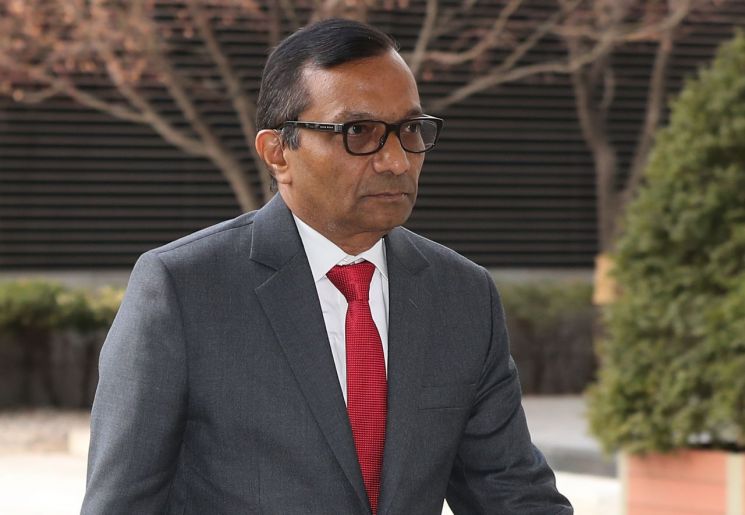 Pawan Goenka, President of Mahindra, visited the headquarters of the Korea Development Bank in Yeouido, Seoul, on the afternoon of the 16th. On this day, President Goenka met with Lee Dong-gul, Chairman of the Korea Development Bank, to discuss the revival plan for Ssangyong Motor.
 Photo by Yonhap News
© The Asia Business Daily(www.asiae.co.kr). All rights reserved.


















