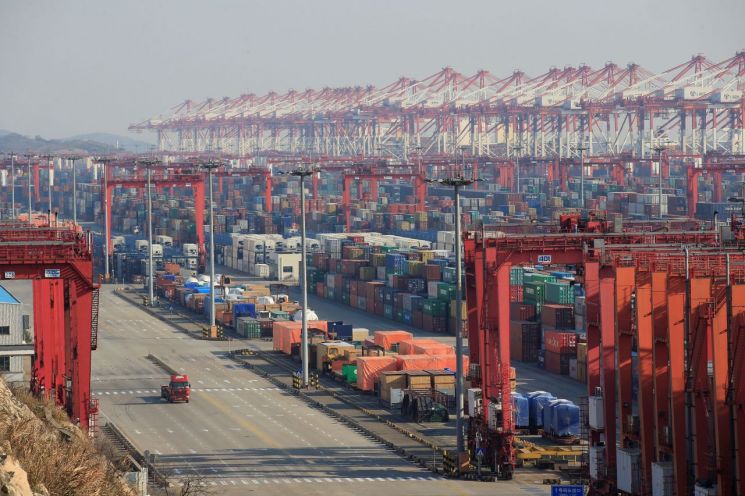
[Asia Economy Beijing=Correspondent Sunmi Park, Reporter Hyunjin Jung] "These days, the vacancy rate of office buildings in Beijing has increased significantly. It's evidence that the economy is not doing well. For example, in Chaoyang District's SOHO, a representative office building, the daily rent for a 415㎡ space has dropped to 2,282 yuan (about 384,000 won). Two years ago, it was around 3,735 yuan, so it has fallen by more than 30%."
On the 17th, real estate agent Hwang Jinji, whom we met in Beijing, complained that rents are rapidly falling due to the noticeably higher vacancy rates in office buildings these days. He explained that the daily rent per 1㎡ in the nearby high-rise Ludi Building has also dropped from 12 yuan two years ago to about 9 yuan recently. As of last month, the vacancy rate of office buildings in Beijing soared to 15.9%, the highest level since 2010. This means that 16 out of every 100 offices are empty. This is partly due to an oversupply of office buildings, but also because small companies have failed to survive amid the trade war and economic slowdown, and venture capital and private equity (PEF) investments in the technology sector have decreased, leading to an exodus from Beijing.
Last year, the three main drivers of the Chinese economy (exports, investment, and consumption) all faltered, bringing the collapse of the 'Baoliu (保六, maintaining a 6% growth rate)' close. It means that recovering the economic growth speed seen in the past has become virtually impossible.
The biggest reason China recorded its lowest-ever economic growth rate last year was the US-China trade war. The manufacturing and export sectors were depressed, and the economic environment became uncertain, causing consumer and investment sentiment to deteriorate rapidly. According to statistics from the National Bureau of Statistics of China and the General Administration of Customs on the 18th, China's dollar-denominated export growth rate last year was only 0.5%, taking a direct hit from the trade war. The manufacturing index fell below the baseline of 50 for a total of eight months (January, February, May to October), indicating economic contraction. China is transitioning from the world's manufacturing factory to a massive consumer market, but retail sales growth has also declined from 8-10% in early 2018 to 7-8% currently.
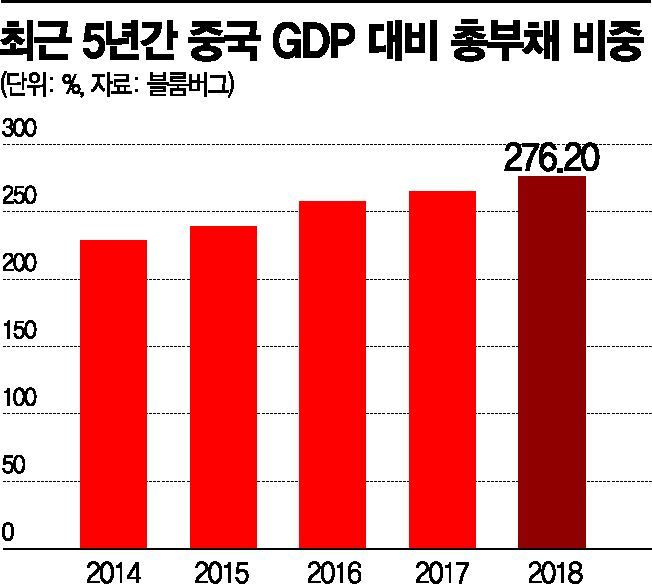
However, experts say that the Chinese economy has reached structural limits. In particular, the liquidity unleashed to revive the economy during the global financial crisis 10 years ago is considered a decisive factor that trapped the Chinese economy in a 'debt trap.' The debt bomb is the number one risk factor cited by economic experts for the Chinese economy. According to Bloomberg, China's total debt-to-GDP ratio rose from 229.27% in 2014 to 276.20% in 2018. A recent survey by the Institute of International Finance (IIF) also showed that as of the third quarter of last year, China's debt-to-GDP ratio reached 310%, the highest among developing countries.
Credit rating agency S&P estimated that more than 130 billion yuan worth of bonds defaulted in China last year. This surpasses the record 121 billion yuan default in 2018. S&P stated, "More Chinese companies will fail to repay debts this year," adding, "The amount of bonds maturing this year for Chinese companies is about 6.5 trillion yuan." Among last year's defaulted bonds, 90% came from small and medium-sized private enterprises that have difficulty raising funds. International credit rating agency Moody's expressed concern that the default scale could grow to 200 billion yuan this year.
There is growing consensus that the economic growth rate will enter the 5% range this year. The possibility of a renewed trade war with the US remains a factor causing instability in China's economy this year. In the second phase of trade negotiations expected to intensify after November, tariffs or designation as a currency manipulator could again be used as US negotiation 'cards.' Nick Marro, an analyst at the Economist Intelligence Unit (EIU), believes that China will find it difficult to comply with the agreement, making it highly likely that negotiations will break down by the end of this year.
Widening social imbalances spreading throughout society are also cited as risk factors that could strangle China's economy this year. Last year, China's per capita GDP exceeded $10,000 for the first time. Although this appears to be a significant achievement on the surface, in the current situation where poverty eradication, a core national agenda of President Xi Jinping, has not yet been completed, it has become a symbol of social imbalance and widening wealth gaps.
Song Hong, deputy director of the Institute of World Economics and Politics under the Chinese Academy of Social Sciences, a government think tank, said, "The Chinese economy is at a structural turning point, but if the economic growth rate falls rapidly due to the trade war and other factors, it could face a crisis," adding, "A major risk this year is that the structural transition of the economy does not proceed smoothly, causing both emerging and traditional industries to decline simultaneously."
© The Asia Business Daily(www.asiae.co.kr). All rights reserved.
![Clutching a Stolen Dior Bag, Saying "I Hate Being Poor but Real"... The Grotesque Con of a "Human Knockoff" [Slate]](https://cwcontent.asiae.co.kr/asiaresize/183/2026021902243444107_1771435474.jpg)
















