Over 28,998 Imported Cars Sold Last Year with Prices Over 100 Million KRW
Imported Cars Over 300 Million KRW More Than Double Compared to Previous Year
Rising SUV Share Drives Overall Increase in Imported Car Prices
No Domestic Competitors for High-End Models Over 300 Million KRW
[Asia Economy Reporter Su-yeon Woo] Amid the economic downturn causing a slowdown in various consumption indicators, high-priced imported cars that make people gasp are selling like hotcakes in the imported car market. Last year, the imported car market experienced negative growth for the first time in three years due to the recession, but sales of vehicles priced over 100 million won set an all-time record.
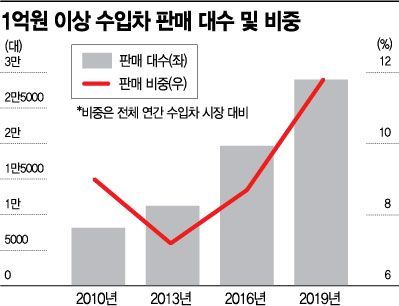
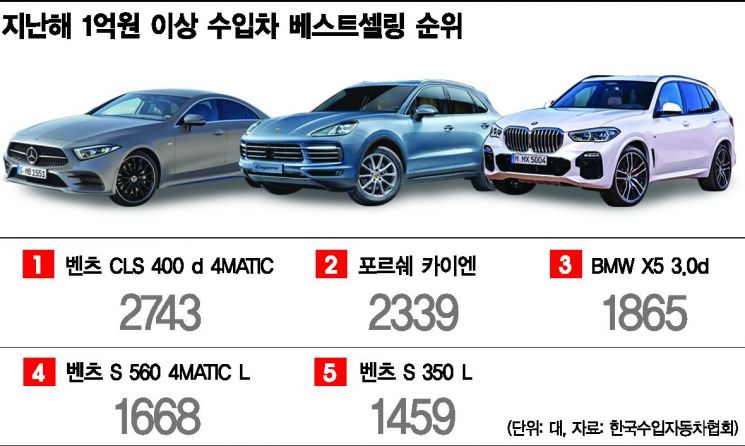
According to the Korea Imported Automobile Association on the 16th, sales of vehicles priced over 100 million won in the domestic imported car market in 2019 reached 28,998 units, marking the highest performance ever. The proportion of vehicles priced over 100 million won compared to the entire imported car market also increased by 1.7 percentage points from the previous year to 11.8%. The best-selling model was the Mercedes-Benz coupe CLS 400d 4MATIC (2,743 units), followed by Porsche's sports utility vehicle (SUV) Cayenne with 2,339 units, and BMW SUV X5 3.0d with 1,865 units, ranking second and third respectively.
Notably, while the overall imported car market experienced a downturn last year, sales of ultra-luxury imported cars priced over 300 million won surged explosively to 424 units, more than double the previous year's 139 units. The best-selling model among imported cars priced over 300 million won was the Mercedes-Maybach S 650, the top-tier sedan in the Maybach lineup, which was introduced to the domestic market for the first time last year, with 188 units sold.
The growth of supercar brands Lamborghini and Rolls-Royce, most models of which are priced over 300 million won, is also noteworthy. Lamborghini, which sold only 11 units domestically in 2018, grew by an astonishing 1,400% last year, selling 173 units. The Urus, which sold 100 units domestically last year, is the only Lamborghini model priced in the 200 million won range.
In the early 2000s, when the imported car market was in its infancy, vehicles priced over 100 million won accounted for about 20% of the market, a relatively high proportion. At that time, imported luxury cars were regarded as symbols of wealth, and the perception was strong that imported cars were vehicles for a privileged few. In the 2010s, as imported car manufacturers introduced competitively priced models in the high 30 million won range, the popularization of imported cars began, and the proportion of vehicles priced over 100 million won dropped to around 7% (7.2% in 2013).
Recently, as the imported car market, which was mainly sedan-focused, has been reorganized around sports utility vehicles (SUVs), the overall price range of imported cars is on the rise. According to Kaizyu statistics, SUVs accounted for 39.8% of newly registered imported cars last year, rising to a market share close to that of sedans (42%).
Also, the absence of domestic competing models in the high-end market priced over 100 million won supports the steady demand for high-priced imported cars. Currently, the most expensive domestic car, the Genesis SUV GV80, has a top price of about 89 million won, which is below 100 million won.
Professor Ho-geun Lee of the Automotive Department at Daeduk University said, "Despite the economic downturn, the increase in demand for high-priced imported cars means that current economic policies do not affect the top income class," adding, "It is also important to note that there are still no high-end domestic competing models in terms of technology or brand."
© The Asia Business Daily(www.asiae.co.kr). All rights reserved.
![Clutching a Stolen Dior Bag, Saying "I Hate Being Poor but Real"... The Grotesque Con of a "Human Knockoff" [Slate]](https://cwcontent.asiae.co.kr/asiaresize/183/2026021902243444107_1771435474.jpg)

















