[Asia Economy Reporter Inho Yoo]
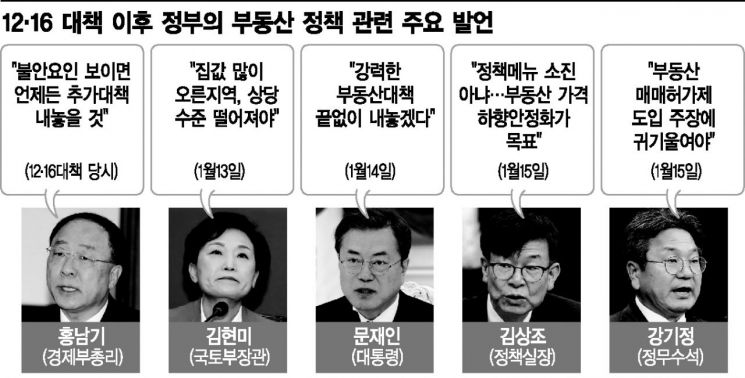
Following President Moon Jae-in's New Year's press conference on the 14th, where he stated, "We will present strong measures until the end," the government's 'verbal intervention' regarding housing prices has become overt.
Not only has the Blue House's Senior Secretary for Political Affairs mentioned the introduction of a housing transaction permit system?a measure that was effectively concluded as 'impossible' even within the government and outside the real estate policy line?but there have also been daily threatening remarks through the media such as "We will drastically lower housing prices in Gangnam," spreading anxiety and fear in the market.
Criticism is emerging in the market that, with the election approaching, real estate is being used as a political tool, putting aside careful and sophisticated policy alternatives.
The first to raise the verbal intervention balloon regarding housing prices was Minister Kim Hyun-mi of the Ministry of Land, Infrastructure and Transport. In an interview with a media outlet on the 13th, Minister Kim stated, "In areas where housing prices have risen significantly, prices need to fall to a considerable extent." This aligns with President Moon's remarks the following day, which mentioned the 'restoration' of housing prices in some areas. Considering that Minister Kim had not responded to any media interviews since her appointment, this was seen as unusual.
The day after the New Year's press conference, Blue House aides also continued to intervene in housing prices. On the 15th, Kang Ki-jung, Senior Secretary for Political Affairs at the Blue House, appeared on a radio program and said, "There are people who think that a real estate transaction permit system should be established for certain areas where prices are rising unreasonably," adding, "This is something our government should consider." On the same day, Kim Sang-jo, Chief of the Blue House Policy Office, also stated in a radio interview, "The goal is to stabilize real estate prices downward," specifically adding, "Stabilizing Gangnam is the primary goal."
The verbal intervention is causing considerable repercussions in the market. On the 16th, various inquiries and critical posts flooded real estate online communities. One post on a real estate community read, "Last week, there was a rumor about a 'fake Ministry of Land, Infrastructure and Transport real estate measure' which included the introduction of an ultra-high-priced housing transaction permit system. Was the rumor actually true?"
Another netizen criticized, "It is absurd to require state permission even to buy and sell privately owned houses. It seems the government is turning real estate issues into political issues ahead of the general election."
Experts are also voicing concerns. They warn that the government's mention of anti-market and ultra-constitutional policies without careful review itself could increase market confusion and fear.
Professor Kwon Dae-jung of Myongji University's Department of Real Estate said, "Among countries that have adopted market economies, none have gone as far as implementing a housing transaction permit system," pointing out, "If such a permit system is implemented, the market will completely collapse." He added, "Article 23, Clause 1 of the Constitution guarantees the property rights of all citizens. If the government regulates what is guaranteed, disputes may arise in the future."
Professor Lee Hyun-seok of Konkuk University's Department of Real Estate also criticized, saying, "It is difficult to find a capitalist country, other than socialist states, that implements a housing transaction permit system."
In particular, the housing transaction permit system is criticized for legally placing housing sales contracts in a state of 'conditional invalidity,' causing market confusion and undermining the stability of private transactions. If the buyer does not obtain permission after the contract is signed, the contract itself becomes retroactively invalid, potentially leading to disputes between parties.
In fact, under the land transaction permit system, which is a similar concept to the housing transaction permit system, even if the transaction balance has been paid, failure to obtain permission results in retroactive invalidation. Furthermore, if permission is not granted while the contract is in a conditionally invalid state, the contract itself becomes void, so claims for damages due to non-performance or penalties for contract cancellation cannot be made between the parties.
An industry official said, "The government, which knows the problems of the housing transaction permit system better than anyone through multiple policy review processes, mentioning it can only be interpreted as an attempt to shake housing prices by stimulating market sentiment," adding, "This is a typical real estate political act."
However, some in the market express cautious views that the actual introduction of the housing transaction permit system is unlikely due to the high risks and backlash. The Participatory Government announced the introduction of the public concept of land in the October 29, 2003 measures and considered this system as part of it, but postponed its introduction due to public opposition and instead implemented the housing transaction reporting system as a compromise.
Since then, the introduction of the housing transaction permit system was carefully reviewed in major real estate measures such as the August 31, 2005 measures, but it was never institutionalized. This was due to considerable public opposition, as it directly controls the exercise of private property rights and infringes on the freedom of residence and movement, which is an ultra-constitutional idea.
Kwon Young-sun, Senior Researcher at the Korea Research Institute for Human Settlements, said, "As multi-homeowners are not putting properties on the market, housing supply is decreasing, and if the housing transaction permit system is introduced, side effects will be significant," adding, "There is also a risk of unconstitutionality, so the actual possibility of introduction is low."
Reporters Inho Yoo and Jae-won Moon sinryu007@
© The Asia Business Daily(www.asiae.co.kr). All rights reserved.
![Clutching a Stolen Dior Bag, Saying "I Hate Being Poor but Real"... The Grotesque Con of a "Human Knockoff" [Slate]](https://cwcontent.asiae.co.kr/asiaresize/183/2026021902243444107_1771435474.jpg)















