Investor Deposit Amounts Significantly Increase Following the December 16 Real Estate Measures
[Asia Economy Reporter Oh Ju-yeon] Expectations for a rise in the domestic stock market have grown this year, leading to an influx of funds into the stock market since the end of last year. In particular, since the announcement of the December 16 real estate measures, which included the expansion of areas subject to the price ceiling system for pre-sale apartments and additional regulations on mortgage loans, the demand for stock purchases has noticeably increased.
According to the Korea Financial Investment Association on the 16th, the monthly investor deposit funds last year showed that at the end of December, investor deposit funds amounted to 27.34 trillion won, a 10.82% increase compared to the previous month (24.67 trillion won). This figure is 17.69% higher than the 23.23 trillion won recorded in August when the KOSPI index plunged intraday to 1891.81, falling below the 2000 mark. Investor deposit funds refer to money that investors have left with securities firms after selling stocks or funds entrusted to buy stocks, classified as funds waiting to be used for future stock purchases. An increase in investor deposit funds means that more money is flowing into the stock market.
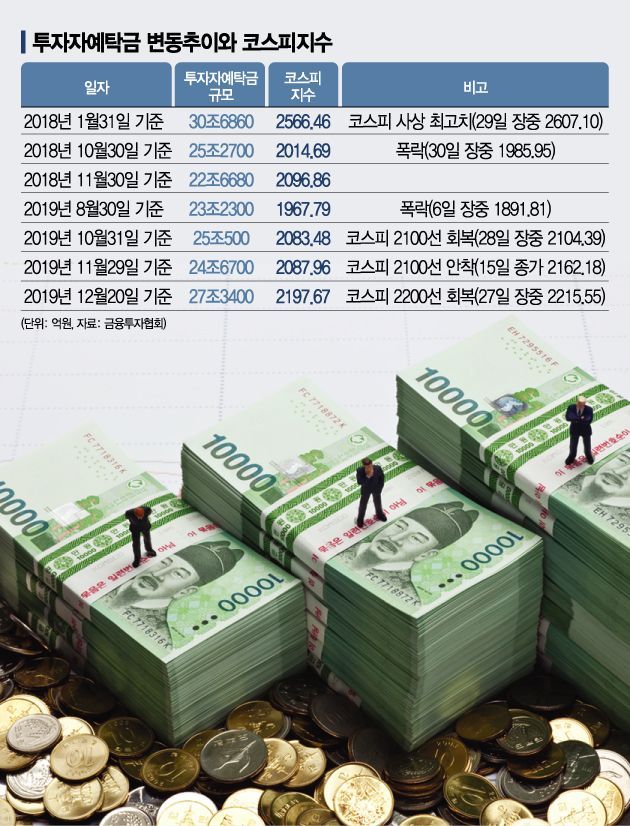
At the end of last year, based on the possibility of a global economic recovery and a strengthened preference for risk assets, each securities firm raised their 2020 KOSPI forecasts to as high as 2400?2500 points, which effectively raised investors' expectations for a stock market rise. Moreover, as the government continuously introduced high-intensity real estate measures to divert funds from real estate to other investment destinations, some investors have been turning their attention to the stock market.
For example, starting from the announcement of the 18th real estate measure on December 16, known as an ultra-strong real estate policy, the daily investor deposit funds increased. In early December, daily investor deposit funds remained in the range of 23 to 24 trillion won. On December 9, the funds were 23.59 trillion won, and on the 13th, 24.95 trillion won. After the real estate measures were announced on December 16, the next day, the 17th, the funds jumped to 25.59 trillion won. Thereafter, the funds stayed above 25 trillion won, reaching 26.74 trillion won on the 24th, a week later, and 28.52 trillion won on the last trading day of the year, December 30. This represents a maximum increase of 20.90% before and after the measures.
This trend has continued into this year. On the 3rd, the funds reached 30.67 trillion won, marking the highest level in the past two years. The daily investor deposit funds surpassed 30 trillion won last in January 2018, when the KOSPI hit an all-time intraday high of 2607.10 on January 29. On the 31st of that month, daily investor deposit funds also recorded 30.686 trillion won.
Positive views on the domestic stock market have persisted this month as well. Seung-bin Cho, a researcher at Daishin Securities, stated, "Currently, the relative strength of the KOSPI compared to emerging market stock indices is at its lowest level since 2008, making valuations relatively attractive. Furthermore, when the relative strength of the KOSPI compared to emerging market indices is at a low level and Korean exports improve, Korea tends to record relatively higher returns compared to emerging markets, so the investment attractiveness of the Korean market is relatively high at this point." Jang-yeol Kim, head of the research center at Sangsangin Securities, forecasted, "The Korean market can rise further due to sensitivity to the increase in semiconductor spot prices. We expect the KOSPI to settle at the 2300 level this spring and anticipate significant gains in the KOSDAQ."
© The Asia Business Daily(www.asiae.co.kr). All rights reserved.
![Clutching a Stolen Dior Bag, Saying "I Hate Being Poor but Real"... The Grotesque Con of a "Human Knockoff" [Slate]](https://cwcontent.asiae.co.kr/asiaresize/183/2026021902243444107_1771435474.jpg)















