With Property Tax Burden Soaring on Homes Over 900 Million Won,
Shift from Monthly Rent to Semi-Jeonse Widens
Only 6 Full Jeonse Listings This Year Among Latest Rentals in Raedaepel
[Asia Economy Reporter Onyu Lim] Mr. Kim, in his 40s, who is living on a lease in an 84㎡ (exclusive area) apartment at Raemian Daechi Palace in Daechi-dong, Gangnam-gu, Seoul, is very worried ahead of his lease renewal in May. The problem is not only that the lease price, which was 1.3 billion KRW at the time of moving in, has surged by 300 million KRW to 1.6 billion KRW in two years, but also that the landlord might suggest switching to a deposit-based monthly rent (so-called banjeonse). The current market rate for banjeonse in the area is a deposit of 1 billion KRW with a monthly rent of around 2 million KRW. Even for Mr. Kim, who works at a large corporation, this amount is by no means easy to bear. Mr. Kim lamented, "I cannot move elsewhere because of my two sons' school."
There is a growing trend among landlords to pass on the increasing burden of high-value property holding taxes, caused by the comprehensive real estate tax rate hike and the realistic adjustment of official property prices, to tenants. Following the surge in lease prices centered around Gangnam after the December 16 real estate measures last year, cases of converting a significant portion of lease deposits into monthly rent have recently been increasing.
According to the real estate brokerage industry on the 16th, in areas such as Daechi-dong in Gangnam-gu and Jamsil-dong in Songpa-gu, there are quite a few complexes where banjeonse listings outnumber full lease listings.
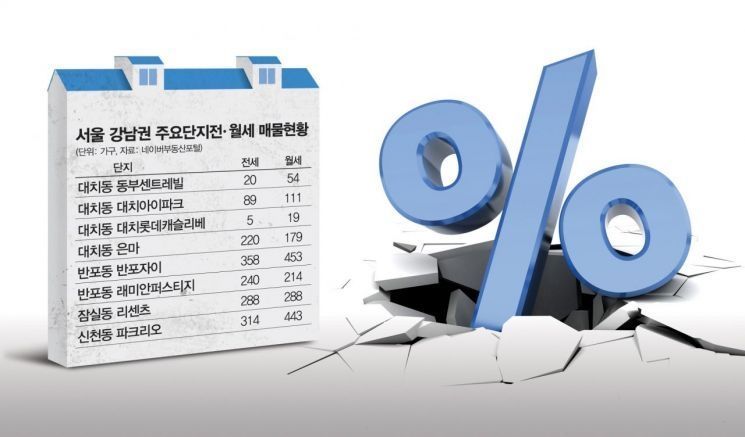
In the case of the 84㎡ exclusive area at Raemian Daechi Palace, out of 20 current lease and monthly rent listings, only 6 were full leases. The remaining 14 listings were all banjeonse properties with deposits ranging from 500 million to 1.1 billion KRW. Depending on the deposit size, monthly rents ranged from as low as 1.5 million KRW to as high as 3.5 million KRW. A representative from R Real Estate in Daechi-dong said, "Recently, there are not many full leases, and the atmosphere is that many are switching to banjeonse. Compared to two years ago, lease prices have risen significantly, but landlords want to keep the deposit the same and collect the difference as monthly rent."
The situation is similar in surrounding complexes in Daechi-dong. Although some listings may overlap, according to listings registered on the Naver Real Estate portal, major complexes such as Dongbu Centreville, Daechi I-Park, and Daechi Lotte Castle Live had more monthly rent listings than full lease listings.
This phenomenon is occurring repeatedly throughout the Gangnam area. A survey of the latest 20 lease and monthly rent listings at Banpo Xi in Banpo-dong, Seocho-gu, and Rescence in Jamsil-dong, Songpa-gu, showed that full lease listings were only 6 and 7, respectively. In Songpa-gu, the number of lease and monthly rent listings at Rescence in Jamsil-dong was equal at 288, while at Park Rio in Sincheon-dong, there were 314 full leases compared to 443 monthly rents.
Regarding this trend, some analysts suggest that concerns about the government's strengthened property holding tax leading to a 'lease shortage and banjeonse expansion' are becoming a reality. In a low-interest-rate environment, if holding taxes increase, landlords find it more advantageous to offer banjeonse with partial monthly rent rather than raising the deposit.
Previously, through the December 16 measures, the government raised the comprehensive real estate tax rates by 0.1 to 0.8 percentage points for owners of high-value homes with official prices above 900 million KRW. For single-homeowners, the comprehensive real estate tax rate increased from 0.5-2.7% to 0.6-3.0%, a rise of 0.1-0.3 percentage points. For owners of three or more homes or two homes in regulated areas, the rate increased from 0.6-3.2% to 0.8-4.0%. The tax burden cap for two-homeowners in regulated areas was raised from 200% to 300%. Meanwhile, the government provided a temporary exit for multi-homeowners to sell their properties by excluding the capital gains tax surcharge until the end of June and applying long-term holding special deductions.
A representative from A Real Estate in Daechi-dong said, "Landlords do not directly say it is because of the holding tax, but the tax burden is a major factor behind the switch to banjeonse."
© The Asia Business Daily(www.asiae.co.kr). All rights reserved.
![Clutching a Stolen Dior Bag, Saying "I Hate Being Poor but Real"... The Grotesque Con of a "Human Knockoff" [Slate]](https://cwcontent.asiae.co.kr/asiaresize/183/2026021902243444107_1771435474.jpg)















