[Asia Economy Reporter Naju-seok] Russian President Vladimir Putin has abruptly proposed a constitutional amendment. Immediately after the announcement of the amendment proposal, the cabinet resigned en masse. There is an interpretation that President Putin is laying the groundwork for permanent rule by elevating himself to the status of 'Gukbu (National Father)'.
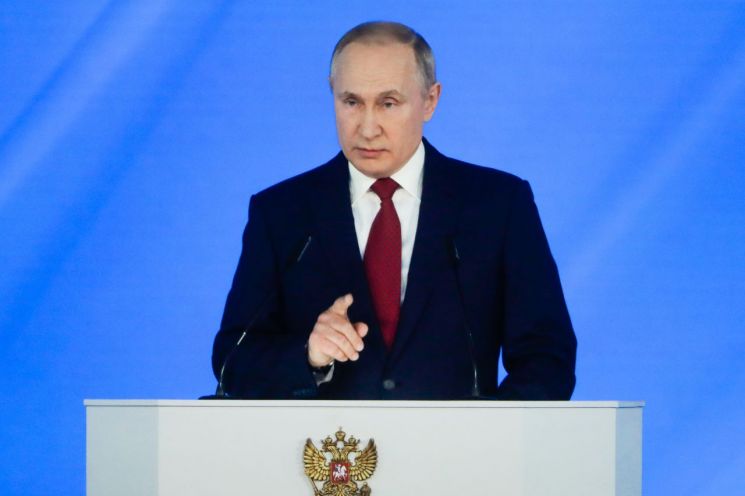
On the 15th (local time), President Putin expressed his intention to pursue constitutional amendments during his state of the nation address to the Russian parliament. The amendment proposal includes reducing the powers of the president, strengthening the prime minister and the parliament, and constitutionally banning the president from serving three consecutive terms.
Immediately after President Putin announced the amendment proposal, the cabinet decided to resign en masse. Russian Prime Minister Dmitry Medvedev expressed his intention to resign, stating, "It is appropriate for the cabinet to resign so that the president can make all necessary decisions."
Just a few hours after the resignation announcement, President Putin nominated Mikhail Mishustin, head of the Federal Tax Service, as the new prime minister and submitted the appointment approval request to the lower house. President Putin said, "I am grateful for everything achieved through cooperation" and "I am satisfied with the results so far." Foreign media viewed the nominee Mishustin as a typical bureaucrat unrelated to President Putin's successor.
The constitutional amendment proposed by President Putin generally contains provisions to strengthen the institutional foundation of democracy. However, experts inside and outside Russia interpret it as a step for President Putin, whose term ends in 2024, to extend his power.
In Russia, it is interpreted that Prime Minister Medvedev, who had shared power with President Putin, lost power due to this resignation. It is reported that Medvedev was offered the position of Deputy Chairman of the Security Council by President Putin. However, it is expected that his future role will be limited.
Foreign media such as The New York Times (NYT) also raised the possibility that President Putin is planning permanent rule, citing the sudden announcement of constitutional amendments and the subsequent resignation of Prime Minister Medvedev.
It is explained that President Putin will choose a way to maintain power while avoiding criticism that he is scheming for lifelong rule by banning three consecutive terms in the constitution. Through the amendment proposal, President Putin, who reaffirmed his intention not to run in the 2024 presidential election, could extend his power by installing a figurehead president like in 2008 and serving as a de facto prime minister.
The inclusion of provisions strengthening the powers of the prime minister and the State Council in the constitution is also related to this. Despite pushing policies that faced popular backlash, such as pension reform, President Putin still enjoys high public support. Therefore, it is judged that he can carry out political operations such as constitutional amendments as he wishes.
Another scenario is that President Putin might follow the example of Nursultan Nazarbayev, who ruled Kazakhstan for 30 years, by stepping down as the official head of state but being honored as a national father or similar figure. Although he would have no official power, he could continue to exercise actual control.
Nazarbayev announced his sudden resignation from the presidency but continues to hold power by serving as the 'Leader of the Nation' and chairman of the Security Council.
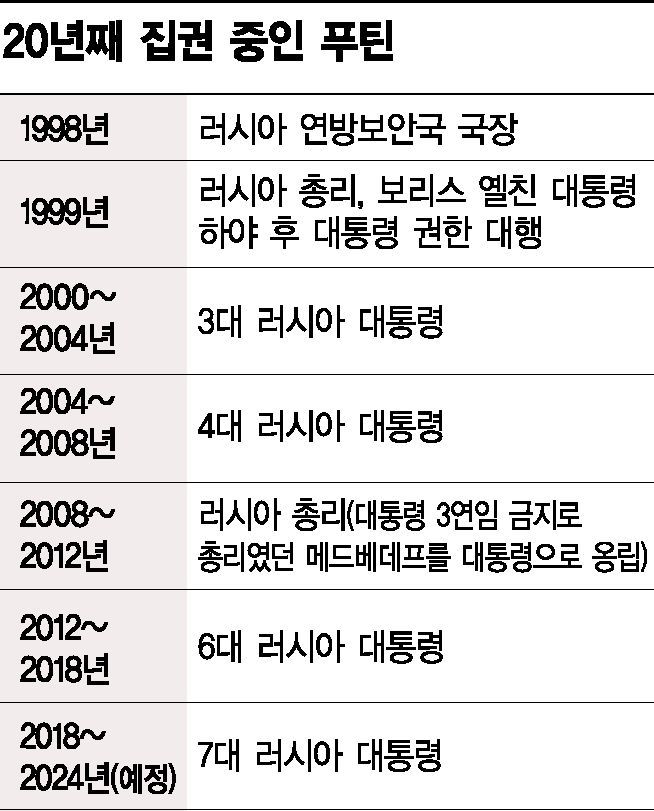
President Putin maintained power for a long time by partnering with his close aide, Prime Minister Medvedev. He served two consecutive presidential terms from 2000 to 2008 but was barred from a third consecutive term, so he nominated Medvedev as the next presidential candidate and took the prime minister position himself. Even while serving as prime minister, Putin effectively remained the real power in Russia. Putin ran again in the 2012 presidential election and was elected president for a six-year term. Since then, President Putin has consistently appointed Medvedev as prime minister. President Putin also won the 2018 presidential election and can remain in power until 2024.
Opposition politician Leonid Volkov said on social media, "It is clear that everything points to President Putin's lifelong rule."
© The Asia Business Daily(www.asiae.co.kr). All rights reserved.
![Clutching a Stolen Dior Bag, Saying "I Hate Being Poor but Real"... The Grotesque Con of a "Human Knockoff" [Slate]](https://cwcontent.asiae.co.kr/asiaresize/183/2026021902243444107_1771435474.jpg)
















