Friction Surrounding Trauma Centers Treating Severe Trauma Patients Has Persisted for Years
Trauma Centers Struggle with Staffing Despite Support Budgets
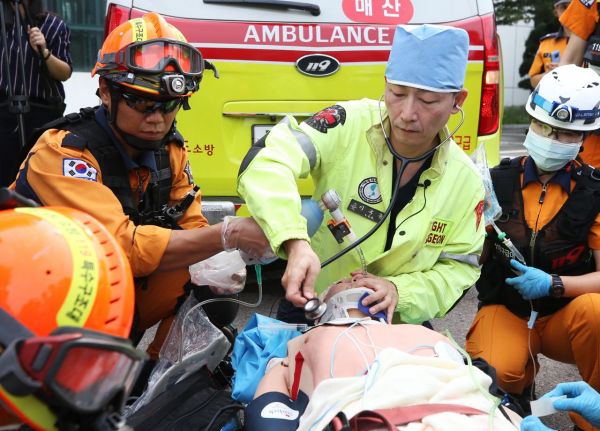 In August last year, Lee Guk-jong, Director of the Gyeonggi Southern Trauma Center, is providing emergency treatment during a comprehensive simulation training for emergency medical helicopters held at the Gyeonggi Provincial Government Office in Suwon, Gyeonggi-do.
 [Asia Economy Reporter Choi Dae-yeol] "Severe trauma centers that don't generate profit should be the responsibility of the state, not the private sector." "We petition for the establishment of a trauma treatment hospital specializing in Lee Guk-jong."
As the conflict between Professor Lee Guk-jong of Ajou University Hospital and the hospital itself has erupted, the trauma-dedicated treatment center at the heart of this conflict is also suffering. These petitions posted on the Blue House National Petition Board have garnered support from about 3,000 and 5,000 people respectively as of the morning of the 16th. After returning from training with the Navy the previous day, Professor Lee continued sharp criticism of the hospital’s attitude, and it is expected that health authorities will inevitably have to reconsider the overall operation system of trauma centers.
◆ Trauma Mortality Rate Higher than in the U.S. and Japan = A trauma center refers to a specialized treatment center equipped with facilities, equipment, and personnel capable of providing appropriate emergency surgery and treatment for severe trauma patients who suffer from multiple fractures, organ damage, or excessive bleeding due to sudden external shocks such as traffic accidents or falls. The country is divided into 17 regions for operation. Currently, 14 centers are in operation, with Jeju and Gyeongnam scheduled to open additional centers this year.
While emergency medical facilities broadly handle acute myocardial infarction, stroke, infectious diseases, and more, trauma centers specialize specifically in severe trauma. Since trauma patients can arrive at any time, medical staff are always on standby, and emphasis is placed on cooperation during patient transport before arrival and interdisciplinary collaboration within the hospital.
Interest in trauma centers increased when Professor Lee treated Captain Seok Hae-gyun, who was critically wounded by gunshot during the 2011 Aden Bay rescue operation. Professor Lee also treated a North Korean soldier who defected in 2017. Although cancer is the leading cause of death among Koreans overall, trauma is the leading cause of death among those under 45 years old.
Regarding the preventable trauma mortality rate, which indicates how well the treatment system for severe trauma patients is established, South Korea’s rate was 19.9% as of 2017, about 10 percentage points lower than two years prior. This indicator shows the likelihood that severe trauma patients would have survived if they had been transported and treated promptly. In other words, about 2 out of 10 patients who died could have survived if moved quickly and treated in time. Major advanced countries such as the U.S. and Japan have rates around 15%, lower than South Korea’s.
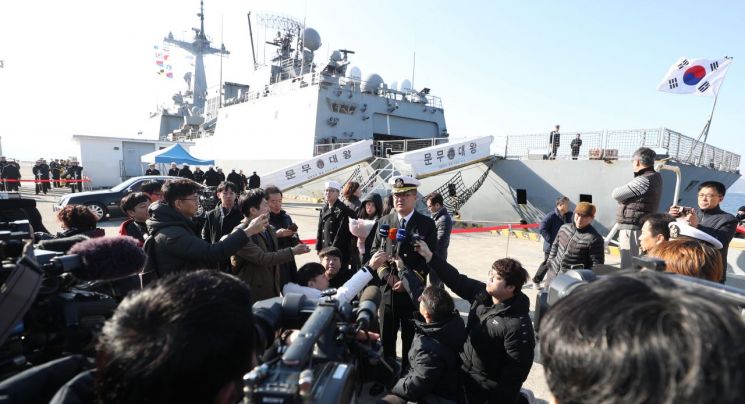 On the 15th, at the naval port in Jinhae District, Changwon City, Gyeongnam, during the arrival ceremony of the Navy's cruising training squadron, reporters asked a Navy official questions regarding Professor Lee Guk-jong of Ajou University. It was reported that the professor did not face the press that day but met with Captain Seok Hae-gyun, whom he had treated in the past.
 ◆ This Year’s Budget Reduced Compared to Last Year’s 62.2 Billion KRW = As awareness of the importance of trauma centers has spread, policy support has increased accordingly, but difficulties faced by frontline medical sites remain. This is because the field is highly demanding and even medical staff tend to avoid it. According to the Ministry of Health and Welfare, the budget allocated this year to support the operation of regional trauma centers is 58.1 billion KRW, about 7% less than the same period last year.
This is not due to a decreased need for the project but because a significant portion of the budget, which is used to hire dedicated specialists, has not been smoothly utilized, resulting in many unused funds over the past several years. The budget for supporting regional trauma center operations was 33.4 billion KRW in 2016, but the actual expenditure was 24.7 billion KRW, with an execution rate of only 74%. The execution rate has steadily declined, reaching only 61% in 2018.
There is also controversy over how to use limited hospital resources such as medical staff and beds. A representative from a university hospital said, "It is entirely correct that trauma centers should focus on sudden trauma patients, but by preventing trauma center staff from performing other duties, in some centers the number of surgeries performed by surgeons has decreased to only a few dozen per year, raising concerns that the quality level may decline."
© The Asia Business Daily(www.asiae.co.kr). All rights reserved.
![Clutching a Stolen Dior Bag, Saying "I Hate Being Poor but Real"... The Grotesque Con of a "Human Knockoff" [Slate]](https://cwcontent.asiae.co.kr/asiaresize/183/2026021902243444107_1771435474.jpg)

















