Resolution of External Risks and Reduction of Uncertainty Positive for Financial Markets
Limited Impact Expected in Trade Sector
China Increasing Imports of US Manufactured Goods May Reduce Imports from Other Countries
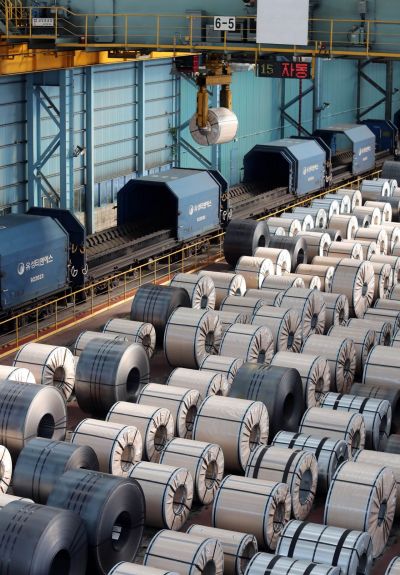
Steel and Machinery Sectors with High Exposure to China Expected to be Affected
[Asia Economy Reporters Eunbyeol Kim and Bokyung Kim] The truce in the US-China trade war is viewed positively for the South Korean economy in terms of "resolving external risks." The financial markets, which had been volatile due to the trade war, are expected to stabilize, and the rebound in global trade volume could positively impact exports. However, there is also analysis suggesting that overly optimistic expectations in the trade sector should be avoided. Since China has agreed to increase imports of US products, it cannot be ruled out that imports of products from other countries may decrease.
On the 16th, Joo Won, Director at Hyundai Research Institute, stated, "The Phase 1 US-China trade agreement removes external negative factors, which is expected to have a positive effect on the financial markets." However, he also forecasted that the trade agreement could be negative for the trade sector. According to the agreement released by the US Trade Representative (USTR), the increased imports from China include not only agricultural products but also manufactured goods, energy, and services across the board. In particular, the increase in imports of US manufactured goods could deal a blow to South Korea. China has agreed to additionally import manufactured goods worth $32.9 billion (approximately 38 trillion KRW) this year and $44.8 billion next year, totaling $77.7 billion. The imported items include industrial machinery, electrical equipment, automobiles, optical medical devices, steel, and aviation. South Korea has a high export share to China in steel and machinery products.
Joo said, "There are positive effects on the financial markets and negative effects on the trade sector, and it is currently unclear which will have a greater impact," adding, "In the short term, the impact on the trade sector is expected to be greater."
Moon Byung-ki, Senior Researcher at the Korea International Trade Association, said, "It is good news that tensions have eased as both countries made concessions," adding, "It will have a positive effect on preventing the spread of protectionism, recovering semiconductor prices, and boosting corporate investment." However, Moon also expressed concerns about South Korea's exports to China. He analyzed, "The increase in Chinese imports of manufactured goods could result in a substitution from Korean products to US products." Professor Jung In-gyo of Inha University said, "The US-China trade agreement has complex implications for our exports," explaining, "While the normalization of US-China relations could stabilize exports to China, if China starts using US machinery and equipment, it will negatively affect exports to China."
This analysis sparked controversy when the International Monetary Fund (IMF) released a related report in November last year. At that time, the IMF estimated that if China expands imports of ten major items including electronics, machinery, and automobiles from the US, South Korea's exports could decrease by about $46 billion (53 trillion KRW). The South Korean government rebutted this, stating, "It is based on a hypothetical scenario analysis and is unlikely to materialize."
Additionally, with the trade agreement in place, Asian currencies including the yuan are likely to strengthen simultaneously, which is another factor to watch. Kim Sung-taek, Deputy Director of the International Finance Center, said, "(The trade agreement) will contribute somewhat to the global economic recovery, but the issue is the exchange rate," adding, "We need to monitor the negative effects on exports when the won-dollar exchange rate weakens." On the same day, the People's Bank of China set the yuan-dollar central parity rate at 6.8807 yuan, down 0.06% from the previous day (indicating a rise in the yuan's value). However, in the Seoul foreign exchange market, the won-dollar exchange rate opened at 1,159.5 won, up 2.5 won, and continued to rise.
© The Asia Business Daily(www.asiae.co.kr). All rights reserved.
![Clutching a Stolen Dior Bag, Saying "I Hate Being Poor but Real"... The Grotesque Con of a "Human Knockoff" [Slate]](https://cwcontent.asiae.co.kr/asiaresize/183/2026021902243444107_1771435474.jpg)
















