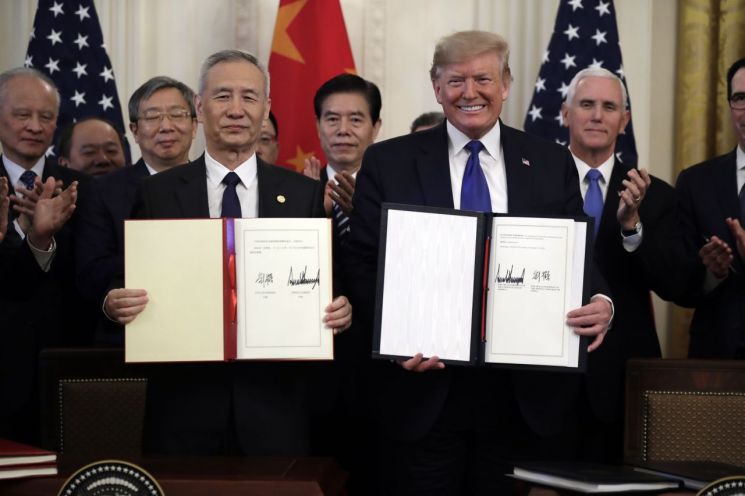
[Asia Economy New York=Correspondent Baek Jong-min] The long-awaited Phase One trade agreement signaling a truce in the US-China trade dispute that has threatened the global economy for the past two years has finally been reached. The agreement, which satisfied both leaders, is being evaluated as having removed a major source of global economic uncertainty.
On the 15th, US President Donald Trump signed the Phase One trade agreement at the White House together with Vice Premier Liu He. The signing was completed about a month after both sides officially announced the agreement on December 13 last year, finalizing the deal.
This agreement is effectively the first accord between the US and China, who had been engaged in a full-scale trade war, and is significant in that it established a truce to prevent further escalation. The opacity that had loomed over the global economy is also expected to ease somewhat.
Both leaders gave high praise to the agreement. In particular, President Xi Jinping mentioned in a letter to President Trump, read aloud by Vice Premier Liu He, that "the US-China agreement is good for the world." This is interpreted as an acknowledgment of the negative impact the US-China conflict has had on the global economy.
The Phase One agreement, reportedly about 86 pages long, includes China’s commitment to purchase large volumes of US products, including agricultural goods, while the US agreed to withdraw planned additional tariffs on China and reduce tariff rates on some existing products. It also contains provisions addressing intellectual property protection, prohibition of forced technology transfer, and currency manipulation?issues the US had persistently raised. This represents significant concessions by China in areas where US companies have strong competitiveness.
China’s promise to ease US companies’ access to its financial markets is another important point. This could provide an opportunity for highly competitive US financial firms to expand their presence in China. Additionally, China’s commitment to halt artificial depreciation of the yuan is a considerable achievement for the US.
According to foreign media, China has agreed to purchase an additional $200 billion (approximately 231.7 trillion KRW) worth of US products over the next two years in sectors including agriculture, manufactured goods, services, and energy. Specifically, this includes $37.9 billion in services, $77.7 billion in manufactured goods, $32 billion in agricultural products, and $52.4 billion in energy.
China’s plan for US agricultural purchases is $12.5 billion in the first year and $19.5 billion in the second year. In 2017, China purchased $24 billion worth of US agricultural products; with the additional $32 billion over two years, the average annual purchase over two years will be about $40 billion.
The US will not impose tariffs on $160 billion worth of Chinese products that were initially scheduled to be taxed starting December 15 last year. The 15% tariff on another $120 billion worth of Chinese goods will be reduced to 7.5%. However, the 25% tariff on $250 billion worth of Chinese products will remain unchanged. President Trump expressed hope that tariffs could be lifted if a Phase Two trade agreement is reached.
Bloomberg reported that China will submit an "action plan" within 30 days after the agreement takes effect to implement the agreed terms.
The issue of subsidies to Chinese state-owned enterprises was not included in this agreement and is expected to be addressed in the upcoming Phase Two agreement.
A dispute resolution mechanism for non-compliance was also established. The agreement stipulates that if a violation is determined, there will be 90 days of consultations at working and senior levels, and if unresolved, the authority to reimpose tariffs is granted.
Robert Lighthizer, the US Trade Representative and head of the US high-level negotiation team, told reporters that in the short term, the focus will be on implementing the Phase One agreement, with further negotiations to begin afterward.
However, the Phase Two agreement is expected to include more detailed provisions on structural issues such as intellectual property protection, forced technology transfer, and subsidies, making it potentially a more difficult path than Phase One.
This implies that there remains a possibility of waves that could once again shake the global economy during the negotiation process.
© The Asia Business Daily(www.asiae.co.kr). All rights reserved.
![Clutching a Stolen Dior Bag, Saying "I Hate Being Poor but Real"... The Grotesque Con of a "Human Knockoff" [Slate]](https://cwcontent.asiae.co.kr/asiaresize/183/2026021902243444107_1771435474.jpg)











