Asia Economy & Seoul City Joint Project [Work-Life Balance 2.0 Era]
'Work-Life Balance Strong Small Business' How Work and Life Changed - Medical Device Company 'SNJ'
Actively Introducing Work-Life Balance Systems Such as 30-Minute Staggered Commuting
CEO Jang Tae-hee "Stable Life Leads to Work Efficiency... Felt the Need for Change"
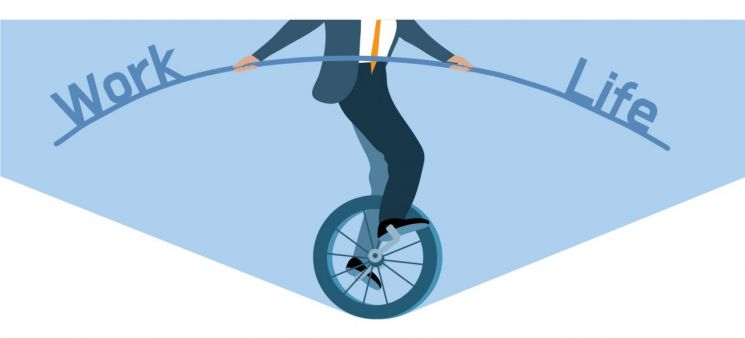
Work-life balance (WLB) is a core value that sustains companies, employees, and broadly, our society. Moving beyond merely recognizing the importance of WLB, the phase where it is practiced and integrated into daily life is what we call 'WLB 2.0.' However, it is not as easy as it sounds. Especially for business owners running small and medium enterprises, questions like 'Where should I start?' 'What do employees really want?' and 'Will it be too burdensome for management?' often make it difficult to take the first step. That’s why Asia Economy and Seoul City will assist you. Through the year-round 2020 campaign, WLB 2.0, we introduce one company each month that has excellent systems and culture. These companies have experienced creating something out of nothing through consulting from the Seoul Foundation of Women & Family’s Work-Life Balance Support Center. They share vivid experiences on how they became 'WLB Strong Small Businesses' and how they overcame challenges along the way. Sometimes from the perspective of management, sometimes from employees, you can directly see the positive effects and productive outcomes WLB has had on their lives.
[Asia Economy Reporter Hyunju Lee] Jung Yunho (46), a father of two children. Accompanying his elementary school-aged first child to school is his responsibility. After the birth of his youngest child, he took over this role from his wife. "When the younger sibling was born, I thought the older child might have psychological difficulties. When I take him to school, we have one-on-one conversations that help us navigate those issues more smoothly."
The time Jung and his child arrive at school is 8:30 a.m. After watching his child run eagerly toward the school gate through the car window, Jung heads to work. He arrives at the company at 9:30 a.m. The 'legally permitted 30-minute tardiness' is thanks to the company’s WLB system, known as the 'flexible working hours system.' This system allows employees to set their own start and end times in 30-minute increments. For example, if you start work at 9:30 a.m., you leave at 6:30 p.m.; if you start at 10 a.m., you leave at 7 p.m. The company Jung works for is neither a public enterprise nor a large corporation. It is 'SNJ,' a medical device manufacturer located in Guro-gu. The company has a total of 22 employees.
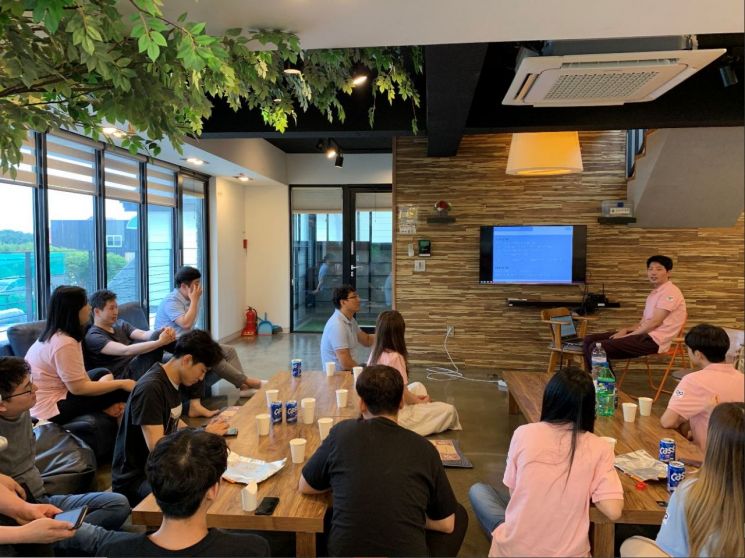
Jang Taehee, CEO of SNJ, a medical device manufacturer equipped with a somewhat 'impressive' WLB system despite its size, said, "Since the average age of employees is just over 30, we realized that individuals value their personal lives as much as their wages. It is actually the most difficult task for small and medium enterprises to retain talented employees for a long time, but by actively adopting WLB systems, we have been able to achieve results in this area, which I am grateful for."
The urgency to introduce WLB systems stemmed largely from CEO Jang’s desire to grow the company further. After witnessing employees resigning one after another during the three years following his appointment in 2015, he deeply felt the importance of long-term employment. His thinking quickly led to the importance of 'rest' for improving productivity. "As a manager, I think doing a good job is important, but I also believe my own life is important. I know well that a stable life leads to work efficiency. It must be the same for employees. Ultimately, change was necessary to improve efficiency."
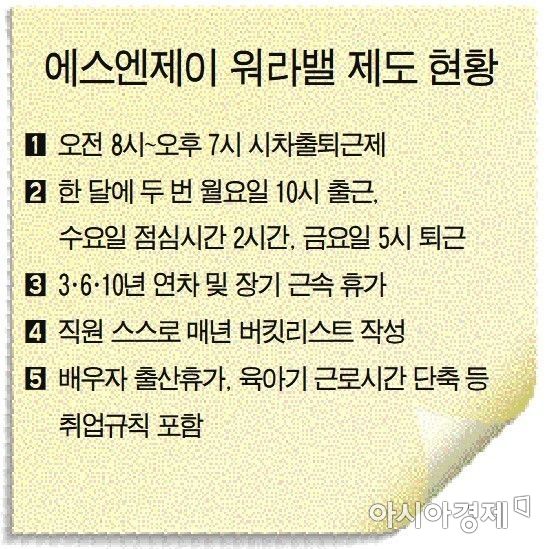
Currently, SNJ’s working hours are 40 hours per week, but employees who have experienced 'reduced working hours and increased work efficiency' believe that a 30-hour workweek could soon be implemented. Instead of reducing the number of employees, they increased the workforce. The additional employment was supported by the Employment Creation Incentive Program. Last year, seven new employees joined, the highest number since the company’s founding.
Employee satisfaction naturally increased. Jung Eunkyung (28), in her second year at the company, said, "With more free time, many employees have started exercising or learning English." All four of her colleagues who joined at the same time are still working at the company. Kim Geunyeong (28), who works in the development team, said, "It takes an hour to get from the company to my home, but thanks to the flexible working hours system, I can commute by subway more comfortably. Since each team sets its monthly schedule, there is no loss of manpower."
Utilizing Employment Creation Incentive Program, Reducing Work Hours and Increasing Staff
Employee Satisfaction Naturally Improves: "Free Time Used for Learning English and Exercising"
Employees also create 'bucket lists' annually during workshops. Since 2016, the accumulated lists have included ten items such as company-wide incentives and a 3-day, 2-night workshop in Jeju Island. Among these, the introduction of flexible working hours and focused work time systems have been implemented in reality. Production worker Go Dongyeon (28), who has been with the company for three years, considered changing jobs due to the 1.5-hour commute but overcame the crisis by effectively using the system. The proportion of long-term employees (3 to 6 years) at SNJ has risen to about 40%.
Jung, the 'late-born father,' said, "What really matters is concentration rather than simply working long hours." He added, "If communication among employees is possible using various technologies and devices, an environment free from constraints of time and place is more efficient." He also said that his decision to have a second child was greatly influenced by the company’s culture that values WLB. Jung said, "Of course, I think the company cannot take full responsibility for everything, but I believe that if the government strongly promotes policies such as expanding public childcare centers, it can create a synergy effect with corporate WLB systems."
© The Asia Business Daily(www.asiae.co.kr). All rights reserved.



















