[Asia Economy Reporter Jeong Hyunjin] The United States, the European Union (EU), and Japan have joined forces to curb China's industrial subsidy issues. They agreed to collectively raise their voices for strengthening the World Trade Organization (WTO)'s subsidy prohibition regulations. This move appears to be the U.S. taking the lead in pressuring the subsidy issue, which was not included in the Phase One U.S.-China trade agreement.
According to the U.S. Trade Representative (USTR) and others on the 14th (local time), USTR Representative Robert Lighthizer, EU Trade Commissioner Phil Hogan, and Japan’s Minister of Economy, Trade and Industry Hiroshi Kajiyama met in Washington DC and issued a joint statement reflecting this content. They discussed and agreed on the need to strengthen the WTO’s industrial subsidy prohibition regulations.
They argued that the current prohibited subsidy items stipulated in Article 3, Paragraph 1 of the Agreement on Subsidies and Countervailing Measures (ASCM) are insufficient to prevent market and trade distortions, and that the scope of prohibited subsidies should be expanded in the ASCM. Subsidies to be added to the ASCM include subsidies related to overcapacity industries and failing enterprises, unlimited guarantees, and direct debt forgiveness. Currently, export subsidies and domestic product preference subsidies are designated as prohibited. The three trade chiefs also expressed concerns about excessively large subsidies and subsidies that help uncompetitive companies exit the market. They emphasized that it must be explained that there are no seriously negative issues caused by subsidies in trade and that transparency is essential.
This agreement is widely interpreted as a measure targeting China. The issue of China’s industrial subsidies is known to be a key agenda item in the Phase Two U.S.-China trade negotiations. The U.S. initially sought to include subsidy support for China’s state-owned enterprises in the Phase One trade agreement, but it was scrapped due to China’s opposition.
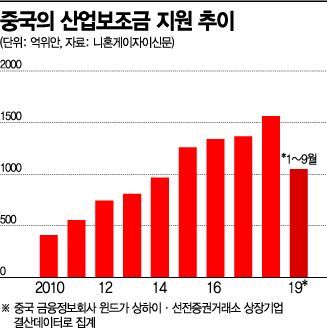
The Nihon Keizai Shimbun cited financial information company Wind’s data compiled from the financial statements of companies listed on the Shanghai and Shenzhen Stock Exchanges, reporting that China’s industrial subsidies doubled from 156.2 billion yuan (approximately 26.3 trillion KRW) in 2013 to 156.2 billion yuan in 2018. Last year, over 90% of the 3,748 Chinese companies surveyed received subsidies. Foreign media pointed out that although WTO member countries are required to report subsidy items under the agreement, China hardly reports them.
The Nihon Keizai Shimbun stated, "Although the U.S. and China will sign the Phase One trade agreement document on the 15th, the issue of China’s excessive subsidies has been postponed to Phase Two," adding, "To pressure China to resolve structural problems, it is necessary for not only the U.S. but also Japan and Europe to coordinate their pressure."
They are expected to try to persuade other countries to join ahead of the WTO Ministerial Conference in June, but it is uncertain whether substantial results will be achieved. This is because backlash from emerging countries including China is anticipated, and trade friction issues between the U.S. and the EU remain unresolved.
The EU is concerned that the U.S., having reached a Phase One trade agreement with China, might unleash a tariff barrage on Europe. Since the inauguration of U.S. President Donald Trump in 2017, the EU and the U.S. have clashed over various trade issues. Phil Hogan, the EU Commissioner visiting Washington DC for the first time since the new EU Commission took office, plans to hold discussions not only with Representative Lighthizer but also with U.S. Commerce Secretary Wilbur Ross and Treasury Secretary Steven Mnuchin.
According to the Wall Street Journal (WSJ) and others, before his visit to the U.S., Hogan expressed his intention by saying, "Relations with the U.S. are facing difficulties," and "We will attempt to reset trade relations between the EU and the U.S." The U.S. has threatened retaliatory tariffs in response to France’s digital tax imposed since last year. Additionally, trade conflicts between the two countries over subsidies to aircraft manufacturer Airbus continue, and efforts are expected to be made to resolve these issues.
© The Asia Business Daily(www.asiae.co.kr). All rights reserved.
![Clutching a Stolen Dior Bag, Saying "I Hate Being Poor but Real"... The Grotesque Con of a "Human Knockoff" [Slate]](https://cwcontent.asiae.co.kr/asiaresize/183/2026021902243444107_1771435474.jpg)
















