Ministry of Health and Welfare, MFDS, and Related Ministries Announce Joint Biohealth Regulatory Improvement Plan
Guidelines for Medical Data Utilization and Human-Derived Research Resources to Be Established Within the Year
 A participant in Samsung Electronics' VR therapy experiment "Be Fearless" is wearing the HMD "Gear VR" to treat acrophobia through a virtual environment. The small screen at the bottom left shows the virtual environment displayed in VR.
[Asia Economy Reporter Choi Dae-yeol] Pscious, a healthcare company operating based in Spain and the United States, develops virtual and augmented reality (VR/AR) platforms for psychological treatments including acrophobia, flight phobia, agoraphobia, and claustrophobia. The method involves allowing patients who fear specific situations to indirectly experience them through VR software and devices, while medical professionals monitor the patient's viewed images in real time to find appropriate treatment methods.
The government has decided to designate and manage such VR/AR technology-based cognitive behavioral therapy software and other convergent medical device technologies as separate medical device categories to promote their development. While these are already approved and managed as medical devices in various countries overseas, the domestic industry requested this measure due to a lack of related legal grounds in Korea, which causes difficulties in exporting abroad.
Although some domestic entities are planning related software or platforms, the perception of these as medical devices is still lacking. This field has been active overseas for several years. For example, the BraveMind program developed at the University of Southern California was created to treat soldiers suffering from post-traumatic stress disorder (PTSD) due to war experiences. Experts such as medical staff interpret the biological responses patients exhibit when exposed to virtual environments and use them for psychological treatment. Some companies also utilize VR/AR for surgical support, educational programs, or rehabilitation such as brain injury recovery.
The Ministry of Health and Welfare, the Ministry of Food and Drug Safety (MFDS), the Ministry of Trade, Industry and Energy, and other related ministries announced a biohealth regulatory improvement plan including these contents on the 15th. According to the improvement plan decided at the Innovation Growth Strategy Meeting chaired by Deputy Prime Minister Hong Nam-ki, guidelines for medical data utilization will be prepared in the second half of this year. Interest in medical data utilization has increased following the passage of the Data 3 Act, which facilitates the use of pseudonymized information, by the National Assembly on the 9th, but there is currently no specific procedure or method, which could cause confusion.
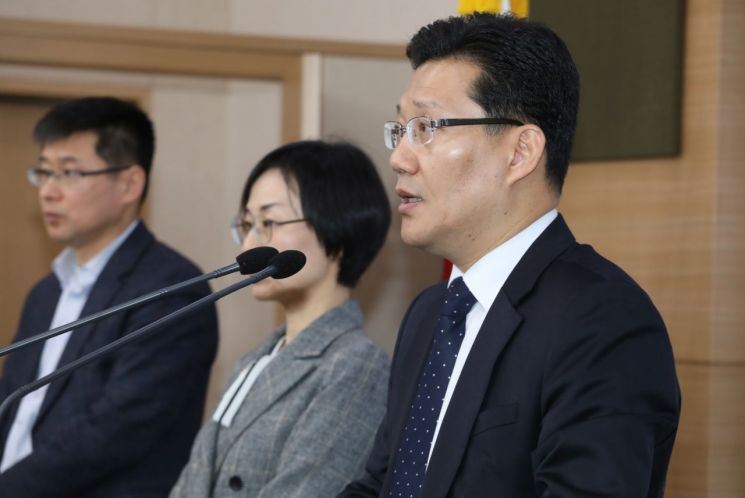 On the 15th, Lim In-taek, Director of the Health Industry Policy Bureau at the Ministry of Health and Welfare, is speaking at the joint briefing of related ministries on the 'Core Regulatory Improvement Measures for Biohealth' held at the Seoul Government Complex Annex in Jongno-gu, Seoul.
 The guidelines will include pseudonymization procedures, necessary security measures, the process of utilizing pseudonymized information or transferring it to third parties such as companies, and requirements for utilization. The guidelines are expected to be introduced as early as the third quarter of this year, along with the establishment of a comprehensive strategy related to medical data utilization. Lim In-taek, Director of the Health Industry Policy Bureau at the Ministry of Health and Welfare, said, "Domestic hospitals possess vast amounts of medical data, but legal grounds for pseudonymization and other privacy protection measures are insufficient, and data can only be used for public interest research, making it difficult to utilize for rare and intractable disease treatments or innovative medical device development. We plan to establish guidelines including pseudonymization and security procedures in the medical field in the second half of this year to expand medical data utilization."
The Waste Management Act will be revised within this year to allow recycling of human adipose tissue, which includes stem cells and is highly useful in pharmaceutical development fields. The government expects this to aid clinical trials of pharmaceuticals and medical research. As research demand increases for new types of human-derived research resources such as gut microbiomes and organoids?cell aggregates cultured from stem cells that resemble human organs?guidelines for Institutional Review Board (IRB) review will also be prepared. A new title of Bio Master (tentative) will be established, focusing on fields requiring expertise such as bio-production process management, to encourage the training of specialized personnel.
Additionally, the system will be improved to expedite the review of medical devices incorporating advanced technologies such as artificial intelligence (AI) diagnostic imaging devices. The innovative medical technology evaluation track, which allows market entry by recognizing potential value even if efficacy evaluation data is somewhat insufficient, will be applied to a wider range of technologies and diseases. The scope of direct-to-consumer (DTC) genetic testing will be expanded, and demonstration special cases for disease prediction testing will be actively promoted.
© The Asia Business Daily(www.asiae.co.kr). All rights reserved.
![Clutching a Stolen Dior Bag, Saying "I Hate Being Poor but Real"... The Grotesque Con of a "Human Knockoff" [Slate]](https://cwcontent.asiae.co.kr/asiaresize/183/2026021902243444107_1771435474.jpg)
















