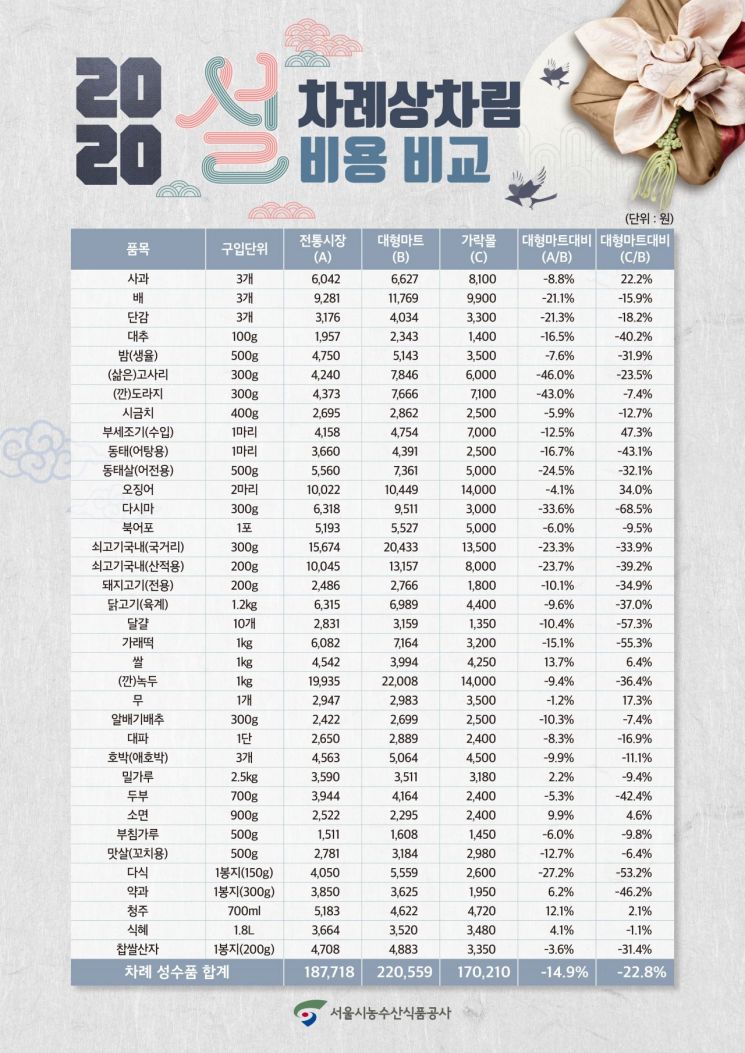
Seoul Agro-Fisheries & Food Corporation Announces Lunar New Year Table Setting Cost Survey for 50 Seoul Traditional Markets and 25 Large Mart Locations Including Garak Market (Garak Mall) (Simplified Criteria)... Average Purchase Cost for a Family of 6-7 is 187,718 KRW at Traditional Markets, 220,559 KRW at Large Marts, Making Traditional Markets 15% Cheaper
[Asia Economy Reporter Jong-il Park] Seoul Agro-Fisheries & Food Corporation (President Kim Kyung-ho) conducted and announced a survey on the cost of setting up a traditional Lunar New Year table in 2020 at a total of 76 locations, including 25 traditional markets across Seoul's districts, large supermarkets, and Garak Mall within Garak Market, to provide helpful information for economical Lunar New Year preparations.
On the 7th, 25 members of the Seoul Price Survey Monitoring Team visited 50 traditional markets in Seoul (2 per district) and 25 large supermarkets (1 per district) in person to investigate the retail prices of major Lunar New Year seasonal products.
Since 2017, the corporation has been reflecting the trend of gradually simplified ceremonial table settings by consulting with the Korea Traditional Food Research Institute and conducting surveys among Seoul citizens (67% responded they intend to simplify), adjusting the survey units of some items to better fit reality.
Reflecting the simplification trend, the survey of 36 major items in high demand during Lunar New Year (based on a family of 6-7 members) showed that the purchase cost at traditional markets was 187,718 KRW, a 5.4% increase from the previous year; at large supermarkets, it was 220,559 KRW, a 1.6% decrease from the previous year. This year, traditional markets remained about 15% cheaper than large supermarkets.
In traditional markets, vegetables such as radish, small napa cabbage (albaegibaechu), and green onions saw relatively large price increases, and some seafood and processed foods like squid and tofu also rose. However, most fruits such as apples, pears, and persimmons decreased in price.
In large supermarkets, some vegetables like radish and small napa cabbage and some seafood like squid increased in price, but most processed foods such as dasik (traditional Korean sweets), yakgwa (honey cookies), and cheongju (clear rice wine), as well as some fruits like apples and pears, decreased.
Meanwhile, the purchase cost at Garak Mall located in Garak Market was 170,210 KRW, which was 9% and 23% lower than traditional markets and large supermarkets, respectively.
Regarding the supply and price outlook for agricultural and marine products this Lunar New Year (based on Garak Market), apples are expected to show a slight downward trend due to an overall increase in production volume and quality decline.
Consumer preference for some high-quality production areas is clearly emerging, so significant price differences by region are expected.
Pears are forecasted to experience an overall price decline due to increased stock from the previous year, quality deterioration, and an early Lunar New Year.
Napa cabbage and radish are expected to maintain strong prices due to decreased supply caused by reduced cultivation area of overwintering napa cabbage and lower quantities compared to the previous year.
Pollock and dried pollock are expected to maintain strong prices due to decreased imports of frozen Russian pollock and Lunar New Year demand, but the price increase is expected to be limited due to government stock releases. Squid is also expected to maintain strong prices due to decreased catch volume and Lunar New Year demand.
Considering the high price volatility of Lunar New Year seasonal products, the corporation plans to provide continuous updates on major item price indices and transaction trends on its website (www.garak.co.kr) until before the Lunar New Year.
© The Asia Business Daily(www.asiae.co.kr). All rights reserved.
![Clutching a Stolen Dior Bag, Saying "I Hate Being Poor but Real"... The Grotesque Con of a "Human Knockoff" [Slate]](https://cwcontent.asiae.co.kr/asiaresize/183/2026021902243444107_1771435474.jpg)















