Government Shifts from Planned Blackouts to Hydropower and Renewables
Most Benefits Likely to Go to Chinese Companies... Rapid Expansion of Power Demand in ASEAN Region
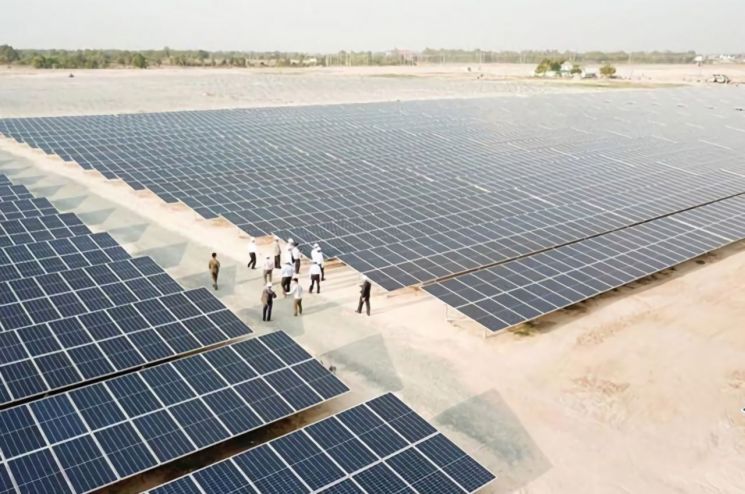 ▲The second solar power plant in Cambodia, Kampong Speu Province power plant. The scale is 60MW class. Photo by Cambodia National Electricity (EdC)
[Asia Economy Phnom Penh, Guest Reporter Ang Gil-hyun] Southeast Asian nations, including Cambodia, members of the Association of Southeast Asian Nations (ASEAN), are accelerating efforts to expand renewable energy.
On the 23rd of last month, the Cambodian parliament passed a bill guaranteeing investment costs and electricity purchase for four solar power plant projects totaling 140 MW (megawatts). These projects, with a total investment of $135 million, will be carried out under a Build-Own-Operate (BOO) model, where the private sector finances, constructs, owns, and operates the plants, and are expected to start producing electricity by the end of this year. Electricity will be purchased by the Cambodia Electricity Authority (EdC) at 7.6 cents per kilowatt (approximately 82 KRW).
Until now, Cambodia had shown little interest in renewable energy. The only renewable energy facility was a single 10 MW solar power plant. However, from mid-March to mid-May last year, an unprecedented planned blackout occurred, prompting changes in Cambodia’s energy policy, which had been focused on hydropower. The planned blackouts were caused by severe droughts that hindered hydropower plant operations. Blackouts were implemented for 4 to 5 hours during weekday mornings and afternoons, excluding holidays and Sundays, causing significant inconvenience to citizens.
Cambodia is now focusing on solar energy among renewable sources. Due to high solar irradiance and large land area, solar power is considered highly suitable. Currently, solar power production in Cambodia is about 70 MW, but if the recently ratified solar power plants and pending solar and wind projects proceed as planned, renewable energy could meet 15% of total electricity demand by 2022.
However, it is unlikely that Cambodia will easily secure profits from the expansion of solar power. Most companies promoting solar projects are either Chinese or joint ventures with Chinese firms, leading to expectations that China will be the biggest beneficiary. China also monopolizes the supply of solar panels. JinkoSolar, the world’s largest solar module manufacturer based in China, announced last month that it will supply 150 MW of solar panels to three solar power plants.
In addition to solar power plants, a French company is developing an 80 MW wind power plant on Cambodia’s southern coast. This company estimates Cambodia’s wind power potential at 500 MW.
The renewable energy expansion boom is occurring throughout Southeast Asia beyond Cambodia. According to the International Renewable Energy Agency (IRENA)’s report "Renewable Energy Market Analysis: Southeast Asia" released last year, electricity consumption in the ASEAN region doubled compared to 1995 and is expected to grow by 4.7% annually until 2034.
Multinational accounting and management consulting firm KPMG, in its report "Transition to Renewable Energy," evaluated the renewable energy potential in ASEAN as very large, noting that 70 million people in the region lack stable electricity supply. ASEAN countries are turning to solar and wind energy to address this issue. The sharp increase in power demand combined with the decreasing cost of renewable energy production is also cited as a factor promoting renewable energy in the region.
By country, Malaysia plans to increase the share of renewable energy to 20% by 2030, Indonesia aims for 23% by 2025, and Thailand plans to raise it to 30% by 2036. Vietnam has set goals to produce 12,000 MW of solar power and 6,000 MW of wind power by 2030.
© The Asia Business Daily(www.asiae.co.kr). All rights reserved.
![Clutching a Stolen Dior Bag, Saying "I Hate Being Poor but Real"... The Grotesque Con of a "Human Knockoff" [Slate]](https://cwcontent.asiae.co.kr/asiaresize/183/2026021902243444107_1771435474.jpg)















