Diversification of Top Net Purchase Stocks This Year
Expansion in Automobile, Cosmetics, and Petrochemical Sectors
[Asia Economy Reporter Oh Ju-yeon] When the KOSPI index, which had fallen to the 2060 level last December, closed at 2197.67 on December 30, the significant factor was the dual buying spree of foreign and institutional investors in semiconductor stocks. However, this year, the list of top net purchase stocks has become more diverse. In particular, as individual investors have shown strong buying momentum in both the KOSPI and KOSDAQ markets, the stocks they have concentrated on are also gaining price momentum. Currently, large-cap stocks including semiconductors are leading the rally, but there are forecasts that the upward energy could spread to small and mid-cap stocks in the future.
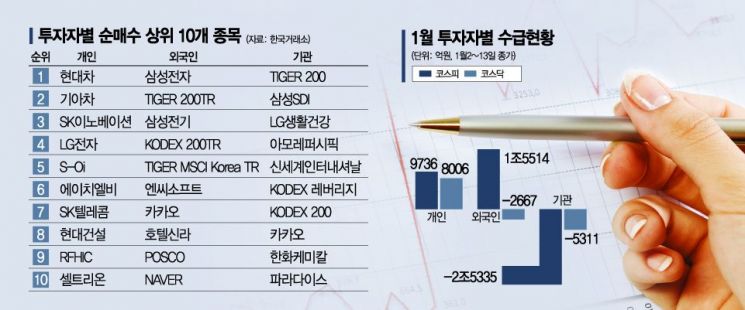
According to the Korea Exchange on the 14th, foreign investors who heavily bought Samsung Electronics (?390.2 billion) and SK Hynix (?352.2 billion) in December last year are now focusing on exchange-traded funds (ETFs) linked to the KOSPI index in January. Samsung Electronics remains the top net purchase stock (?710.2 billion as of the closing price on the 13th), but the second place is TIGER 200TR (?197.2 billion), third is Samsung Electro-Mechanics (?134.4 billion), fourth is KODEX 200TR (?120 billion), and fifth is TIGER MSCI Korea TR (?98.8 billion), showing that assets have been allocated to ETFs linked to the KOSPI 200 index and others.
Although the semiconductor sector is currently driving the domestic stock market rise due to growing expectations of semiconductor industry improvement this year, it is interpreted that additional KOSPI gains will proceed based on various factors beyond semiconductors. Other top net purchases include NCSoft (?97.2 billion) in sixth place, Kakao (?87.8 billion) seventh, Hotel Shilla (?80.2 billion) eighth, and POSCO (?69.2 billion) ninth.
Institutional investors, who had bet over ?1 trillion on Samsung Electronics (?938.3 billion) and SK Hynix (?223.8 billion) in December last year, are now placing more weight on Chinese consumer stocks rather than focusing solely on semiconductors.
The most net purchased stock by institutions is TIGER 200, with purchases totaling ?213.1 billion from the 2nd to the previous day. They also mainly bought LG Household & Health Care (?52.6 billion), Amorepacific (?51.3 billion), Shinsegae International (?33 billion), Paradise (?25.2 billion), and Hotel Shilla (?20 billion), focusing on cosmetics, duty-free shops, and casinos. This buying is analyzed as a response to news that Chinese President Xi Jinping is expected to visit South Korea in the first half of this year and growing expectations of easing the Hallyu ban (Korean Wave ban).
The supply and demand of individual investors are also noteworthy. Since January, individuals have poured a total of ?1.77 trillion into the KOSPI and KOSDAQ markets. This reflects expectations for a stock market rise from the beginning of the year. Considering that foreign investors have net purchased about ?1.3 trillion in these markets and institutions have sold about ?3 trillion in total, individuals are currently the 'big players' supporting the index.
The stocks most net purchased by individuals are mainly automobile and petrochemical stocks. The top net purchase stock is Hyundai Motor with ?139.6 billion bought, followed by Kia Motors with ?127.4 billion net purchases. SK Innovation (?122.9 billion), LG Electronics (?83 billion), and S-Oil (?71.9 billion) follow. Hyundai Motor's price fell from ?118,000 on the 2nd (closing price) to ?110,000 but has recovered to ?117,000 as of 10 a.m. on the day after rising for three consecutive trading days.
The securities industry expects that if the KOSPI rises further, the price increase could spread to small and mid-cap stocks. From 2016 to October 2017, semiconductor profit forecasts continued to rise, leading to gains centered on large-cap stocks including Samsung Electronics, but for the following 3 to 6 months, small and mid-cap stocks outperformed the market return. Also, the inflow of direct and indirect stock investment funds from individual investors is viewed positively.
Moon Dong-yeol, a researcher at Samsung Securities, explained, "Since the low point in August last year, the KOSPI rise has mostly been driven by large-cap stocks," adding, "The rise rate compared to the low point is 16.1% for large caps, while small and mid-caps are only 5.2%." Moon said, "Technically, the relative strength shows a one-sided concentration on large caps for about five months. Although the semiconductor profit recovery is expected to sustain the rise of large caps, there is short-term technical pressure, so while large caps undergo a period of adjustment, the upward energy is likely to spread to KOSPI small and mid-cap stocks."
© The Asia Business Daily(www.asiae.co.kr). All rights reserved.
![Clutching a Stolen Dior Bag, Saying "I Hate Being Poor but Real"... The Grotesque Con of a "Human Knockoff" [Slate]](https://cwcontent.asiae.co.kr/asiaresize/183/2026021902243444107_1771435474.jpg)















