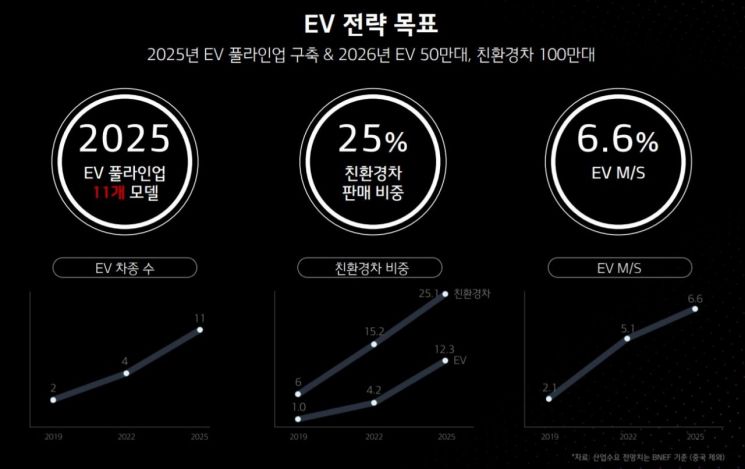
[Asia Economy Reporter Kim Hyewon] Kia Motors' mid-to-long-term future strategy 'Plan S,' unveiled on the 14th, centers on a proactive shift from conventional internal combustion engines to an electric vehicle (EV)-focused business system. The goal is to establish a full lineup of 11 electric vehicle models by 2025 through the development of a dedicated EV platform.
◆ Proactive Shift to an Electric Vehicle Business System = Kia will launch its first dedicated electric vehicle model in 2021. From 2022 onwards, new electric vehicle models will be introduced across all segments, including passenger cars, sports utility vehicles (SUVs), and multi-purpose vehicles (MPVs). All models will feature a driving range of over 500 km on a single charge and ultra-fast charging capabilities within 20 minutes, enhancing technological performance.
The EV lineup will offer a diverse range of choices by simultaneously operating high-performance 'dedicated electric vehicles' with differentiated product appeal tailored to customer needs?such as dual charging systems (400V and 800V)?and affordable 'derived electric vehicles.'
Since global EV sales vary by region due to environmental regulations, subsidy scales, and infrastructure, Kia will implement market-specific strategies. Advanced markets such as South Korea, North America, and Europe will build a full EV lineup by 2025, expanding EV sales to 20% of total sales to foster these regions as core EV markets, considering fuel efficiency regulations and brand image enhancement. Emerging markets will selectively introduce EVs based on adoption speed while focusing on expanding internal combustion engine vehicle sales.
In particular, Kia will establish a customer value-centered planning-development-production system by introducing an innovative 'electric vehicle architecture' development framework that actively incorporates market requirements from the product planning stage.
Kia is also exploring innovations in EV sales methods. Customized subscription models that alleviate customers' purchasing burdens through integrated management of the EV lifecycle, battery rental and lease programs for core EV components, and businesses related to used batteries are under consideration. Kia is leading the creation of an EV ecosystem by establishing a resource circulation system through infrastructure and technology acquisition to recycle EV waste batteries as energy storage systems (ESS).
◆ Expansion of Mobility Services Based on Electric Vehicles and Autonomous Driving = Kia plans to diversify its business areas by offering electric vehicle and autonomous driving-based mobility services in major global cities. It will enter the purpose-built vehicle (PBV) market, where demand is expected to increase due to the activation of e-commerce and expansion of vehicle sharing, securing new corporate customer segments.
Kia will collaborate with local partners such as regional operators in global metropolitan areas actively addressing environmental pollution and EV adoption to build 'mobility hubs' equipped with EV charging stations, vehicle maintenance centers, and various convenience facilities. These mobility hubs will serve as transfer points between internal combustion engine vehicles, which are restricted from entering cities due to environmental regulations, and electric vehicles. Kia will also explore new business models such as small-scale logistics services and vehicle maintenance using the infrastructure within mobility hubs, including charging stations and convenience facilities. In the long term, autonomous driving-equipped robo-taxis and on-demand robo-shuttles will operate within urban bases secured through mobility hubs.
Kia is focusing on the growth potential of the PBV market targeting corporate customers rather than merely repurposing vehicles sold to individual customers. Currently, corporate customers in transportation, logistics, and distribution account for about 5% of global industrial demand, but this is expected to rise to approximately 25% by 2030.
To secure core customers and preempt the market, Kia will concentrate on advancing PBV products. After a transitional period operating separate trims for existing vehicles such as the Niro and Soul electric cars, Kia plans to develop and supply PBVs dedicated to target customers, including vehicles exclusively for car-sharing services, low-floor logistics vehicles facilitating easy loading and unloading, and fresh food delivery vehicles equipped with refrigeration and cooling systems.
When autonomous driving technology becomes widespread, Kia will expand its business model to include customized PBVs based on electric and autonomous driving technologies, applying integrated modular 'skateboard platform' technology such as ultra-compact unmanned delivery vehicles and robo-taxis. For PBVs used for specific purposes, securing price competitiveness is paramount; therefore, Kia will actively collaborate externally, utilize its specialized vehicle network, and establish dedicated development teams and production systems.
© The Asia Business Daily(www.asiae.co.kr). All rights reserved.
![Clutching a Stolen Dior Bag, Saying "I Hate Being Poor but Real"... The Grotesque Con of a "Human Knockoff" [Slate]](https://cwcontent.asiae.co.kr/asiaresize/183/2026021902243444107_1771435474.jpg)
















