[Asia Economy Reporter Naju-seok] Was it necessary to hastily eliminate Qasem Soleimani, commander of the Iranian Revolutionary Guard Corps Quds Force? The necessity of the operation to kill Soleimani is causing controversy in the U.S. political sphere.
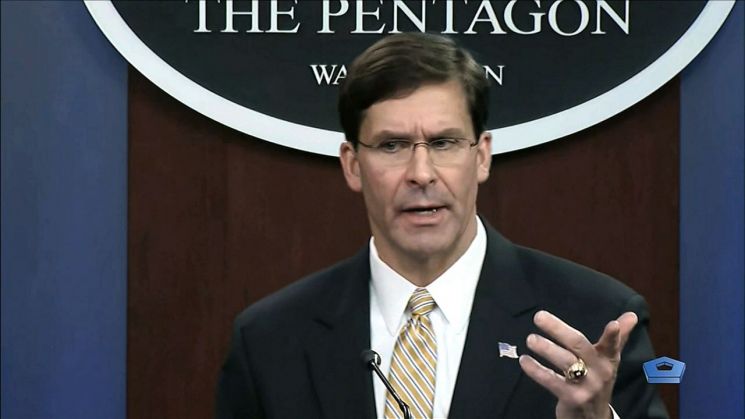
On the 12th (local time), U.S. Secretary of Defense Mark Esper appeared on CBS's 'Face the Nation' and stated, "I have not seen anything regarding the four embassies," sparking controversy. This statement contradicts U.S. President Donald Trump's claim that four U.S. embassies were under imminent threat.
The necessity of urgently eliminating Soleimani has been a contentious issue. Removing him is different from eliminating a terrorist group leader, as he was a military general of a sovereign nation. Therefore, the urgent removal of Soleimani had to be in response to an imminent threat.
Moreover, the U.S. Congress was not informed in advance by the Trump administration regarding Soleimani's removal. Despite the possibility of escalating to war with Iran, the Congress, which holds the power to declare war, received no report about the plan to eliminate Soleimani. This raised controversy within the U.S. about whether Soleimani's removal was truly an urgent threat that could not even be reported to Congress.
If, as President Trump explained, an attack on U.S. embassies was imminent, the urgency of the operation to eliminate Soleimani is partially justified. However, if even Secretary Esper did not see evidence of an imminent threat, the situation changes.
Nonetheless, Secretary Esper stated, "What President Trump saw, and what I expected, was that they (Iran) targeted our embassies."
Robert O'Brien, U.S. National Security Advisor, said regarding this issue, "What President Trump mentioned is consistent with what we (the cabinet and White House) have disclosed," adding, "We have strong intelligence that they intended to kill or injure Americans at U.S. facilities in the Middle East." However, he noted, "No matter how sophisticated the intelligence, it is difficult to know the exact target," and said, "It is reasonable to predict that Iran planned to attack U.S. embassies in at least four countries in the future."
The New York Times (NYT) reported that intelligence officials who requested anonymity said there was no definite intelligence that Iran was planning to attack the U.S. However, pieces of intelligence formed a mosaic-like picture suggesting that Soleimani was mobilizing militias to attack U.S. embassies and bases in Lebanon, Yemen, Iraq, and other locations.
© The Asia Business Daily(www.asiae.co.kr). All rights reserved.
![Clutching a Stolen Dior Bag, Saying "I Hate Being Poor but Real"... The Grotesque Con of a "Human Knockoff" [Slate]](https://cwcontent.asiae.co.kr/asiaresize/183/2026021902243444107_1771435474.jpg)















