Saturation Expected by November 2021... Concerns Over Wolsong Operation Suspension
NSSC Decides on Additional Construction of 7 Wolsong Nuclear Power Plant MACSTOR Units by Vote
Securing Storage Space for 168,000 Spent Nuclear Fuel Assemblies Next Year
[Asia Economy Reporter Kim Bo-kyung] The spent nuclear fuel storage facility (MACSTOR) at the Wolseong Nuclear Power Plant in Gyeongju, Gyeongbuk, will be expanded. As a result, units 2 to 4 of Wolseong will be freed from the risk of shutdown, and space to store spent nuclear fuel within the nuclear power plant site has been secured.
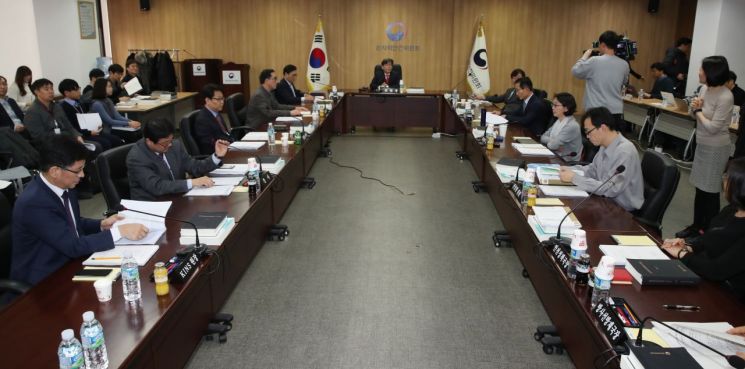
On the 10th, the Nuclear Safety and Security Commission (NSSC) held its 113th meeting at the Gwanghwamun NSSC office and voted to approve the "Wolseong Units 1-4 Operation Change Permit" for the construction of 7 additional MACSTOR units.
Spent nuclear fuel is material that has been used as fuel in a nuclear reactor. Spent nuclear fuel removed from the reactor is first stored in a wet storage facility. After several years, when the heat of the spent nuclear fuel has sufficiently cooled, it is transferred to a dry storage facility for temporary storage, and one type of such temporary storage facility is MACSTOR.
On this day, 6 out of 8 commissioners, more than half, voted in favor, confirming the additional construction of MACSTOR. This is about four years since Korea Hydro & Nuclear Power (KHNP) applied for an operation change permit to expand MACSTOR in April 2016.
Among the commissioners, Chairman Eom Jae-sik, Secretary-General Jang Bo-hyun, and commissioners Kim Jae-young, Lee Kyung-woo, Lee Byung-ryeong, and Jang Chan-dong expressed opinions to approve the MACSTOR expansion, while Kim Ho-cheol and Jin Sang-hyun opposed, stating that the agenda should be reconsidered.
Previously, KHNP originally planned to build a total of 14 MACSTOR units but constructed only 7 initially due to economic reasons and has been using them since 2010. As of September last year, the storage rate of MACSTOR at Wolseong Nuclear Power Plant was 93.1%, and it was predicted that MACSTOR would reach saturation by November 2021.
Accordingly, concerns arose that all units 2 to 4 of Wolseong might be shut down when saturation occurs in November 2021, but this decision has made it possible to prevent a shutdown crisis.
Until now, NSSC commissioners have been divided between the position that MACSTOR construction should be expedited for safe nuclear power plant operation and the position that the review of MACSTOR expansion is premature, leading to ongoing discussions.
Typically, MACSTOR construction takes about 19 months and licensing about 3 months, so if KHNP immediately starts construction, it is expected that 7 MACSTOR units could be installed by next year.
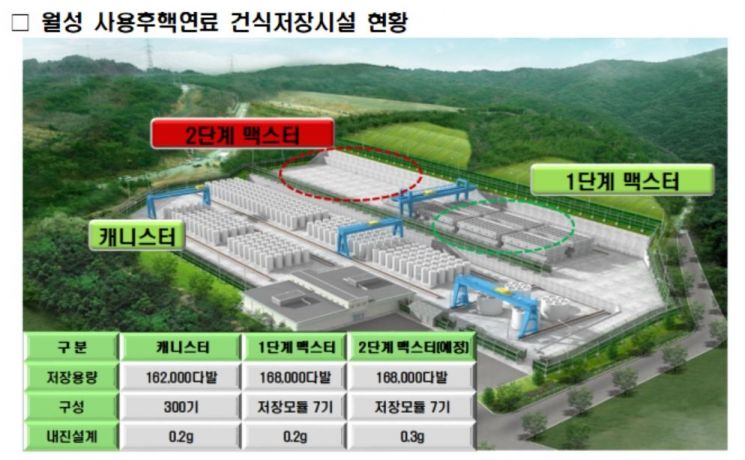
The dry storage facilities at Wolseong Nuclear Power Plant consist of two types: cylindrical "canisters" with a diameter of 3 meters and a height of 6.5 meters, and rectangular MACSTOR units measuring 21.9 meters in length, 12.9 meters in width, and 7.6 meters in height. MACSTOR has the advantage of storing fuel more densely than canisters. While one canister on the Wolseong site can store 540 bundles, one MACSTOR unit can hold 24,000 bundles.
At Wolseong Nuclear Power Plant, 300 canisters were installed from 1991 to 2006, and 7 MACSTOR units were constructed from 2007 to 2009. The 300 canisters are currently saturated with 1,620,000 spent nuclear fuel bundles, and as of September last year, 7 MACSTOR units stored 1,564,800 bundles, recording a storage rate of 93.1%.
Canisters and MACSTOR are facilities for temporarily storing spent nuclear fuel within the nuclear power plant site. A permanent disposal site is needed to transfer spent nuclear fuel from temporary storage facilities for final disposal, but such a disposal site does not yet exist domestically.
The Ministry of Trade, Industry and Energy established the "High-Level Radioactive Waste Management Policy Review Preparation Group" in 2018 to first publicize the spent nuclear fuel issue. Last year, the "Spent Nuclear Fuel Management Policy Review Committee" was formed to oversee the public opinion collection process, but discussions have stalled due to conflicts among members.
© The Asia Business Daily(www.asiae.co.kr). All rights reserved.
![Clutching a Stolen Dior Bag, Saying "I Hate Being Poor but Real"... The Grotesque Con of a "Human Knockoff" [Slate]](https://cwcontent.asiae.co.kr/asiaresize/183/2026021902243444107_1771435474.jpg)
















