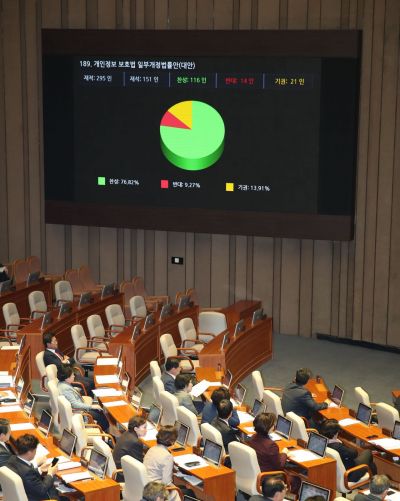
 On the 9th, the partial amendment bill to the Personal Information Protection Act (alternative) was passed at the plenary session held at the National Assembly.
 [Asia Economy Reporter Choi Dae-yeol] The amendments to the Personal Information Protection Act, Credit Information Act, and Information and Communications Network Act, collectively known as the 'Data 3 Laws,' passed the National Assembly on the 9th, paving the way for active research utilizing individual information and the emergence of more segmented financial products and services. The biohealth industry positively evaluated this, saying that a foundation has been established to utilize big data such as various medical information. On the other hand, civic groups viewed it negatively, expressing concerns about potential harm to the public due to insufficient safety measures.
Among the Data 3 Laws handled at the National Assembly's Legislation and Judiciary Committee and plenary session that day, the amendment to the Personal Information Protection Act allows the use of 'pseudonymized information,' processed so that specific individuals cannot be identified, for purposes such as statistical compilation or research without the individual's consent. The newly introduced concept of pseudonymized information is the core. The amendment to the Credit Information Act permits the use or provision of pseudonymized information without the consent of the credit information subject for commercial statistical compilation, research, or public interest record preservation. The amendment to the Information and Communications Network Act transfers all personal information-related content to the Personal Information Protection Act.
So far, related industries such as pharmaceuticals, bio, and medical devices have argued for the removal of regulations that make data utilization difficult. To develop artificial intelligence (AI) technology, which is spotlighted in the Fourth Industrial Revolution era, a learning process based on vast data is necessary. However, since the use of personal information has been difficult, it has hindered industrial development, making regulatory improvement urgent.
Jang Jin-seong, head of the Medical AI department at JLK Inspection, which manufactures medical imaging diagnostic devices, said, "Personal medical information is sensitive, so there are many restrictions on its use in research, but if data can be used more broadly, it will help research." A professor at a university hospital said, "In some regions of China, personal medical records are actively used to adjust insurance premiums in real time," adding, "Using big data and AI technology to continuously refine chronic disease management and medical diagnostic support services is considered to have a significant cost-saving effect."
On the other hand, there are voices of concern about the loosening of restrictions. Although anonymization is said to prevent identification of individuals, information aggregation makes personal identification sufficiently possible, and third parties, not the individuals themselves, become the rights holders of each piece of personal information. Civic groups such as the Citizens' Coalition for Economic Justice and lawmaker Chae I-bae of the Bareunmirae Party held a press conference at the National Assembly's Press Center before the Legislation and Judiciary Committee meeting that morning, demanding a halt to the bill's passage. Lawmaker Chae, a member of the committee, clearly expressed opposition during the standing committee session that day.
They emphasized, "Despite being a significant matter that changes the foundation of the personal information system, it was pushed forward unilaterally in response to corporate demands without social consensus," and added, "It is merely a basic rights restriction law and a personal information theft law that infringes on citizens' fundamental rights for corporate profit, disguising itself as a livelihood bill, and undermines the minimum standards and principles our society must uphold with economic logic."
© The Asia Business Daily(www.asiae.co.kr). All rights reserved.

















