Police and Korea Research Institute for Human Settlements Study on the Effectiveness of 'CPTED' Facilities
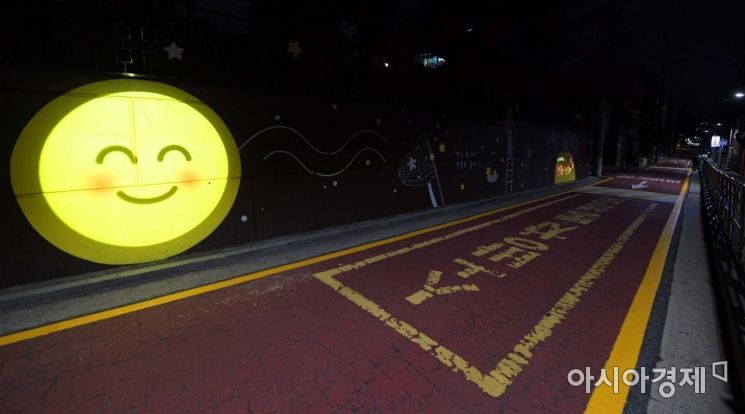 A large moon-shaped light brightly illuminates the alley behind an elementary school in Seocho-gu. The brightly smiling moon naturally brings a smile to the faces of citizens on their way home from work. The designs, embodying citizens' safety and hope, are coming together one by one, with the wish that they will create a safe Korea free of crime. Photo by Mun Ho-nam munonam@
[Asia Economy Reporter Lee Gwanju] A study has found that lighting and closed-circuit television (CCTV) installed in shared living spaces such as alleyways have an excellent crime prevention effect. These results are expected to be utilized in the future expansion of 'Crime Prevention Through Environmental Design (CPTED)'.
The National Police Agency and the Korea Research Institute for Human Settlements disclosed the results of the "Effectiveness Analysis Study on Crime Prevention Environmental Design Facility Techniques" on the 8th. This study was conducted by verifying the actual effects of crime prevention facilities that have been widely used in CPTED projects so far.
The study found that in outdoor areas where unspecified many people live, such as alleyways, lighting (streetlights and security lights) and CCTV had high crime prevention effects, and in indoor and outdoor spaces of buildings such as apartment complexes, access control devices like locked entrances were effective. In places where lighting was installed, the five major crimes occurring at night, such as robbery and theft, decreased by about 16%, and disorder-related 112 emergency calls, such as drunken disturbances and juvenile delinquency, decreased by 4.5%. Additionally, in places where CCTV was installed, the five major crimes occurring within 100 meters at night decreased by about 11%. In cases where locked doors (door locks) were installed at the first-floor entrances of multi-family and one-room apartment buildings, there was about a 43% reduction in crime compared to buildings without such locks.
Facilities such as emergency bells, convex mirrors, mirror sheets, and murals, which have been widely used in recent crime prevention environmental improvement projects, did not directly lead to a reduction in crimes or 112 emergency calls. However, since these facilities primarily aim to alleviate residents' fear of crime rather than directly reduce crime itself, the researchers analyzed that it cannot be concluded that they have no crime prevention effect.
Park Sohyun, director of the Korea Research Institute for Human Settlements, said, "The significance of this study lies in the detailed analysis of the preventive effects of each security facility, which is rare worldwide." Min Gap-ryong, commissioner of the National Police Agency, emphasized, "This study will be an opportunity for CPTED, which has been actively implemented mainly by local governments recently, to take a step forward."
© The Asia Business Daily(www.asiae.co.kr). All rights reserved.

















