[Asia Economy Reporter Naju-seok] The Philippine government is challenging nuclear power generation for the first time in 30 years. Attention is focused on whether the Bataan Nuclear Power Plant, which was completed at an astronomical cost but never operated, will be restarted. Global nuclear power companies, including Korea Hydro & Nuclear Power, have begun groundwork for the reconstruction project of the Philippine nuclear power plant.
According to foreign media on the 7th, experts from the International Atomic Energy Agency (IAEA) visited the Philippines for an eight-day schedule last month to inspect nuclear power-related infrastructure facilities. The Philippine government plans to decide whether to restart the Bataan Nuclear Power Plant based on the Infrastructure Nuclear Review Report (INRI) and other documents reviewed by the experts.
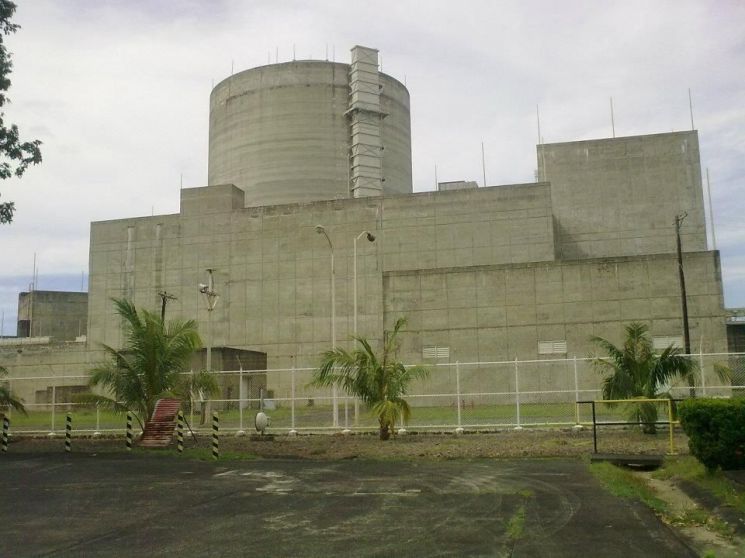
The Philippines has had a nuclear power plant for 30 years. However, it was never operated because fuel was never loaded. During the era of President Ferdinand Marcos, notorious as a dictator, the Philippines pushed for the construction of a nuclear power plant in 1976 in the Bataan area west of the capital Manila. However, problems were raised from the site selection stage for the Bataan Nuclear Power Plant. The area is located on a fault line prone to earthquakes and is close to Mount Pinatubo, which erupted in 1993. Moreover, the construction was halted after the Three Mile Island nuclear accident in the United States in 1979, where the reactor core melted down.
Cost was also an issue. Initially, Westinghouse of the United States, which was in charge of building the Bataan Nuclear Power Plant, agreed to build it for $500 million, but as costs continued to rise, the construction cost reached $2.3 billion by the time of completion in 1984.
Despite the Philippine government's efforts to proceed with the project after many twists and turns, the plant was never operated. After the Marcos regime, which aggressively pushed for nuclear development, collapsed in the 1986 People Power Revolution, President Corazon Aquino decided not to operate the nuclear power plant. Subsequently, the Philippine government considered converting the Bataan Nuclear Power Plant into coal or gas power plants, but due to concerns about economic feasibility, it was instead used as a tourist site.
The reconsideration of reusing the Bataan Nuclear Power Plant came after 30 years during the administration of President Rodrigo Duterte. The Philippine government projected that electricity demand would more than triple by 2040 due to rapid economic growth and judged that nuclear power was necessary to solve power supply issues. President Duterte instructed to consider restarting the Bataan Nuclear Power Plant as long as there are no safety issues.
Countries such as South Korea, Russia, China, and the United States are competing in the Bataan Nuclear Power Plant reconstruction project. Russia, in particular, is active regarding the reconstruction of the Bataan Nuclear Power Plant. According to the ASEAN Post, in November 2017, the Russian state-owned company Rosatom sent about 20 experts to investigate the feasibility of restarting the nuclear power plant. At that time, Russia proposed repair costs of approximately $3 to $4 billion for operating the Bataan Nuclear Power Plant.
South Korea has also been preparing to enter the Bataan Nuclear Power Plant reconstruction project by conducting preliminary feasibility studies. A Korea Hydro & Nuclear Power official explained, "The Philippine government has not yet officially announced plans to restart the Bataan Nuclear Power Plant," but added, "Preliminary feasibility studies have already been conducted." The official said, "Our greatest competitiveness lies in possessing world-class technology in construction and operation."
However, concerns about safety have not yet been resolved. Despite many advantages, public opinion in the Philippines remains divided because a single accident could be fatal.
© The Asia Business Daily(www.asiae.co.kr). All rights reserved.
![Clutching a Stolen Dior Bag, Saying "I Hate Being Poor but Real"... The Grotesque Con of a "Human Knockoff" [Slate]](https://cwcontent.asiae.co.kr/asiaresize/183/2026021902243444107_1771435474.jpg)















