Oil Refining Industry Faces Concerns Over Refining Margin Decline Due to Soaring Oil Prices
Fuel Costs Account for 20-30% in Aviation and Shipping... "Burden Will Increase"
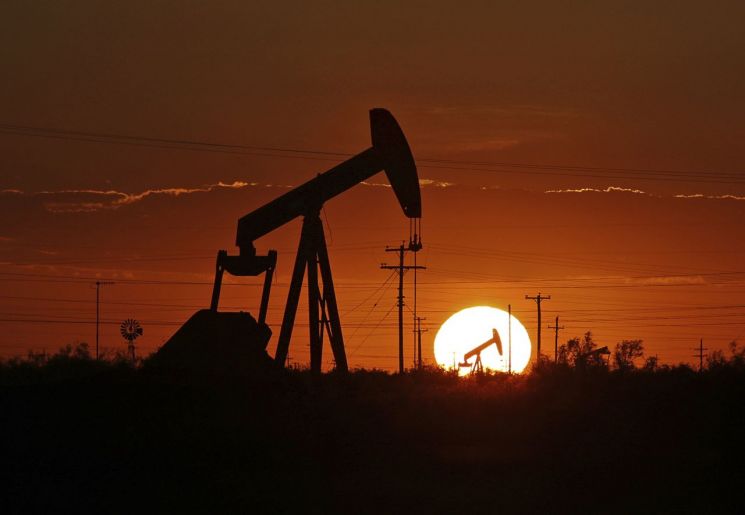
[Asia Economy Reporters Hwang Yoon-joo and Yoo Je-hoon] As tensions rise following the killing of Qasem Soleimani, a key figure in Iran's military and commander of the Revolutionary Guard, by the United States on the 3rd (local time), the domestic industrial sector is also on high alert. Although there is no expected disruption in crude oil supply and demand in the short term, if the Strait of Hormuz is blocked, it could have a significant impact across industries such as refining, aviation, and shipping.
On the 6th (local time), West Texas Intermediate (WTI) crude oil for February delivery closed at $63.27 per barrel on the New York Mercantile Exchange (NYMEX), up 0.4% ($0.22).
At 3:30 p.m., Brent crude for March delivery on the London ICE Futures Exchange was trading at $68.65 per barrel, up 0.06% ($0.04). Other crude types, including Dubai crude, also maintained an upward trend.
The refining industry is the first to react to the sharp rise in international oil prices. While rising international oil prices usually lead to increased inventory valuation gains, benefiting refiners, the current situation is different. When supply concerns cause a sharp rise in international oil prices, consumption of petroleum products contracts, reducing refining margins (the difference between petroleum product prices and crude oil prices plus costs).
An official from the Korea Petroleum Association explained, "If international oil prices rise sharply by $10, petroleum product consumption shrinks, and product prices only increase by $8. As a result, the refining margin spread narrows, and losses in refining margins may outweigh inventory valuation gains."
Since October last year, refining margins have been below the breakeven point ($4-5 per barrel). This is due to reduced demand for petroleum products amid a global economic slowdown caused by the US-China trade war, while supply has increased mainly in China and the US. Consequently, in the third week of November last year, refining margins recorded a negative value for the first time in 18 years, and in December, refining margins turned negative for the first time on record.
A refining industry insider said, "With a conservative outlook on fourth-quarter earnings, if Middle East risks further narrow refining margin spreads, refining sector performance could deteriorate more than expected."
The logistics sector, including aviation and shipping, is also on edge. Given that fuel costs account for 20-30% of operating expenses in the transportation industry, rising oil prices could directly impact profitability. The aviation and shipping industries, which recorded losses last year due to reduced demand on Japan routes amid Korea-Japan tensions, oversupply, excess capacity, and the US-China trade dispute, face a potentially 'fatal blow.'
For example, Korean Air, the country's largest full-service carrier (FSC), spent 2.3697 trillion won on fuel costs as of the third quarter last year, accounting for 24.9% of total operating expenses (9.5044 trillion won). Jeju Air, the largest low-cost carrier (LCC) in Korea, spent 301.4 billion won on fuel, representing 28.3% of its operating expenses during the same period.
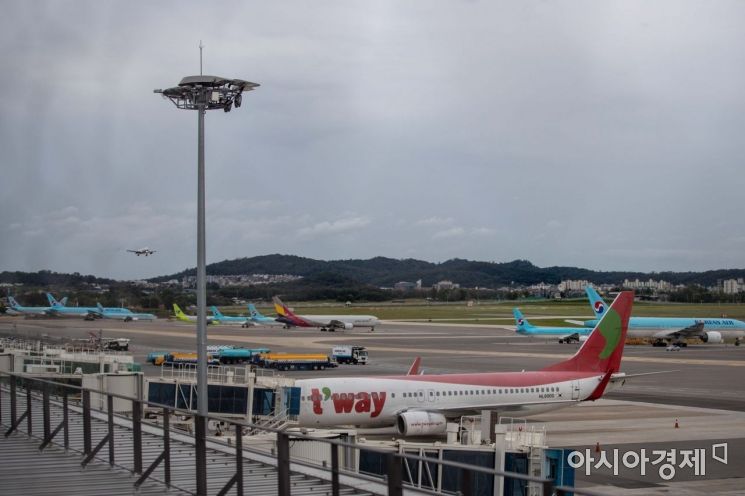 On the 22nd, as the 17th typhoon 'Tapa' moves northward causing flight cancellations, an aircraft is waiting at the domestic apron of Gimpo Airport in Seoul. Photo by Kang Jin-hyung aymsdream@
Korean Air, which consumes about 33 million barrels of fuel annually, estimates that a $1 increase per barrel in oil prices would result in approximately $33 million (about 38.6 billion won) in additional costs. Jeju Air also anticipates an additional cost of around 15 billion won.
Industry insiders believe that since some airlines are responding to oil price fluctuations through fuel hedging and stockpiling, the short-term impact may be limited except for some smaller airlines.
The shipping industry faces a similar situation. Since January 1st, the International Maritime Organization's (IMO) sulfur oxide (SOx) emission regulations have come into effect, widening the price spread between traditional bunker C fuel and low-sulfur fuel oil (LSFO). On top of this, crude oil prices are surging, placing the industry under double pressure. The fuel surcharge (BAF) introduced last year applies only to LSFO, so rising oil prices inevitably increase fuel costs.
Although Korea does not import Iranian crude oil due to US sanctions, concerns are rising that prolonged tensions between the US and Iran or a blockade of the Strait of Hormuz could disrupt crude oil supply, worsening the situation.
Seventy percent of Korea's imported crude oil comes from the Middle East, and about 90% of that passes through the Strait of Hormuz. While Iran has never blocked the Strait, rising tensions make the possibility difficult to rule out.
Choi Jin-young, a researcher at eBest Investment & Securities, said, "If the US and Iran enter into full-scale war, a further sharp rise in oil prices is inevitable. Although the impact on the oil market is limited since Iranian crude exports are close to zero, the possibility of supply disruptions in the Strait of Hormuz due to full-scale conflict is a risk that must be monitored."
In the shipping industry, additional costs beyond oil prices are also likely to increase. A representative from a Korean shipping company said, "When a Japanese tanker was attacked in the Strait of Hormuz last June, insurers demanded a 20-30% increase in premiums. As US-Iran tensions escalate, related costs will also rise." A representative from a Korean airline added, "If tensions in the Middle East continue and oil prices rise sharply, it will become an unbearable situation."
© The Asia Business Daily(www.asiae.co.kr). All rights reserved.
![Clutching a Stolen Dior Bag, Saying "I Hate Being Poor but Real"... The Grotesque Con of a "Human Knockoff" [Slate]](https://cwcontent.asiae.co.kr/asiaresize/183/2026021902243444107_1771435474.jpg)
















