"From This Year, Annual Supply of 49,000 Seoul Apartments Expected for 6 Years... Sufficient Volume"
Seoul City Dismisses Market Concerns Over Current Supply Shortage as "Exaggerated Supply Shortage Theory"
Strengthening Property Tax and Realistic Public Price Needed... Seoul Plans to Establish 'Real Estate Price Disclosure Support Center'
'Real Estate National Sharing System' Execution Plan Soon to Be Prepared: "Real Estate Unearned Income Causing Inequality Must Be Recovered"
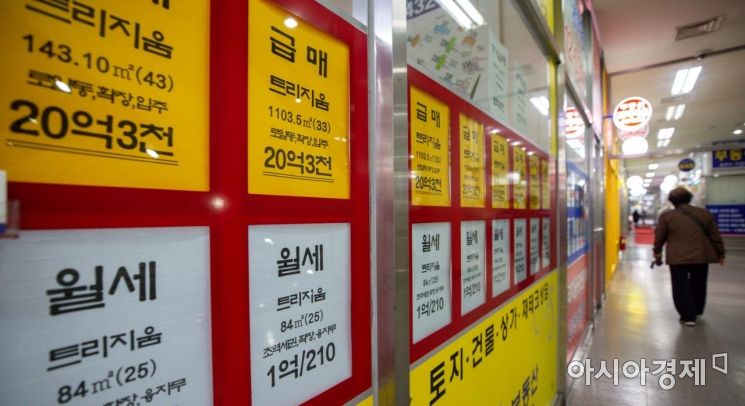 The government announced the "Housing Market Stabilization Plan," which includes strengthening the comprehensive real estate tax on high-priced housing and regulating mortgage loans for apartments priced over 1.5 billion KRW in speculative and overheated speculation areas. On the 17th, a price list was posted at a real estate agency office in Songpa-gu, Seoul. Photo by Kang Jin-hyung aymsdream@
[Asia Economy Reporter Yuri Kim] The Seoul Metropolitan Government has dismissed concerns about a "shortage of supply within Seoul" as a cause of the rapid rise in Seoul housing prices, stating that "there is no shortage of supply in Seoul." Additionally, it emphasized its commitment to preventing the spread of unfairness through real estate by implementing the "Real Estate National Sharing System," which has been repeatedly mentioned by Mayor Park Won-soon.
On the 6th, Jin Hee-seon, Deputy Mayor for Administration 2 of Seoul, held a press briefing at Seoul City Hall on major issues such as housing supply and demand in Seoul, stating, "Housing supply in Seoul is not insufficient compared to previous years," and added, "There have been claims that supply has become even more insufficient due to the cancellation of redevelopment zones since Mayor Park Won-soon's inauguration, but this is also not true."
Seoul presented housing supply data for 2008?2013, 2014?2019, and the next six years (2020?2025) to support this claim. The city explained that an average of 61,000 households (34,000 apartments) were supplied annually from 2008 to 2013, and an average of 78,000 households (36,000 apartments) annually from 2014 to 2019. For the next six years starting this year, an average of 82,000 households (49,000 apartments) per year are expected to be supplied, indicating that supply is not insufficient. Ryu Hoon, Director of the Seoul Housing and Architecture Headquarters, emphasized, "The opinion that supply is insufficient does not correspond at all with statistical facts," and said that current market concerns are due to exaggerated supply shortage theories.
However, the city included public rental housing in the supply figures and did not consider demolitions in the tally. Regarding the criticism that supply volumes should be distinguished between rental and owner-occupied housing, given the strong demand for rental housing and the earnest desire of real demanders dreaming of homeownership, the city said, "We will continue to consider how to increase supply to satisfy owner-occupied housing demand."
The claim that Seoul's supply drastically decreased due to Mayor Park's cancellation of New Town projects was also refuted through Seoul's housing supply statistics. From 2005 to 2011, 401 New Town and redevelopment zones were additionally designated, intensifying conflicts among stakeholders. Before Mayor Park's tenure, in April 2011, the city had already announced the "Five Major Directions for New Residential Redevelopment," stating that "areas requested by residents and planned zones with long-term construction restrictions will be canceled." Director Ryu explained, "At that time, Seoul Plaza held daily rallies among parties involved in redevelopment conflicts, showing how severe the conflicts were. The April 2011 announcement included the content that 'we will not proceed with redevelopment where it is not feasible,' and subsequently, 394 zones were canceled. Most of the canceled zones were practically difficult to develop."
However, Seoul acknowledged that the phenomenon of withholding listings has intensified due to an increase in the proportion of non-resident homebuyers and multi-homeowners. It also identified the excessive liquidity in the market due to macroeconomic changes as a major cause of housing price increases. Ultimately, these issues combined to drive up housing prices, rather than a shortage of supply in Seoul.
Director Ryu stated, "The recent Seoul housing market shows a strong trend of financialization of real estate assets due to excessive liquidity inflows," adding, "Supply is sufficient, but speculative demand has expanded more than real demand from residents outside Seoul and large homeowners." He pointed out, "Since 2016, the proportion of non-resident homebuyers has increased, indicating an expansion of investment (speculative) demand. The number of multi-homeowners in Seoul is also 899,000, accounting for 15.8% of the total, and this trend is gradually increasing." He emphasized, "With 173,000 newly registered rental homes over two years and an expansion of rental registration operators, the phenomenon of long-term withholding of listings is expected to continue."
He also criticized the lack of consistency in government policies, which has sustained psychological anxiety. With housing and real estate policies changing every time a new government starts, citizens' distrust in policy consistency has persisted, leading to continued expectations for "regulatory easing" policies from the next government.
Accordingly, Seoul reiterated the need to strengthen holding taxes and realize official property prices to prevent multi-homeownership from causing an increase in unearned income and worsening inequality. The city also plans to establish a Real Estate Price Disclosure Support Center, recently mentioned by Mayor Park, at the city level.
Director Ryu said, "There is almost no role for metropolitan governments beyond the central government and local governments in reforming the disclosure system and improving realization rates," adding, "Legally and institutionally, Seoul has no authority. However, even before legal authority is granted, participation through establishing a Real Estate Price Disclosure Support Center can help identify differences with city prices and provide detailed assistance." He continued, "At the district level, there may be reluctance as it is a subject of complaints, but Seoul can view the overall picture and intends to play that role," adding, "This can reduce trial-and-error like the numerous complaints last year due to the gap between standard housing and individual housing prices."
Seoul also plans to actively participate in this year's government roadmap for realizing official property prices, propose system improvements, and conduct surveys and analyses on the "gap between official prices and actual transaction prices."
The "Real Estate National Sharing System," previously mentioned by Mayor Park in his New Year's address, is also planned to have an implementation plan soon. Deputy Mayor Jin said, "The idea of a sharing fund started from the awareness that real estate is one of the causes of unfairness and inequality," adding, "To implement this, discussions on legal and institutional amendments with the government and policy formulation at the Seoul city level are necessary. Currently, related departments such as the Housing and Architecture Headquarters have formed a task force (TF) to develop policies. We will inform you separately once the content is organized."
Seoul emphasized, "We will secure housing supply in urban areas while steadily proceeding with supply according to these trends," and added, "We will continuously pay attention to expanding public rental housing to around 10%." It further stated, "Unearned income from real estate is a major cause of worsening inequality, and we will work together with the government to do what Seoul can do first," adding, "It is important to secure tax revenue on unearned income through strengthening holding taxes with fair tax rates."
© The Asia Business Daily(www.asiae.co.kr). All rights reserved.
![Clutching a Stolen Dior Bag, Saying "I Hate Being Poor but Real"... The Grotesque Con of a "Human Knockoff" [Slate]](https://cwcontent.asiae.co.kr/asiaresize/183/2026021902243444107_1771435474.jpg)
















