Lee Deok-hwan, Co-Representative of AEkyohyeop
"Pushing Only Solar Power That Can't Be an Alternative
Reducing Fine Dust by Phasing Out Coal?
Contradiction of Increasing LNG Fine Dust"
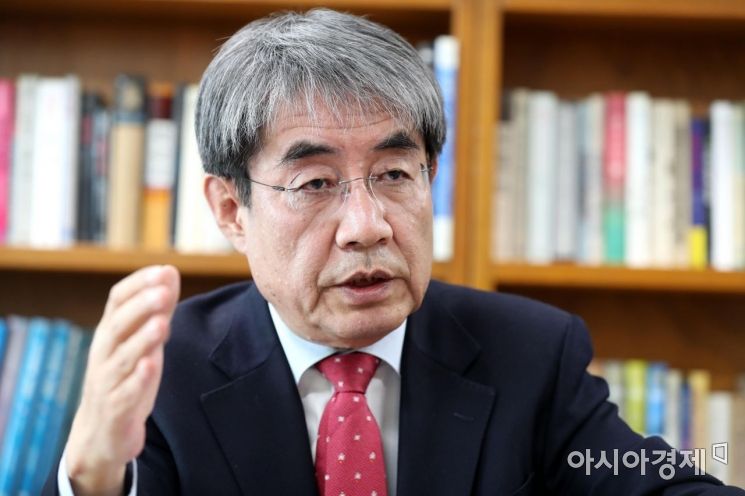 Professor Emeritus Lee Deok-hwan of Sogang University’s Department of Chemistry and Science Communication is being interviewed by Asia Economy on the 3rd. Photo by Moon Ho-nam munonam@
[Asia Economy Reporter Moon Chaeseok] "The claim that the policies of nuclear phase-out, coal phase-out, and renewable energy are the global consensus is a fiction. Energy policies must reflect the realities of each country, and South Korea is a country that, even by burning waste to generate energy, can only produce about 5% of its total consumption."
Professor Lee Deokhwan, honorary professor of Chemistry and Science Communication at Sogang University and co-representative of the 'Professors' Council for Rationalizing Energy Policy (Egyopyeop)', criticized in an interview with Asia Economy on the 3rd that the energy policy of the Moon Jae-in administration in its fourth year lacks practicality.
Professor Lee said, "The Moon administration's 'nuclear phase-out policy' is a policy that fails to present an energy source to replace nuclear power, which accounts for 30-40% of South Korea's electricity production?in short, it reveals 'Geunja-gam' (groundless confidence)."
South Korea is an 'energy-poor country' dependent on imports of major energy sources such as oil and liquefied natural gas (LNG), but the government has not prepared a proper compensation plan. In the case of solar power, which can only generate electricity for an average of 2.6 hours per day, the government still pushes it as an alternative to nuclear power.
Professor Lee stated, "South Korea's solar power is in the position of a 'nutcracker,' with quality lagging behind the United States and Germany, and price competitiveness falling short of China."
The more serious problem is that both the government's stated reasons for energy policy?'fine dust reduction' and 'ensuring safety'?contain serious contradictions. While the government implements a coal phase-out policy to reduce fine dust, it does not properly explain the fine dust reduction measures after the increase in LNG use following the closure of nuclear power plants.
Professor Lee said, "Nuclear power does not produce fine dust, but LNG emits nitrogen oxides into the air, which generate ultrafine dust. Nuclear power plants operate continuously 24 hours once turned on, but LNG plants have to be turned on and off. Between a car driving steadily and a car repeatedly stopping and starting, which one do you think emits more exhaust?"
The government claims that nuclear power has low safety but has not properly verified the safety of energy storage systems (ESS). There are about 1,400 ESS installations in South Korea, divided into renewable ESS and power demand management ESS for large buildings. Power demand management ESS are managed by certified electricians who are on-site 24 hours a day and use transformers, but renewable ESS are virtually neglected.
Professor Lee criticized, "If you look at photos of ESS fire accidents, they are all container boxes, but in reality, it's like a rural man managing the ESS for a solar power plant as if it were a vinyl greenhouse. The problem arises because low-quality assembled parts, not finished products, are put into the batteries of renewable ESS. The government has not concluded whether to hold the battery manufacturers or the charger suppliers responsible."
© The Asia Business Daily(www.asiae.co.kr). All rights reserved.
![Clutching a Stolen Dior Bag, Saying "I Hate Being Poor but Real"... The Grotesque Con of a "Human Knockoff" [Slate]](https://cwcontent.asiae.co.kr/asiaresize/183/2026021902243444107_1771435474.jpg)















