BOK Overseas Economic Focus
Announces 5 Major Issues Leading the Transformation of the Global Economic Landscape
[Asia Economy Reporter Sim Nayoung] This year, the global economy is expected to see a moderate improvement in growth as the global shocks that caused psychological contraction, sluggish trade, and investment last year have somewhat eased. However, with the growth potential of major countries stagnating or declining and the global division of labor system weakening, structural growth is constrained, and latent risks make it difficult to be optimistic about the medium- to long-term outlook.
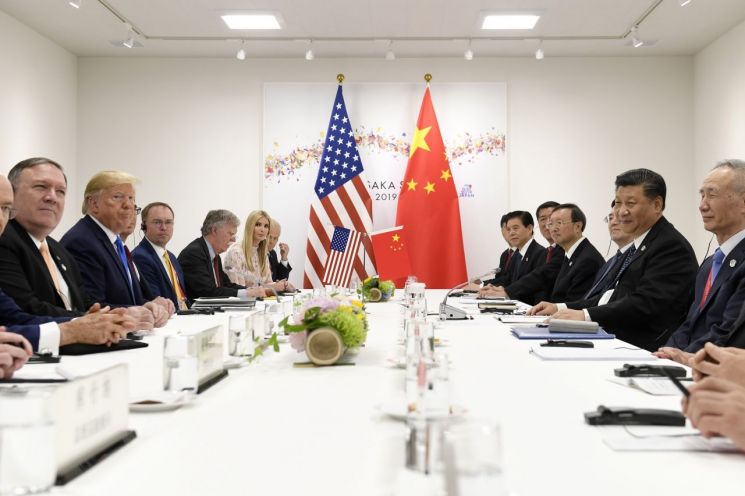
The Bank of Korea announced on the 5th through 'Overseas Economic Focus' the selection of five major issues that will lead the transformation of the global economy landscape from this year onward. The first is the competition for leadership in the 4th Industrial Revolution among major countries. Efforts to promote the 4th Industrial Revolution by the US, Germany, Japan, China, and others to secure new growth engines continue, with recent intensification of leadership competition centered on the US and China.
As China emerges as a competitor to the US in some fields related to the 4th Industrial Revolution, the US is showing moves to counter this. Germany and Japan are also continuing efforts to secure the competitiveness of their domestic industries. The Bank of Korea stated, "there is a latent possibility that trade frictions between countries may arise during the intensification of the competition for leadership in the 4th Industrial Revolution among major countries."
The second is the reorganization of the international trade order. The multilateral trade system is weakening while regional trade agreements are being activated. Amid the weakening of the multilateral trade system based on the World Trade Organization (WTO), there has been a movement to lead the formation of a new international trade order through Regional Trade Agreements (RTAs).
Recent RTAs have expanded in scale and deepened regional integration compared to before. The expansion of RTAs is expected to play a role in compensating for the weakening of the WTO system, but there are also concerns that it could lead to a trade order based on power dominance.
The third is the changing roles of ASEAN and China within the global value chain (GVC). Since the 2008 global financial crisis, amid the weakening trend of GVCs, the global final goods production base has shifted from China to ASEAN. Between 2010 and 2018, China's share of final goods exports decreased, while ASEAN's share increased.
Due to China's industrial upgrading, rising manufacturing production costs, and the impact of tariff increases from the US-China trade dispute, this trend of changing roles within the GVC is expected to continue for the time being. With China's continued increase in investment toward ASEAN, the vertical division of labor structure between ASEAN and China is expected to be further strengthened in the future.
The fourth is the possibility of a policy shift in China's growth structure transition. With China's economic growth rate expected to fall to the 5% range in 2020, the key question is whether the qualitative growth strategy can be maintained. Since the 2010s, the Chinese government has been pursuing a sustainable qualitative growth strategy in the medium to long term, focusing on expanding domestic demand centered on consumption and reducing leverage rather than short-term growth stimulus.
Some expect that the Chinese government will revise its policy toward emphasizing economic stimulus to respond to downward pressures on the domestic and external economy. On the other hand, there are arguments that the Chinese government will continue the qualitative growth policy stance due to changes in perception of economic growth rates and concerns about expanding financial risks.
The Bank of Korea diagnosed, "Considering the recent policy directions of the Chinese government, China is expected to continue a policy stance that emphasizes qualitative growth, which implies that its role as a global production base will weaken while its importance as a consumer market will expand."
The fifth is the acceleration of international efforts to address climate change. Major international organizations emphasize climate change response as an essential factor for sustainable growth, and related policies are being promoted recently, centered on the EU. Especially this year is the deadline for parties to the Paris Climate Change Agreement to renew their greenhouse gas reduction targets and submit long-term low-carbon development strategies for 2050, drawing global attention to each country's stance on climate change response.
Despite concerns about conflicts of interest between countries and downturns in some industries, strengthened environmental regulations?including regulations on ship fuel gas emissions, automobile exhaust emissions (EU and China), and the EU's carbon border tax?are becoming established as a fundamental trend in the global economy, affecting production and trade in major industries.
The Bank of Korea stated, "Countries around the world are actively promoting climate change response not only from the perspective of environmental protection but also as a way to pioneer new industries and markets."
© The Asia Business Daily(www.asiae.co.kr). All rights reserved.
![Clutching a Stolen Dior Bag, Saying "I Hate Being Poor but Real"... The Grotesque Con of a "Human Knockoff" [Slate]](https://cwcontent.asiae.co.kr/asiaresize/183/2026021902243444107_1771435474.jpg)















